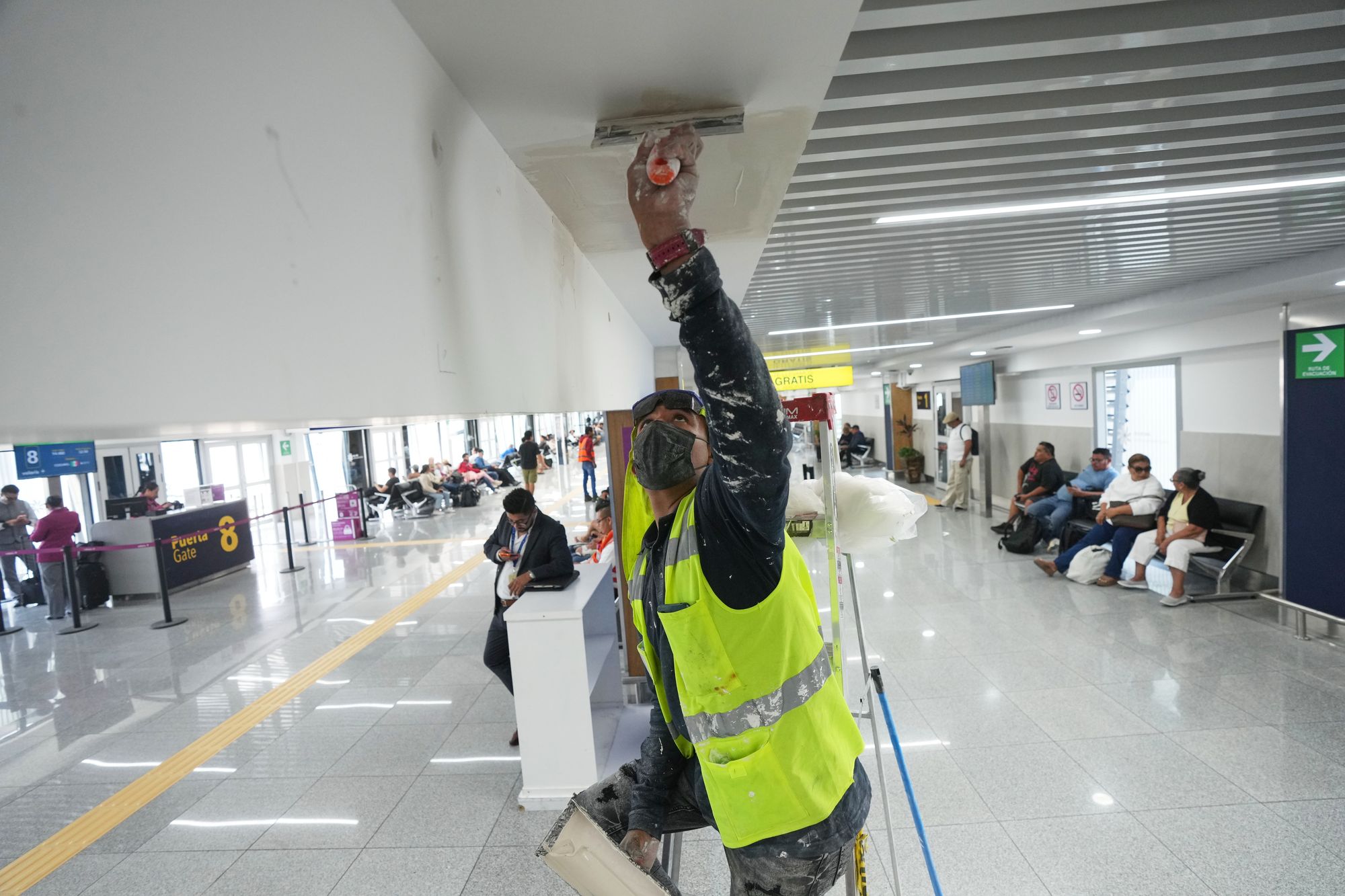
As Mexico prepares to co-host the 2026 FIFA World Cup, thousands of passengers arriving at Mexico City’s Benito Juárez International Airport are currently navigating a chaotic construction site.
Buzzing drills, scattered pipes, and unfinished flooring greet travellers, a stark contrast to the numerous posters promoting the upcoming football tournament and large-scale figures of balls and trophies that dot the terminals. These festive decorations aim to distract from the year-long renovations.
Luis Ibarra, a 28-year-old engineer, seated near one of the six cranes still operating at Terminal 1, expressed little concern about the ongoing work. He noted that the airport has long suffered from issues such as flooding, leaky roofs, and severe overcrowding, making the upgrades a necessity.
Airport authorities told The Associated Press that over 3,000 people are working 20 hours a day to complete one of the largest renovation projects at Mexico’s busiest airport.
The undertaking has not been without its difficulties. Juan José Padilla, general director of Benito Juárez International Airport, told the AP that complications have been “more than we expected” a year into the renovation, despite the first phase being over 90 per cent complete.
He attributed these unexpected challenges to half-century-old infrastructure and a lack of original blueprints for certain areas.
“We are facing years of neglect,” Mr Padilla stated, acknowledging that decades of underinvestment had impacted the terminals, which handle approximately 120,000 passengers daily.
Against this backdrop, a $500m (£395m) modernisation project commenced in May 2025. This substantial investment is entirely funded by the airport itself, which has been administered by the Mexican Navy since 2023. Project coordinator Capt. Arturo Flores detailed that the extensive upgrade includes new terminal facades, renovated restrooms, refreshed baggage carousels, and the replacement of nearly 100,000 square metres of flooring and lighting.
An internal redesign has also reclaimed 30,000 square metres of waiting space for travellers. The second phase of work is scheduled to begin in August, following the World Cup, and continue until December.
Security enhancements are also a key part of the renovation, with the number of cameras increasing from 2,200 to over 4,000. These new cameras will utilise artificial intelligence to detect suspicious vehicles, luggage, or individuals. Mr Padilla also confirmed that an anti-drone system is expected to be installed shortly to address any potential contingencies.
Earlier this month, Mexico’s foreign ministry announced an agreement with the US Department of Transportation to reinforce the 2015 bilateral transportation pact through a new series of measures. These include expanding the number of slots – specific windows allocated for aircraft takeoffs and landings – which Washington had requested for US airlines.
During the previous administration, available slots at the capital’s airport were cut from 61 to 43 per hour, before rising slightly to 44 last year. Mr Padilla reported that the number of slots available to both foreign and domestic airlines will soon be increased to 46.
This latest airport upgrade represents a significant initiative by President Claudia Sheinbaum, following a turbulent period under her predecessor, Andrés Manuel López Obrador. His attempt to reroute capital flight operations to a new, military-run airport in a different location ultimately failed to gain traction.