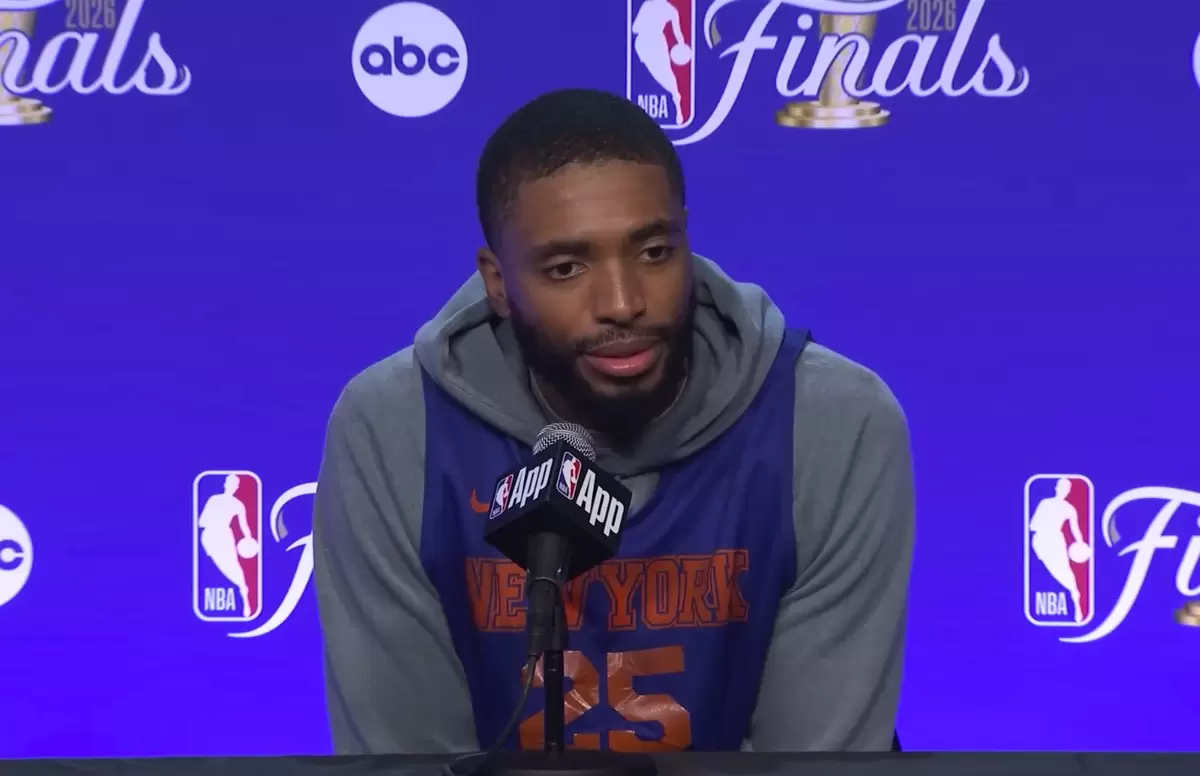
Mikal Bridges addressed a series of offensive issues on Tuesday, pointing to physicality, ball movement, and late-game execution as key problems following the Game 3 loss to the San Antonio Spurs.
Bridges credited the Spurs’ defensive tone while reflecting on how New York fell behind in key stretches. “They’re a really good team, you know, really well coached and I think, you know, they came out the gates, you know, more physical than us,” he said. “And I think that was the, you know, the main part right there, just being more physical.”
He added that the Knicks failed to match that level consistently. “It was just, you know, playing the more playing hard team than us,” Bridges said.
A major concern for New York has been offensive stagnation, something Bridges addressed directly when discussing late-clock situations and overall flow. “I think our offense got to be way better,” he said. “I think, you know, we’re just stagnant offensively, you know, and not helping the next guy out, you know, that’s either on the ball or, you know, one pass away.”
He stressed that the solution starts with movement. “I think we just got to, you know, move without the ball and be less stagnant so we can, you know, help each other out.”
The Spurs’ defensive structure, anchored by help schemes around Victor Wembanyama, has contributed to late-clock possessions for New York. Bridges acknowledged the pattern but did not frame it as the preferred offensive identity. “I think our offense got to be way better,” he said earlier in the session.
New York’s reliance on late-clock execution has also become a concern. Bridges pointed to decision-making under pressure and the need for quicker reads. “I think this goes with the stagnant part,” he said. “Sometimes, you know, if we’re catching it and we’re not making a move, I think if that guy doesn’t make a move, nobody and it maybe be stuck.”
He continued, “None of us are helping the next guy out, you know, nobody’s giving him the pass or give him I think we kind of just stand and ball watching and puts that guy in a tough situation because they’re really good defensive team.”
The Knicks also struggled with their usual cutting actions in Game 3, something Bridges connected to execution rather than scheme. “Yeah, I think yeah, like I said, just I think it was just too much ball watching, you know, standing around,” he said. “We just got to keep moving, you know.”
Karl-Anthony Towns has often served as a central hub in New York’s offense, but Bridges emphasized that spacing and rhythm depend on collective movement. “Yeah, I think KAT’s a really good passer,” he said. “So, you know, I’ve been cutting my whole life, you know, since high school.”
He added that timing and trust drive their connection. “It’s a lot of trust, but I think both understanding because he could pass really well and I know I could cut pretty well.”
Bridges also pointed to consistency across possessions as the deciding factor heading into Game 4. “We watch film and know, you know, personally for game three, a lot of mistakes that we, you know, we had that’s controllable,” he said. “The best thing you could do is just learn from it.”
With the series tightening after the Spurs’ Game 3 win, Bridges framed the response as straightforward. “We just got to keep moving, keep helping the next guy out,” he said. “Yeah, like I said, we hold the ball a little too long on a catch.”