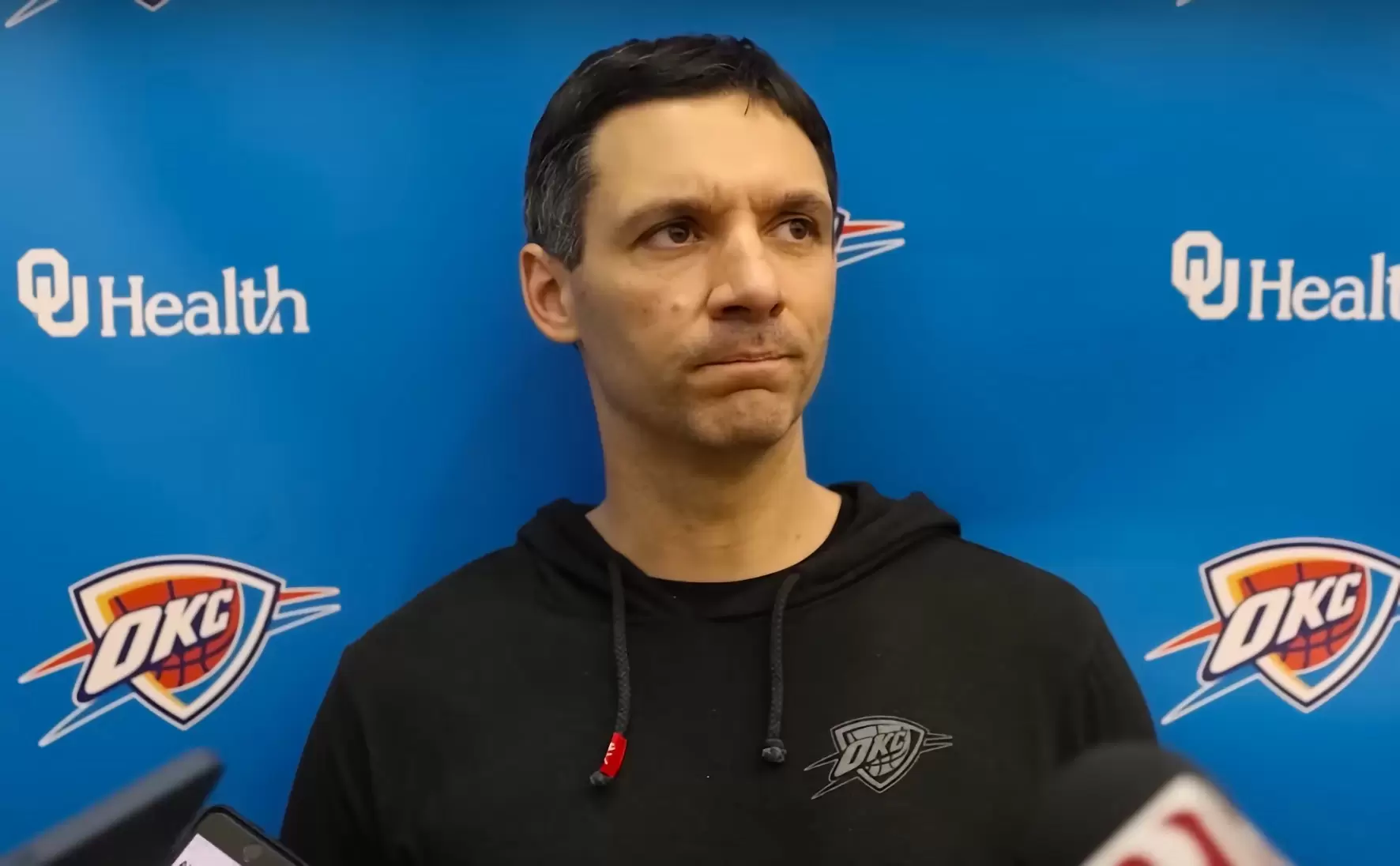
Speaking after practice on Sunday, Oklahoma City Thunder head coach Mark Daigneault discussed his team’s offensive consistency ahead of Game 1 of the Western Conference Finals against the San Antonio Spurs. He pointed to both execution and variance when assessing why Oklahoma City’s offense has improved during the postseason.
“It’s twofold. There’s always a shot variance, you know, so to not acknowledge that would not complete the picture, but we just try to control everything we can control. I think we’ve developed attacks over time against different schemes that we’ve seen. We’ve had the same team and we’ve seen the same stuff over a long period of time and we’ve just tried to hone it,” Daigneault said. “Doesn’t mean there won’t be another problem around the corner, but we’ve also honed a process of solving problems together. So, I think a combination of that has helped us have solid attacks.”
He noted that the Thunder’s offensive growth has been built through repeated postseason adjustments. “I thought we got better in each of the two series going against what they threw at us and that’ll be our challenge again in this series,” he added.
The Thunder coach also addressed the challenge posed by San Antonio, highlighting the depth and balance of their opponent. “I mean just like any really good team. I mean they’re really good on both ends. They’ve got great top end talent. They got great depth. They can attack you in a number of ways on both ends of the floor. And so the better the team is, the more you have to be able to handle and the slighter the margin for error gets. And so it’s a team that we have high respect for and understand what they’re capable of,” he said.
Oklahoma City enters the series after a dominant postseason run led by Shai Gilgeous-Alexander, Chet Holmgren and a supporting rotation that has consistently adjusted across series. The Thunder have also leaned on continuity, something Daigneault emphasized when discussing roster construction and team identity.
When asked about the idea of individual success within a collective system, Daigneault focused on character and internal standards. “I’m not going to compare. I think for our team it comes down to the quality of the guy. You know, that’s really it’s that simple,” he said. “If it’s a question about Shai and his ability to stay plugged into the team despite individual success, you know, it’s the quality of the guy.”
He extended that view across the roster. “If it’s Dub and Chet being All-Stars and All-NBA level players, it’s the quality of those guys. And then I get a lot of questions about the depth of the team and guys that could be playing bigger roles than they do and their willingness to stay committed to the team. And that comes down to the quality of the guy.”
Daigneault also reflected on how early coaching experiences shaped his approach to team-building and communication. “I saw what it should look like,” he said, referencing formative influences in his career. “That becomes a little bit of a north star.”