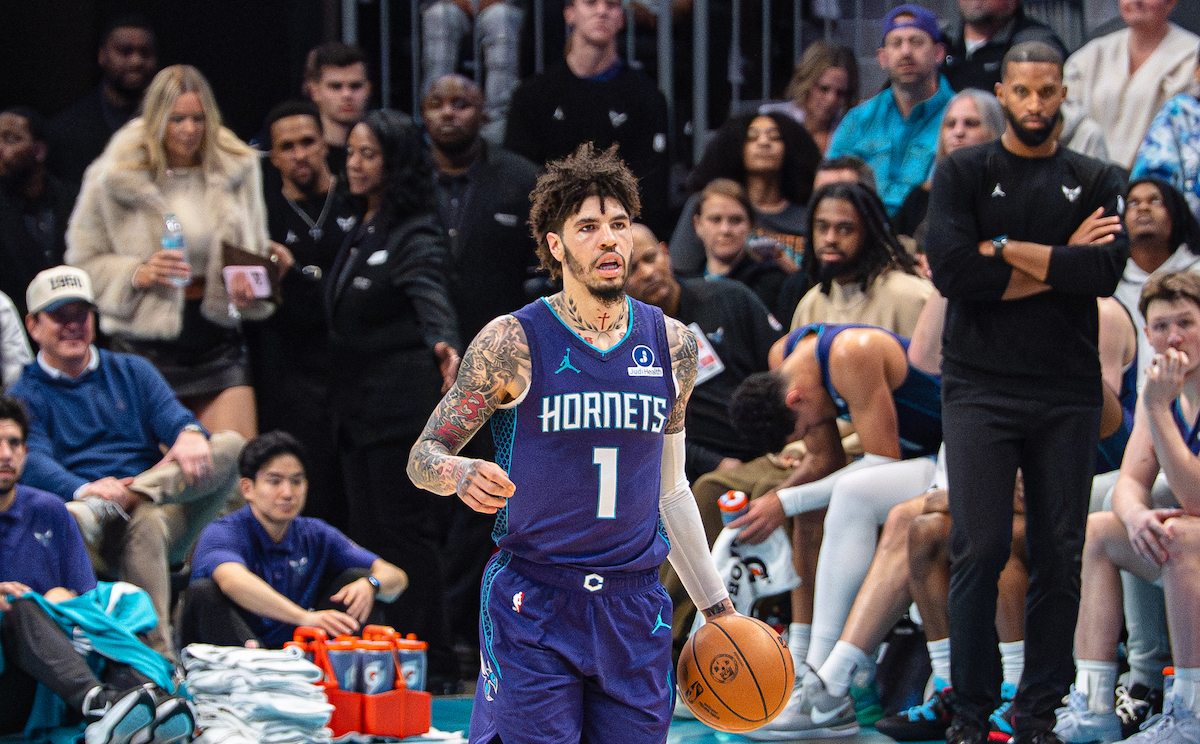
Jamal Crawford is already encouraged by the developing partnership between Anthony Edwards and LaMelo Ball, saying the Minnesota Timberwolves’ new backcourt has shown a level of chemistry that stands out to him.
“That T-Wolves thing got me excited,” Crawford said on Cousins with Vince Carter and Tracy McGrady. “I’m watching Melo and Antman, they are like kindred spirits. You can tell their chemistry is something different. I can see either one going off and the other one be like ‘Nah it’s all you, I’m gonna get you going’, like they have that respect for each other.”
Minnesota made the pairing possible with its June 25 trade for Ball and Josh Green, sending Naz Reid, an unprotected 2033 first-round pick, three first-round pick swaps and three second-round selections to Charlotte. The move came after the Timberwolves also traded Julius Randle and the No. 28 pick, reshaping a team that finished 49-33 and sixth in the Western Conference in 2025-26.
The statistical profiles of Edwards and Ball suggest Minnesota will have two high-volume perimeter creators. Edwards averaged 28.8 points in 61 games last season while shooting 48.9% from the field and 39.9% from three-point range, producing a 57.2% effective field-goal percentage.
Ball averaged 20.1 points and 7.1 assists in 72 appearances for Charlotte, his highest games-played total since appearing in 75 games in 2021-22. He also hit 36.8% of his 10.3 three-point attempts per game and reduced his turnovers to 2.8 per game after averaging at least 3.3 in each of his previous four seasons.
Crawford’s comments focus on a potential solution to one of the central questions surrounding the trade: how Edwards and Ball will divide offensive responsibility. Ball has averaged 7.3 assists across his six NBA seasons, while Edwards averaged 3.7 assists in 2025-26 and remained Minnesota’s primary scorer.
The Timberwolves’ previous offense relied heavily on Edwards alongside Randle, who averaged 21.1 points and 5.0 assists last season, and Reid, who supplied 13.6 points per game as a reserve. Their departures remove 34.7 points per game from Minnesota’s 2025-26 roster and place greater importance on the Edwards-Ball partnership.
Minnesota’s projected starting group of Ball, Edwards, Jaden McDaniels, Trey Lyles and Rudy Gobert would give Edwards a full-time point guard capable of creating for others. Ball’s playmaking could also reduce Edwards’ on-ball workload while allowing him to operate more frequently as a scorer and off-ball threat.
The defensive side presents a different challenge. Minnesota retained McDaniels, who averaged 14.8 points and 1.0 blocks last season, and Gobert, who averaged 11.5 rebounds and 1.6 blocks while earning an All-Defensive First Team selection. How effectively those two can support the Ball-Edwards backcourt will be a major factor after the Timberwolves lost in six games to the San Antonio Spurs in the Western Conference semifinals.
Crawford, however, sees the interpersonal side of the new partnership as an early positive. If Edwards and Ball can consistently balance their individual scoring ability with the willingness to create for each other that Crawford described, Minnesota’s aggressive offseason gamble will have a clearer path toward improving on its 49-win season.