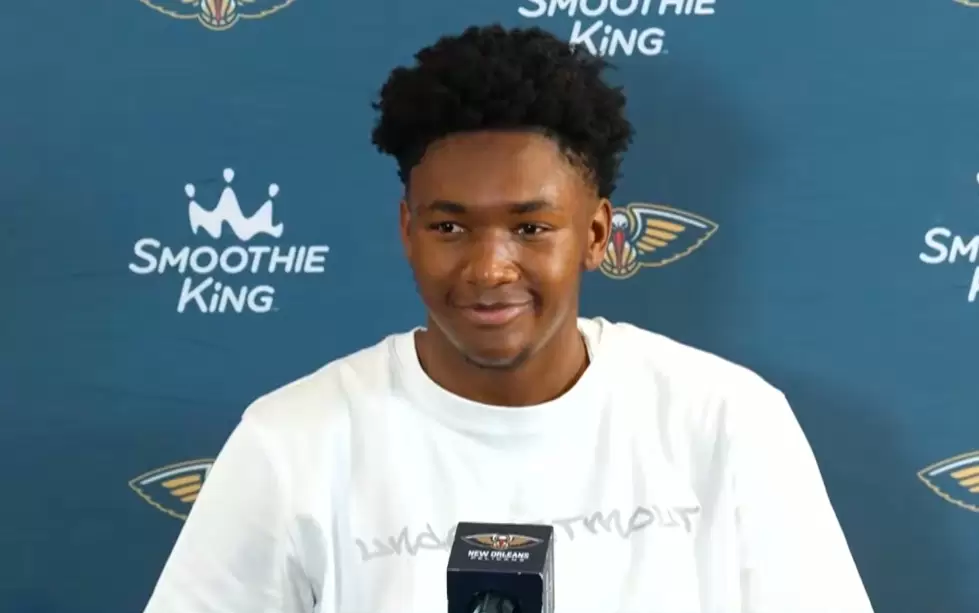
Some players study film for years to master the kind of footwork that makes a basketball court look like a stage. Derik Queen, the Maryland product and highly touted NBA prospect, arrived with something a little harder to teach. Ask him which legends he modeled his paint game after, Tim Duncan, Hakeem Olajuwon, or someone else, and his answer cuts through the mythology with refreshing honesty.
“I don’t even know,” Queen said to Brandon ‘Scoop B’ Robinson. “I felt it was natural. I can’t dance, though, but I can dance on a court. I ain’t gonna lie.”
There is something almost poetic about a 6-foot-9 big man who freely admits he has no rhythm off the hardwood but moves with balletic precision once he crosses the lines. Queen’s footwork has drawn comparisons to the kind of post craft that defined an earlier era of NBA centers, and the praise followed him out of Montverde Academy, where he was regarded as one of the most technically polished big men to emerge from prep basketball in recent memory.
The Blueprint: Carmelo, Duncan, and the Art of Getting Open
Though Queen’s base instincts are organic, his development has been deliberate. He identifies two names above all others when it comes to refining his offensive toolkit: Carmelo Anthony and Tim Duncan, two Hall of Fame players with almost nothing stylistically in common, which tells you everything about the breadth of Queen’s game.
“I still be trying today,” he said. “I made some BS moves, but I still try to work on Melo’s mid-post, his footwork, and just different ways to get open. And Tim Duncan, how he got open, finished backwards, and stuff.”
Carmelo Anthony was the undisputed master of the mid-post, a player who used jab steps, pivots, and shoulder fakes to create separation in tight spaces. Duncan, meanwhile, was the architect of the bank shot and the backwards finish, a big man who weaponized angles and patience in ways that still confound defenders decades later. That Queen is drawing from both lineages, the scorer’s touch of Melo and the technician’s discipline of Duncan, suggests a player who understands not just how to play, but how to think.
Staying Home: The Maryland Decision and What It Meant
When Queen committed to play for Kevin Willard at the University of Maryland, it was more than a recruiting victory for the Terrapins. It was a statement. Queen was among the most sought-after big men in his class, and he chose to stay close to home in College Park rather than chase a more glamorous program. Willard, who has built a reputation for developing frontcourt talent, was the draw.
“Oh, that’s my guy. He just called me actually. I love Willard,” Queen said, the affection in his voice unmistakable. “We played with two bigs, me and Ju. We was just going out there hooping. We both averaging probably 8-9 rebounds a game. We was just winning.”
That pairing, Queen alongside Julian Reese, gave Maryland one of the most physically imposing frontcourts in the Big Ten. It was old-school basketball by modern standards: two legitimate big men anchoring the paint, crashing the glass, and demanding attention. In an era when the college game has trended toward perimeter play and positional fluidity, Maryland’s twin-tower approach was something of an anomaly, and it worked.
The Big Ten: A Graduate Course in Grown-Man Basketball
The Big Ten is not a conference that coddles prospects. Its frontcourt matchups are physical, grinding affairs that test size, conditioning, and mental toughness in ways that many other conferences simply do not. For a young big man projecting to an NBA career, it is among the best possible preparatory environments in college basketball.
Queen acknowledges that his lone season in the conference left its mark. Credit, in part, goes to strength and conditioning coach Kyle Tarp. “My strength coach, Kyle Tarp, definitely got us right,” Queen said. The physical transformation that comes with a year of elite college conditioning, particularly under a staff invested in preparing players for professional basketball, is often underrated in assessments of a prospect’s readiness.
The result is a player who enters the NBA not just with the footwork of a natural and the study habits of a craftsman, but with a body that has already been tested against grown men. The “grown man battles” of NBA nights are not entirely new territory for Derik Queen. He has already danced through them once, and he is only just getting started.