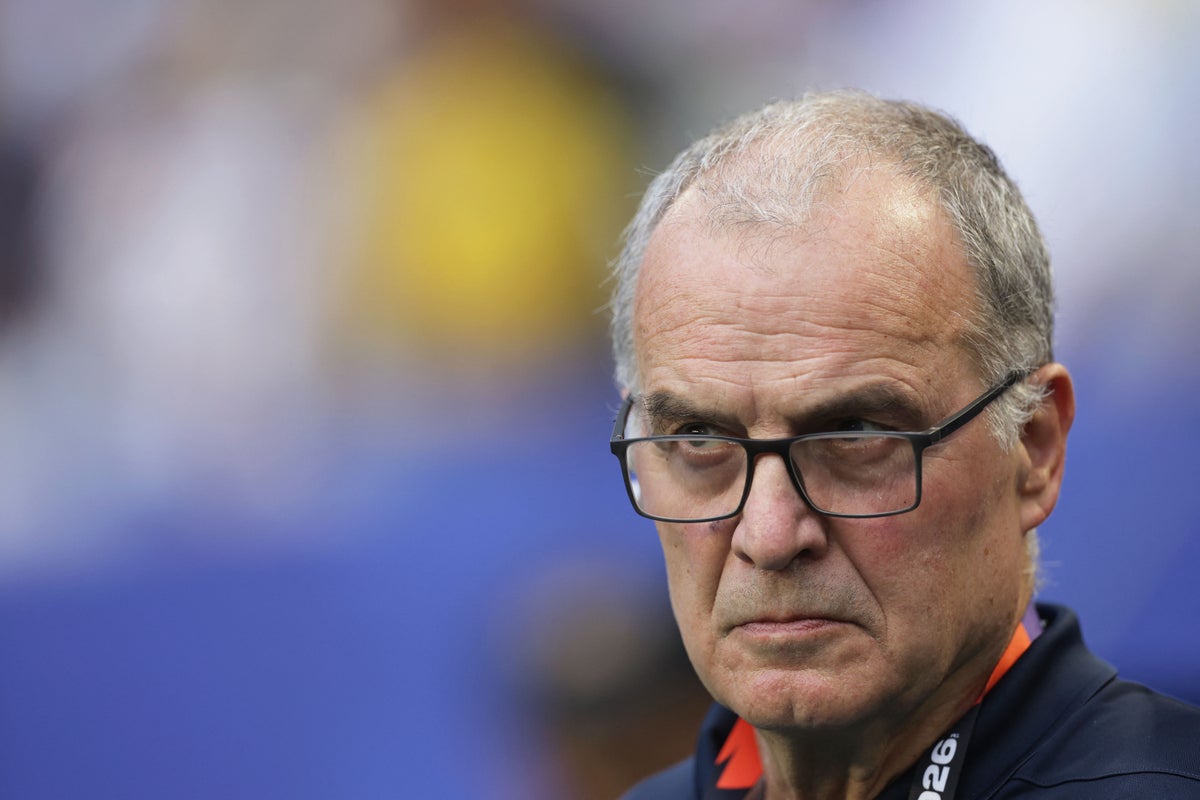
Marcelo Bielsa’s World Cup started with him staring at the floor. Now he is staring at an early exit. “I’m not a model,” said the Uruguay manager after his official Fifa photo showed him refusing to look at the camera. It has not been a model World Cup for him, either: draws with Saudi Arabia and Cape Verde leave Uruguay requiring at least a point against Spain to avert an ignominiously early exit, and with it the end of Bielsa’s reign.
His quirks endear him to some; not in Uruguay though. One of the most idiosyncratic of managers can inspire awe – certainly in Leeds – but has been greeted with greater irritation in Uruguay. Bielsa being Bielsa, instead of deflecting blame, he has found fault with himself. “Organisational mistakes that a squad makes, they always fall upon the driver. And what I mean by that is the head coach,” he said after defensive mix-ups helped the supposed minnows of Cape Verde draw 2-2 with two-time World Cup winners. Uruguay, Bielsa said, now face a “gargantuan challenge” just to progress.
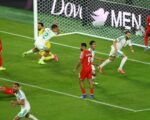
Which should not have been the case; partly from a seemingly friendly group, partly because Bielsa has reasons to support his argument they should have six points so far. Uruguay battered Saudi Arabia in the second half of a game when they took 27 shots and yet drew 1-1. Nevertheless, Uruguay’s is an unhappy camp and Bielsa, in between railing against hydration breaks, has cut a miserable figure when sat on his trademark ice cooler.
Little has gone right for him. Selecting Fede Valverde, a hugely versatile player but one of the world’s best midfielders, on the right wing against Saudi Arabia backfired. Bringing Fernando Muslera, now 40, out of international retirement has looked costly: the veteran made a couple of fine saves in Uruguay’s opener but has been culpable to varying degrees for each of the three goals they have conceded, even if a shambles of a defensive wall for Kevin Pina’s free kick was hardly all his fault.
Meanwhile, the veteran who volunteered to return to international football has watched on from the executive boxes. It can seem that Bielsa is being stalked by Luis Suarez, who ended his international career in 2024 with a blast at the manager. “Players are going to reach a limit and explode,” said, two years ago, a man with a track record of exploding.
That Bielsa, with his famous fondness for high pressing, did not want a 39-year-old Suarez to lead the line now is perhaps unsurprising. Suarez, in turn, had criticised the man-management of Bielsa, who can be socially awkward. He had accused him of treating Agustin Canobbio as like a ball boy; Canobbio, omitted for a couple of years, scored against Cape Verde, though it merely extended Uruguay’s drawing habit.
They have now gone eight months without a win, a time in which the nadir was a 5-1 thrashing by the United States; that they are led by a Bielsa disciple, in Mauricio Pochettino, but one with more warmth and people skills, may have stung. In the aftermath, Bielsa, with his gift for self-flagellation, declared he was “toxic”.
It was a reference to his perfectionism. A self-diagnosis as shy, obsessive and robotic sounded accurate. Yet he also inspires devotion, in part due to a style of play that can be seductive in his speed. Bielsa can feel like the most idealistic of the idealists.
He may be best suited to jobs where there is a distinct identity – think Leeds, think Athletic Bilbao – and can be self-deprecating in his references to his lack of silverware. His influence may be greater than his achievements. His World Cup experiences are largely unsuccessful, albeit with one exception.
Bielsa has become the first man to take charge of each of Argentina, Chile and Uruguay. He steered Chile to the last 16 in 2010, playing some thrilling football. He took Argentina to the 2002 tournament as joint favourites and they exited in the group; perhaps that is a sign Bielsa is better with more impressionable groups of players and lower expectations.
Uruguay, with their storied past, may have represented an awkward post; walking into a job defined in the 21st century by Oscar Tabarez, with the added impediment of being Argentinian, as an era was ending with Suarez, Edinson Cavani, Diego Godin and Muslera, stalwarts for a decade and a half, all in their footballing dotage. Bielsa was further disadvantaged when Al-Hilal omitted Darwin Nunez from their squad for the second half of the season, thus denying Uruguay’s rampaging bull of his sharpness. Nunez was dropped after the Saudi Arabia game. At 39, Suarez may not be the answer but a profligate Uruguay lack goals.
The job came with difficulties. Arguably, Bielsa has compounded them. He and Uruguay feel a mismatch, the team defined by the fighting spirit Tabarez instilled instead experimenting with Bielsa’s brand of chaos. But if Uruguay tumble of the tournament early, it will feel a mess, and probably a sad end to Bielsa’s World Cup career.