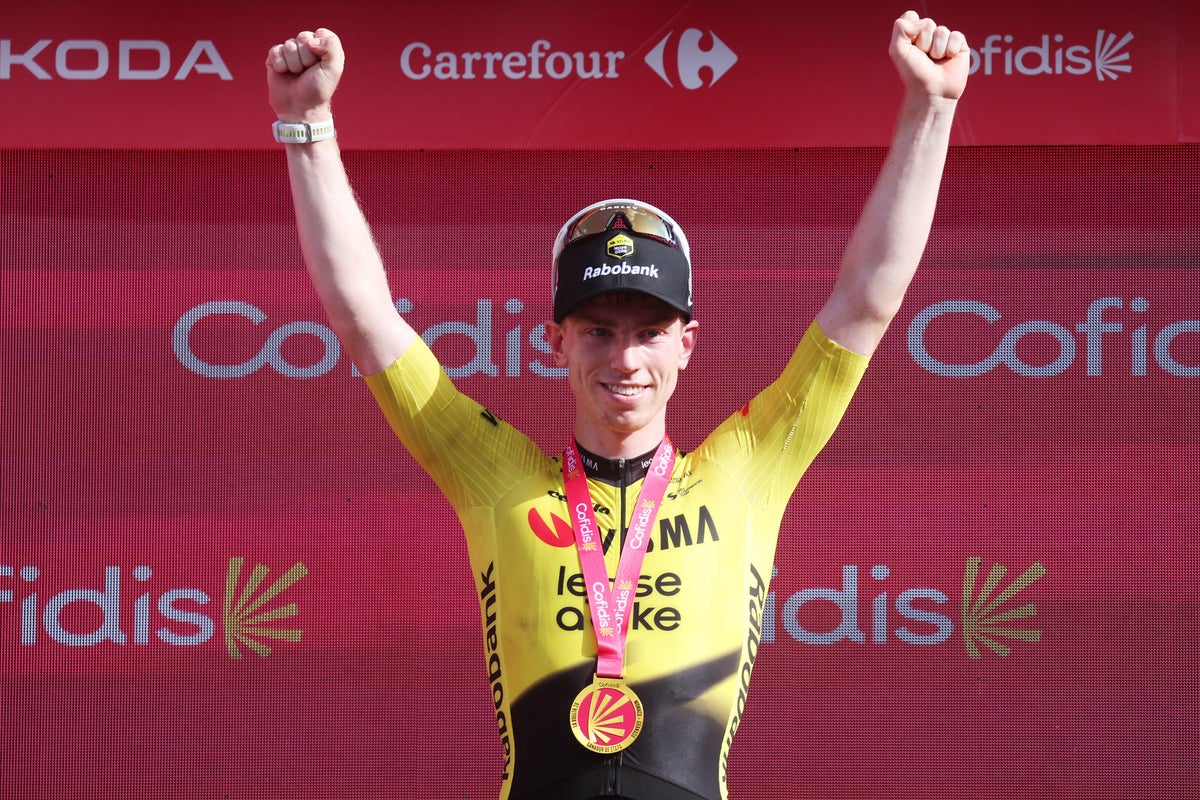
Asked before this Vuelta a Espana which rider would win five stages and leave his rivals utterly demoralised by his dominance, you would probably have said Tadej Pogacar. In the end it was British rider Matthew Brennan, who won five stages on his debut Grand Tour in a coming-of-age performance and narrowly missed out on another two – even one more would have been an outright record.
The 21-year-old Brennan’s haul of wins saw him make history as the youngest rider to win five stages in a Grand Tour, the youngest to claim back-to-back Vuelta stages, and only the second British rider to win four or more times in the same three-week race, after none other than Mark Cavendish. Those wins came on terrain ranging from pan-flat to hilly and in different circumstances, from textbook leadouts from his Visma-Lease a Bike squad to beating Pogacar on an uphill drag. It was all the more impressive given he entered the race with the status of heavy favourite on those flatter stages, with a crack team assembled around him and plenty of pressure to deliver. Evidently he wears that pressure lightly.
As a rider Brennan somewhat defies categorisation; he has more punch than a traditional sprinter and resists the label entirely. The Darlington native most closely resembles the brand of Classics rider epitomised by his teammate Wout van Aert and former world champion Mathieu van der Poel: huge engines on the flat while capable of beating anyone on short, sharp climbs and rolling terrain. He has a way to go before he can be considered an equal to those illustrious names – but he is on the right track.
Brennan has been quick to credit the team around him, most notably “superstar” Van Aert, in post-race interviews and has the chance to continue learning from one of the best in the world at his craft. Van Aert is a serial Classics winner and won a second Monument at Paris-Roubaix this season; Brennan, already a winner at the Kuurne-Brussels-Kuurne Classic, has the potential to match him at the sport’s biggest one-day races.
Seeing a British sprinter racking up wins draws inevitable comparisons to the legendary Cavendish but in terms of physical profile the pair are very different; on stages with 3,000m of climbing the Manxman would be crawling along looking the picture of misery, for one thing. If they share anything it’s the mental toughness, the unbreakable desire to win – and the moodiness when they come up short.
Cavendish was never afraid to speak his mind or ruffle feathers; Brennan too is an outspoken character, who was fiercely critical of the UCI for allowing racing to continue in 44 degree heat on the shortened stage 15 in Cordoba. He later told The Guardian, “I have a platform where I can share an opinion. It’s important to give the opinion of the peloton, and I spoke the majority view.”
Some will make caveats for his performance: a course design packed with difficult mountain stages meant no established top-tier sprinters made the trip to the start line in Monaco. But Brennan still had to adjust to the relentless grind of three-week racing, the fact that you can never switch off for a second – witness what happened when Pogacar did – and physically get through and over 3,275km or road and 58,000m of elevation gain.
He and his team targeted five stages of this race and he achieved a 100 per cent conversion rate. It was a faultless audition for a place in Visma’s squad for the 2027 Tour de France, which starts in the UK. Visma will again prioritise Jonas Vingegaard’s bid at a third Tour title, but if Brennan can demonstrate that he is becoming a utility rider in the Van Aert vein, capable of assisting the Dane on flatter and rolling terrain, he will surely have a place in the squad sewn up – as well as the chance to go for a couple of stage wins of his own.
More broadly, Brennan’s dominance of this Vuelta – perfectly timed on the eve of the sport’s biggest race returning to these shores – encapsulated a corner being turned for British cycling. The mantle of now-retired grand tour winners Geraint Thomas, Chris Froome and Simon Yates has passed on to a younger generation who grew up watching them. There are a record 49 British riders across both the men’s and women’s WorldTour this season.
23-year-old Oscar Onley represents the new face of British grand tour hopes, having finished fourth in the Tour de France last year and now sixth in his debut Vuelta a Espana, despite having struggled with sickness and a nasty crash earlier in the race. The Scot winning the best young rider classification was just reward for what is becoming clear was a characteristically mature ride throughout the three weeks.
Now based in the mountains of Andorra he is an excellent climber – notably the only contender to stick with race winner Enric Mas on stage nine’s climb to Alto de Aitana – but his performance on stage 18’s time trial was also hugely encouraging for his evolution as a GC rider. It has never been his strong point but he only lost 19 seconds to a peak-form Mas and extended his lead over his closest challenge for the white jersey, Slovenia’s newest superstar Jakob Omrzel, by nearly half a minute.
This race also featured Thomas Gloag, a career-best third on stage 19 – one of the toughest mountain stages of the entire race – as well as 23-year-old Callum Thornley, who missed out on victory in the 32km time trial by just three seconds. Former European time trial champion Josh Tarling was third in the opening day time trial in unimaginably difficult circumstances, just a week after the death of his younger brother Finlay in a crash during a race.
And absent from Spain, where he finished third last year, but still racking up top-10 positions in the Canadian grand prix races and winning a second mountain bike world title was Tom Pidcock, who is one of the favourites for next week’s Road World Championships in the void left by Pogacar. While it is not quite the Team Sky era, the strength in depth of modern British cycling is becoming more and more apparent – all led by a breakthrough ride by Brennan in Andalusia.