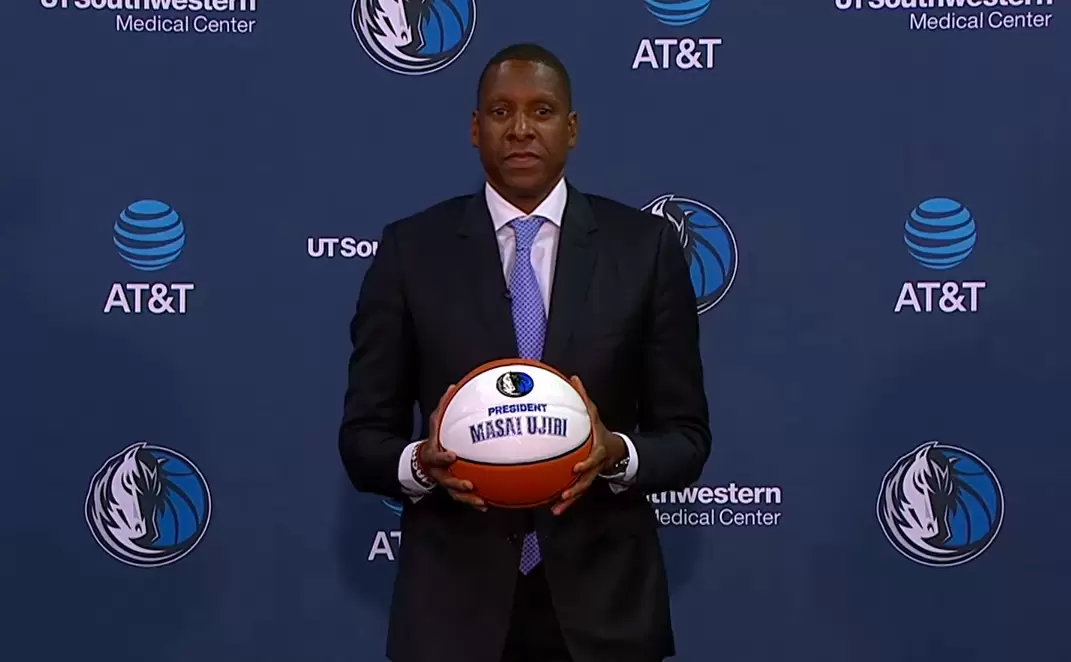

The Dallas Mavericks have entered a new front-office era after officially appointing Masai Ujiri as team president and alternate governor, a move that immediately shifts the franchise into a structured evaluation period following a 26–56 season.
NBA insider Brandon “Scoop B” Robinson reported that Ujiri will begin a 100-day roster and culture audit after taking control of basketball operations, with Dallas positioned at a critical turning point following the transition into the Cooper Flagg era and the aftermath of major roster changes.
The most immediate decision area surrounds head coach Jason Kidd, who signed a multi-year extension in October 2025 but now enters an evaluation phase under new leadership. Ujiri addressed the situation directly, signaling a process-driven approach rather than immediate structural changes.
“There’s no way to read this,” Ujiri told reporters. “I’m going to hear coach Jason Kidd out, his thoughts on everything… If you go back to the history, it’s the same thing. I have to follow a process here.”
Ujiri referenced his past organizational cycles in Denver and Toronto, where he retained long-tenured coaches while gradually reshaping team identity, pointing to continuity as part of his long-term method rather than rapid turnover.
He specifically cited previous stops where he allowed extended coaching evaluations, reinforcing that roster stability and cultural assessment will guide his early months in Dallas rather than immediate structural disruption.
The Mavericks’ current roster construction is centered around 2026 Rookie of the Year candidate Cooper Flagg, who averaged 21.0 points, 6.7 rebounds, and 4.5 assists over 70 games while operating as the team’s primary two-way connector in his first NBA season.
Dallas also remains tied to its long-term framework following the departure of Luka Doncic, whose exit reshaped the franchise timeline and accelerated the move toward a younger, development-focused core built around Flagg’s two-way versatility.
Veteran presence remains on the roster through players such as Klay Thompson, Kyrie Irving, and P.J. Washington, creating a mix of developmental upside and short-term competitive expectations that Ujiri must evaluate during the 100-day window.
Ujiri’s executive profile is defined by long-cycle roster construction, including his championship blueprint with Toronto, where sustained roster adjustments ultimately led to a title-level structure built around balance, defense, and playoff adaptability.
Historical context from Denver further outlines his method. Former coach George Karl previously described the early stages of Ujiri’s system-building as heavily focused on pace and scoring before shifting toward playoff-oriented defensive structure and veteran integration.
The current Dallas situation reflects a similar inflection point, with offensive production already established through Flagg’s emergence, but roster balance and playoff durability still under evaluation following a 26–56 campaign.
Before Ujiri’s arrival, reports also indicated internal discussions around expanded coaching control for Kidd, including potential multi-role authority, though the organization ultimately moved toward a traditional executive-coach separation model.
With the 100-day audit now underway, Dallas enters a defined evaluation phase where roster structure, coaching alignment, and long-term trajectory will be assessed under Ujiri’s established process-driven framework.