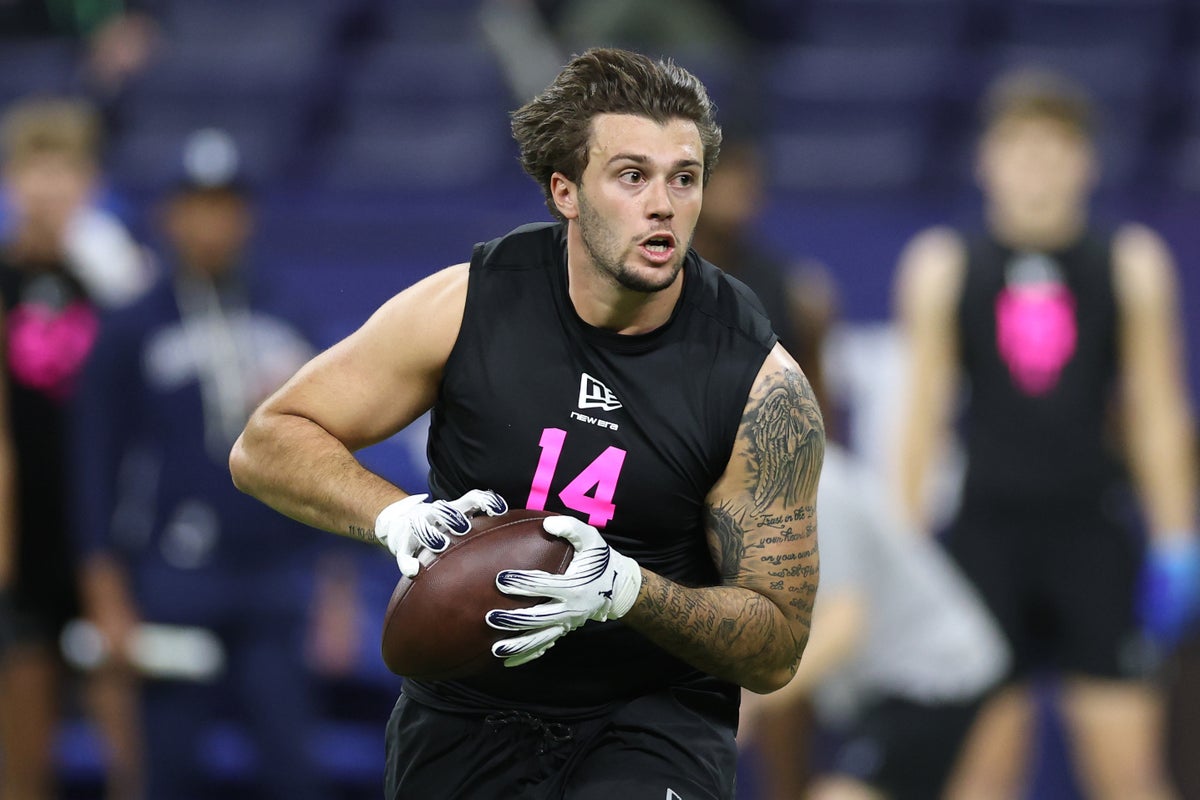
Marlin Klein entered an entirely new world when he opted to leave the home comforts of Germany to play football in the United States.
The then-teenager left behind the sports he loved – soccer and basketball – to embrace a demanding new discipline in the Georgia mountains. There, a high school coach held him to the same rigorous standards as his American teammates.
Compounding the challenge, Klein, not yet fluent in English, grappled with mastering the sport’s complex terminology.
Despite these formidable initial hardships, Klein persevered, earning a college scholarship at Michigan and now stands on the precipice of his ultimate ambition: playing in the NFL.
Reflecting on his decision during the NFL scouting combine in Indianapolis, he admitted the move was perhaps tougher on his loved ones.
“I think it was harder on my family than it was for me,” he said. “I was looking forward to something. I was getting myself into something new and chasing my dream of playing football.
“But, obviously, having your son at 15 years old come up to you and say, ‘I want to come to the US’, it was tough. I left my entire life behind, my entire family, my friends to chase this dream.”
Klein is widely anticipated to discover his next destination this Friday or Saturday, potentially becoming the third Wolverines tight end drafted in as many years.
While A.J. Barner was a fourth-round pick in 2024 and Colston Loveland went at No. 10 overall last year, Klein’s path is arguably the most improbable, given his modest college statistics: 12 career starts, 38 receptions, 364 yards, and just one touchdown catch.
The arduous journey from international prospect to professional player is becoming increasingly viable, thanks to the success of athletes like Australian offensive tackle Jordan Mailata, the European recruitment efforts of former NFL players such as Bjorn Werner, and the league’s International Player Pathway Program. Yet, as Klein attests, it remains far from easy.
“It was my best friend for the first year,” he quipped, referring to Google Translate, which helped him navigate the language barrier. “It was quite the relationship.”
The NFL’s strategic investment in unearthing international talent aligns with its ambition to expand its global fanbase.
The Indianapolis Colts, who drafted Werner, have played in Germany twice recently, and next season’s schedule includes three games in London, alongside fixtures in Madrid, Melbourne, Mexico City, Munich, Paris, and Rio de Janeiro.
Players who can serve as de facto ambassadors in these key markets are invaluable. This year’s draft class, predictably, features a diverse group of intriguing prospects from across the globe.
Among them are defensive tackle Uar Bernard from Nigeria and edge rusher Joshua Weru from Kenya, both of whom impressed at this year’s HBCU Showcase and hope to hear their names called, likely on Day 3. Kicker Kansei Matsuzawa, born in Ichikawa, Japan, transitioned from soccer to American football, playing at Hocking College before becoming a Lou Groza Award finalist at Hawaii.
Australia continues its tradition of producing elite punters with Brett Thorson of Georgia, a ProKick Australia alumnus, who won last season’s Ray Guy Award and is a two-time second-team Associated Press All-American.
Even American prospects sometimes share similar international threads. Former Stanford tight end Sam Roush, despite his deep athletic roots and a family tie to Pro Football Hall of Famer Merlin Olsen, experienced a childhood marked by seven family moves, living in cities from Kuala Lumpur and Jakarta to Atlanta and Nashville.
His introduction to rugby and early morning wake-up calls to watch American football games echo the experiences of many international hopefuls.
“I would wake up at like three in the morning to watch Duke football and basketball games,” Roush recalled, noting his father played for the Blue Devils.
“I played rugby, basketball, a little bit of soccer and baseball. I think the physicality of rugby helped me prepare when I was younger to just kind of step into that role as a physical football player. Those are memories I’ll never forget.”
This weekend could provide Roush – and the other international hopefuls – with an unforgettable moment. For Klein, it would also validate his decision to leave Europe and pursue a goal many once deemed impossible.
“The main thing for me is that if you have a dream, you should full on pursue it, no matter what anybody tells you,” Klein affirmed.
“I mean so many people told me, from Germany, how many American kids are out there, they can play tight end, they can run fast, catch balls. But if you believe in yourself that’s all you need.”