With the World Cup 2026 reaching its latter stages, it’s not just the selection and performances of players that are under the spotlight.
The appointment of referees has been a hot topic of conversation this week, particularly after an all-Argentine official line-up was announced for France’s 2-0 win against Morocco on Thursday evening.
Many fans online questioned that selection, given the likelihood of favourites France coming up against defending champions Argentina in the final in a repeat of the 2022 showpiece match.
It was also confirmed by Fifa that English referees Anthony Taylor and Michael Oliver could not take charge of Argentina, due to the Falklands War 44 years ago.
Here’s a Q&A on how Fifa appoint their referees for the World Cup.
What are the main factors at play?
The most significant factor determining a referee appointment at the World Cup is their collective performance, as referees are usually paired with two assistant referees for the tournament.
This is a multi-year monitoring process by the Fifa Referees Committee, chaired by ex-World Cup final official Pierluigi Collina, considered one of the best referees of all time.
While form and correct decision-making are the primary elements, other geo-political factors are at play.
Obviously, referees cannot officiate their home country – and it was confirmed to The Independent that a referee would not be assigned to a game which has a direct consequence to an official’s home country in the tournament.
For example, an English referee would not have been appointed to a non-England game in their group, such as Panama vs Croatia. In addition, an English referee would not take charge of Argentina vs Switzerland this weekend, given the winner could take on England in the semi-finals.
This context does not work beyond the ‘next-match’ ethos, though, which is why an all-Argentine official line-up took charge of France’s 2-0 quarter-final win over Morocco, even though Argentina could be a potential opponent in the final.
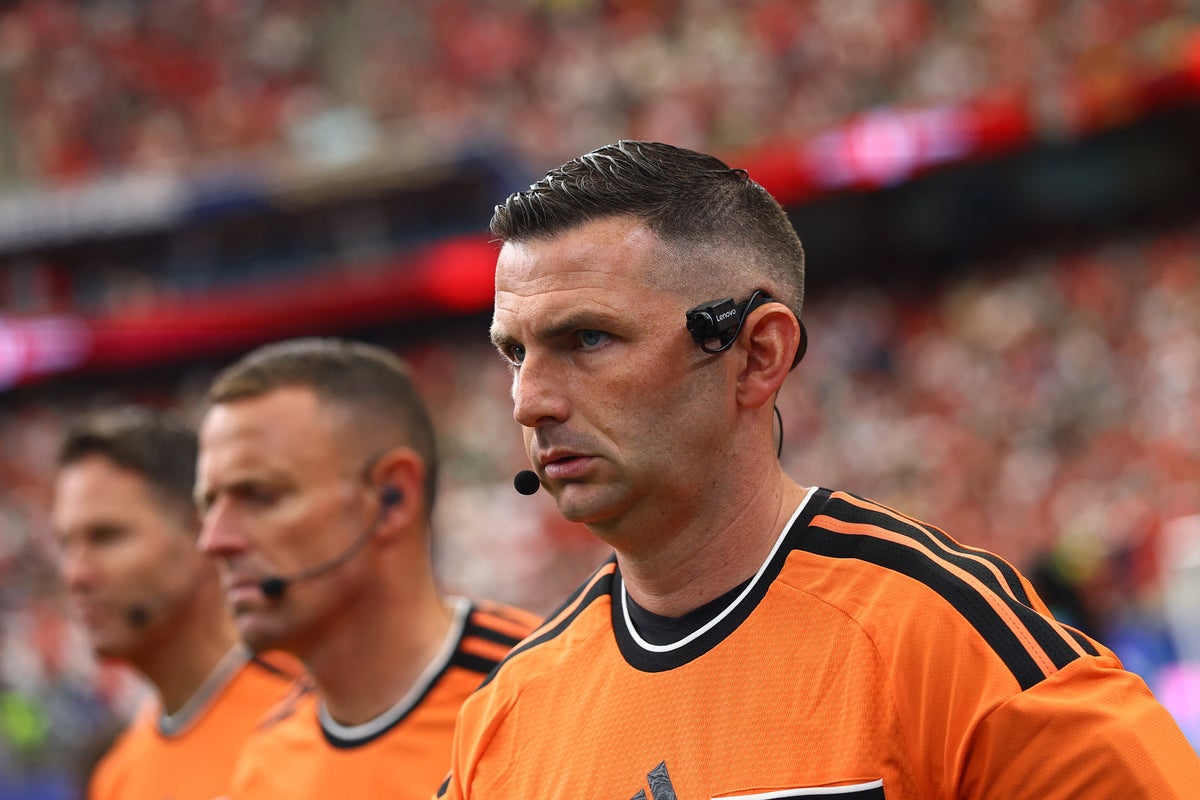
Preferably, Fifa look to appoint from a neutral confederation. If an African nation faces a South American nation, a European referee could be an option. Similarly, that neutrality can cancel out – if two European nations face each other (i.e. Spain vs Belgium on Friday night), then that referee can also be European, as it is with English official Michael Oliver.
However, there are other factors too, including geo-political reasons. An American official would not have taken charge of an Iran game at this World Cup, for instance, given the ongoing conflict between the two countries.
While there is no hard and fast rule, Fifa look to use common sense when appointing referees and are acutely aware of politically sensitive situations. A source described the process as “quite fluid.”
Is the Falklands War a factor?
A Fifa spokesperson confirmed that the 1982 Falklands War is a factor when appointing a referee – so an English official would not be appointed to an Argentina game nor a game which has a direct next-game consequence for Argentina, and vice-versa.
This is why it looks increasingly unlikely that an English referee, whether it be Oliver or Anthony Taylor, will take charge of the final, given England and Argentina are in the same half of the draw.
The Falklands War is still considered a politically sensitive topic, particularly given Argentina’s players sang a song called ‘Muchachos’ referencing the ‘Malvinas’ – the Argentine term for the South Atlantic islands – after their win against Egypt.
Conflicts as far back as World War II, however, are not a factor – so a German referee could take charge of an England match.
Have there been any exceptions to this rule?
Yes, there have been.
Argentine referee Horacio Elizondo took charge of England’s infamous World Cup defeat to Portugal in the 2006 quarter-finals. The match is memorable for Wayne Rooney’s controversial red card after an incident with Ricardo Carvalho.
Fifa were unable to confirm why their current guidance surrounding the Falklands War was not in place 20 years ago.