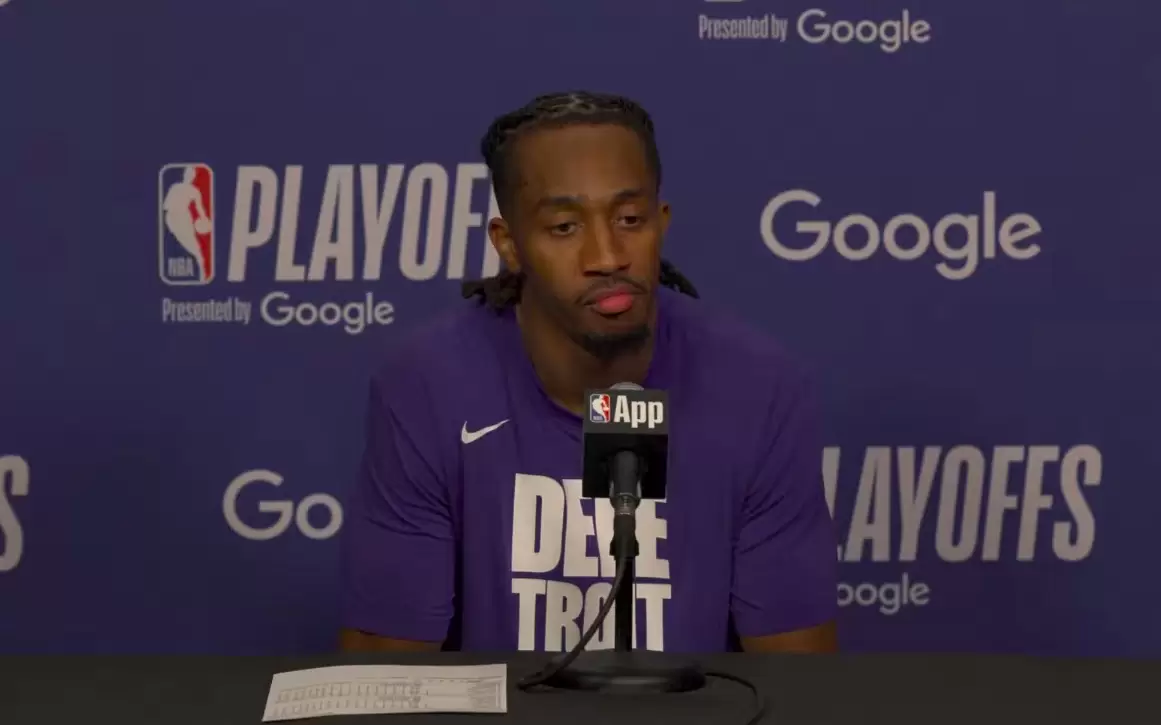
Detroit Pistons guard Daniss Jenkins delivered one of the most candid reactions of the postseason after the Pistons let a late fourth-quarter lead disappear in a crushing 117-113 overtime loss to the Cleveland Cavaliers on Wednesday night.
Detroit entered the final minutes at Little Caesars Arena in control of Game 5 and seemingly on the verge of taking a 3-2 series lead in the Eastern Conference semifinals. Instead, Cleveland closed regulation on a 9-0 run, dominated overtime and moved within one win of advancing to face the New York Knicks in the Eastern Conference finals.
Jenkins, making his first postseason start in place of injured Duncan Robinson, finished with 19 points on 8-for-17 shooting while playing 41 minutes. After the game, though, his focus immediately shifted to Detroit’s defensive breakdowns late in regulation.
“We ain’t supposed to lose that lead like that, man,” Jenkins said. “We just got to be better. We got to execute better defensively. We gave up too many timely threes.”
The Cavaliers repeatedly punished Detroit from deep during the comeback. Max Strus knocked down six three-pointers and Cleveland finished 14-for-35 from beyond the arc, including several critical makes during the closing stretch.
Jenkins pointed directly to those perimeter breakdowns as the deciding factor.
“When you got that lead, we did our job offensively,” Jenkins said. “That was just about not giving up threes. And we didn’t do a good job of that.”
He added: “Tough twos don’t beat you. Threes do.”
Detroit still had opportunities after regulation, but Jenkins admitted the Pistons never should have allowed the game to reach overtime after leading 103-94 with just over two minutes remaining.
“Honestly, we weren’t supposed to go to overtime,” Jenkins said. “We did. And we still was supposed to come out with the win.”
Despite the disappointment, Jenkins remained composed while discussing his expanded role in one of the biggest games of Detroit’s season. Robinson’s injury opened a spot in the starting lineup, and the rookie guard responded aggressively from the opening tip.
“I was just trying to come in and do my job, man,” Jenkins said. “I know how important Duncan is in that starting lineup.”
Jenkins explained that his offensive rhythm came from his activity on defense and his overall energy level throughout the night.
“I involved myself a little more, mainly kind of defensively started on that end,” he said. “Once I get that going, get that into the game, my energy is going and then the ball just find me.”
Cleveland’s late-game defensive strategy centered around trapping Cade Cunningham, who still finished with 39 points and nine assists. Jenkins believed the Pistons handled those doubles correctly offensively, but not defensively afterward.
“When they had him, that’s an advantage for us,” Jenkins said. “We got the ball to open guys.”
Instead, Jenkins said Detroit’s breakdowns started at the point of attack, eventually forcing unnecessary rotations that opened perimeter shooters.
“We all just got to do a better job of doing our job,” Jenkins said. “They only get open threes when we lose our guys and we have to help.”
Jenkins also praised Marcus Sasser for providing energy off the bench during limited playoff minutes.
“He’s a very good guard,” Jenkins said. “I was just trying to tell him get going, because that’s a guy that they didn’t scout for.”
Now the Pistons face elimination entering Game 6 in Cleveland on Friday night. Detroit finished the regular season with the NBA’s best record at 60-22, but Jenkins made it clear the locker room believes the series is still within reach if the defensive mistakes are corrected.