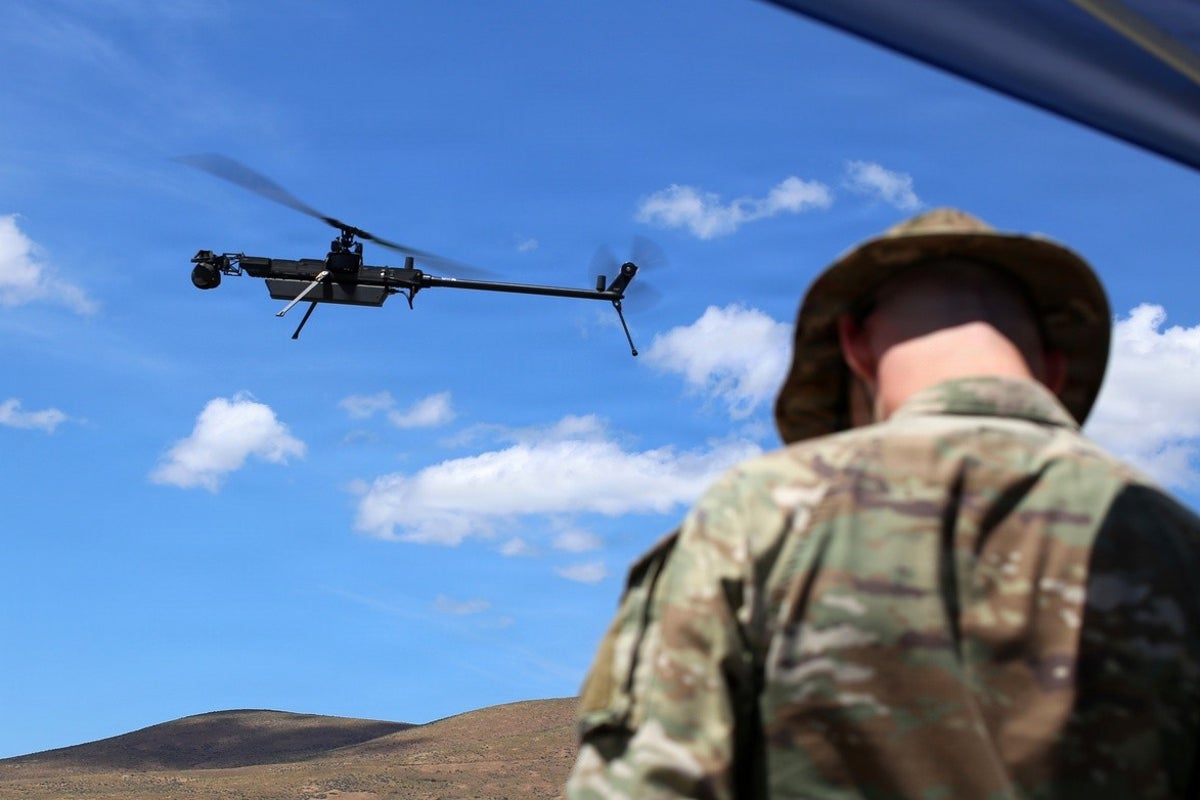
Local police departments and federal agencies across the U.S. are racing to prepare anti-drone defenses ahead of the World Cup, which kicks off next week and is expected to draw up to 7 million visitors across the 11 American venues.
Protecting the tournament is like “78 Super Bowls over 39 days,” Andrew Giuliani, executive director of President Trump’s World Cup task force, told The Associated Press.
And drones, which are increasingly popular among both hobbyists and soldiers in wars like the Iran and Ukraine conflicts, are topping the list of key dangers for many security officials.
“If there is one threat that keeps me up at night, it is from drones,” New York City Police Department Commissioner Jessica Tisch said in May as she announced a multi-million dollar investment in drone systems ahead of the games.
A partial government shutdown earlier this year and supply chain issues reportedly slowed U.S. efforts to beef up anti-drone security. Meanwhile, federal officials are still formulating rules and training departments to implement last year’s SAFER SKIES Act, which gives state and local police the ability in some circumstances to knock out drones that threaten public safety.
”On the counter-drone measures, everybody’s a little behind,” Homeland Security Markwayne Mullin testified before the House Homeland Security Committee on Wednesday.
“Drones are my biggest concern. … Every single day, we improve,” he added. “But that is a huge concern that we have.”
Counter-drone systems have been installed at all 11 U.S. World Cup venues, Mullin testified.
The Secret Service, meanwhile, told lawmakers this spring that the agency has spent more than $100 million in the past year and a half on similar technologies.
FEMA has also directed $250 million in grants to local jurisdictions protecting the games for drone-related tech.
Federal money has helped local police departments and state agencies purchase sophisticated counter-drone technologies.
Washington’s King County Sheriff’s Office, which will help protect Seattle’s Lumen Field, is spending around $12 million on counter-drone tech, and it will use patrol drones to monitor crowds and venue security during the Cup.
“We have to think about, ‘What is the worst case scenario?’” Undersheriff Jeff Flohr told KOMO News in April. “One of our biggest concerns two and a half years ago when we started planning was, ‘What do we do with a dangerous drone?’”
Police in Kansas City, which houses both a World Cup stadium and team bases for England and Argentina, plan to monitor for unauthorized drone traffic, disable UAVs remotely, and send “hunter-catcher” drones with nets to bag threatening unmanned aircraft.
“In these types of operations you don’t know what the intent of the drone is, nefarious or someone trying to make a political statement, it’s a very dynamic and challenging part of the security apparatus,” Tom Adams, of DroneShield, one of the companies working on the effort, told The Sunday Times in May. “You could have to make a decision in seconds.”
Other police departments in New York City, Dallas, and Houston are pouring millions of dollars into tech that both detects drones and uses drones to fly above active World Cup zones for security reasons.
Agencies also spending hours training up officers and drone operators to respond to World Cup threats, which could range from clueless amateurs flying their drones into restricted areas to full-on terror attacks.
The FBI has certified more than 60 law enforcement agencies in a first-of-its-kind federal training program ahead of the games, including the LAPD, NYPD, and Louisiana and Maryland state police departments.
Those agencies will work alongside federal agents who plan to deploy radar, listening devices and other tools to remotely take control of hostile drones.
Axon, the maker of widely used police body cameras, is reportedly coordinating with departments across the 11 U.S. host cities to deploy a system combining its drone detection sensors and cameras with the Skydio X10 drone, which can fly autonomously to the location of a law enforcement alert, Police 1 reports.
Another contractor, Utah’s Fortem Technologies, said in February it had secured a “multimillion-dollar order” with DHS to protect American venues using its net-equipped DroneHunter interceptor drones.
Law enforcement officials urge members of the public to check official airspace maps before flying drones near the World Cup.
Piloting a drone through restricted airspace is punishable by up to a $100,000 fine and a year in prison.