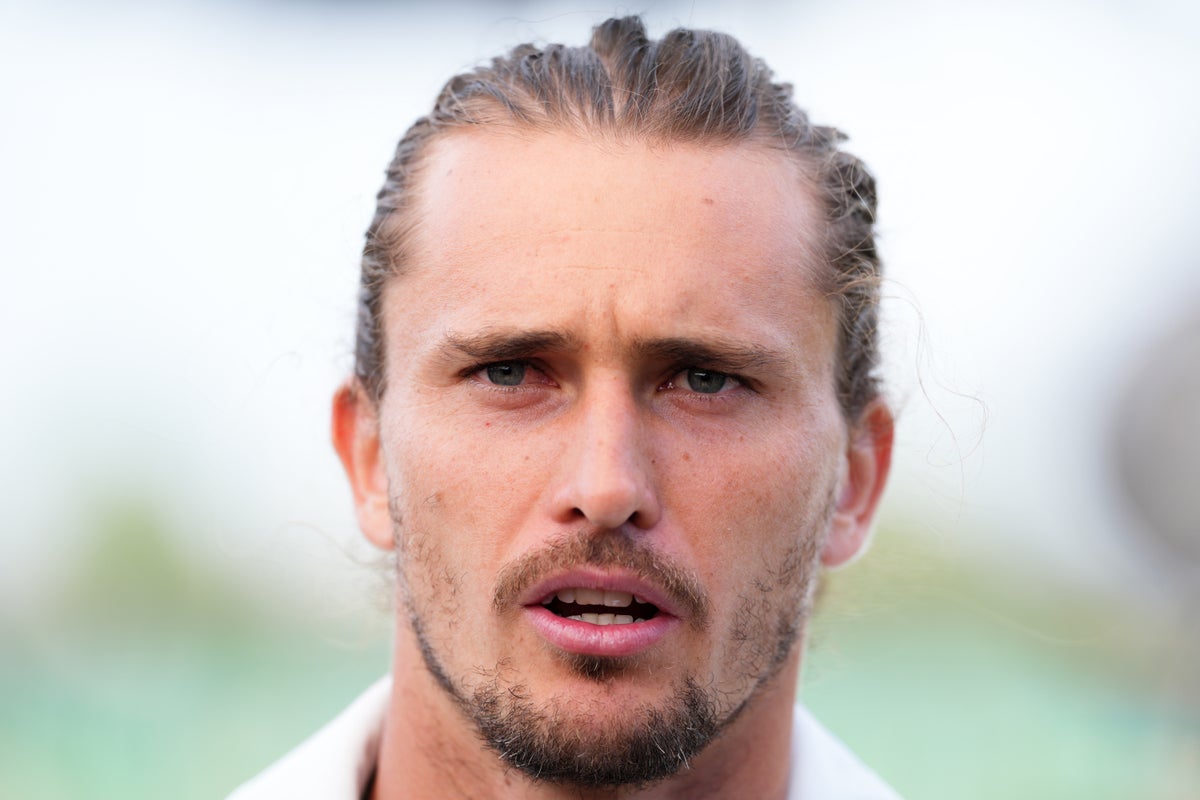
On Sunday, Alexander Zverev will attempt to win his first Wimbledon and second grand slam title when he plays world No 1 Jannik Sinner in the men’s singles final. The 29-year-old German is also bidding to became the first man in the open era to win a second grand slam title immediately after his first, having ended his long wait to win a major crown at last month’s French Open.
After years of trying to break through, Zverev arrives into his first Wimbledon final in the best form of his career, with the powerful world No 2 finally playing the style of aggressive, attacking tennis that many observers in the sport believed his 6ft 6in frame was always capable of producing on Wimbledon’s grass courts. Winning his first grand slam has appeared to have released Zverev, relaxing his shoulders.
But while Zverev’s journey to fulfilling his potential and attempting to become Germany’s fifth Wimbledon champion is one element of Sunday’s final against reigning champion Sinner, he continues to hold an uncomfortable position at the top of the sport. Zverev’s victory at the French Open was his biggest title since he has faced allegations of domestic abuse from two former partners, allegations which Zverev has repeatedly denied.
In October 2023, Zverev was issued with a penalty order and fined almost £400,000 for committing bodily harm against a previous girlfriend and the mother of his daughter, Brenda Patea, after she accused him of strangling her. Under German law, a penalty order is issued by a public prosecutor’s office when a trial is considered to be unnecessary, for example, in situations where there is compelling evidence to support one side.
Zverev eventually reached out-of-court settlement with Patea in June 2024, days before he played in the French Open final against Carlos Alcaraz. The settlement meant legal proceedings were discontinued without a finding or admission of guilt, and Zverev, who described the allegations as “bulls***”, has repeatedly and strenuously denied them.
The prospect of a trial hung over that year’s Roland Garros, with the decision to settle arriving before Zverev played Casper Ruud in the semi-finals. After that match, Zverev was asked about the settlement and said: “They’re not going to drop the case if you’re guilty at the end of the day. Done. We move on. I never ever want to hear another question about the subject again.”
Zverev had previously been accused of domestic abuse by another former girlfriend, Olga Sharypova, who alleged in October 2020 and August 2021 that he had physically and emotionally abused her while they were together. Zverev denied the claims and said they were “unfounded”. A 15-month investigation by the ATP resulted in the body saying there was “insufficient evidence” to substantiate Sharypova’s allegations, and it announced it would not sanction the player.
Zverev continued to play on the tour while legal proceedings rumbled on but the ATP has rules which allow it to “provisionally suspend” players “from further participation in ATP tournaments pending a final determination of the criminal or civil proceeding” should they be charged under criminal or civil law in any jurisdiction.
Zverev maintains the presumption of innocence, but has faced persistent scrutiny over his continued presence on the tennis tour, while the ATP has been heavily criticised for its lack of policy on domestic violence and abuse. It only brought in a safeguarding policy in December 2025, more than five years after the allegations first surfaced, while the ATP came under fire when he was appointed to the Players Advisory Council in January 2024.
Before this season, Zverev’s biggest title of his career arrived at the Olympics in 2021. He lost his first three grand slam finals, against Dominic Thiem in the 2020 US Open, against Alcaraz at the 2024 French Open, and against Sinner at the 2025 Australian Open. Following that defeat in Melbourne, Zverev was heckled by a woman in the crowd who shouted “Australia believes Olya and Brenda!” during his runners-up speech.
Zverev was asked about the incident following the trophy ceremony and said: “I believe there are no more accusations. There haven’t been for, what, nine months now. Good for her, I think she was the only one in the stadium who believed anything in that moment.”
While Zverev’s French Open title brought the allegations he has faced into the wider consciousness, the Wimbledon men’s final carries an even larger audience and is the most-watched tennis match of the year around the world.
Zverev was not asked about the allegations in his press conference following the French Open final, but he did cut short an interview with the French sports daily L’Equipe the following day after he was asked about the allegations. The previous day, L’Equipe took the unusual step of not putting Zverev’s French Open win on its front page.
“Hold on, first of all, this isn’t that kind of interview,” Zverev told the journalist Quentin Moynet. “Secondly, you know that the accusations have been proven false?” The discontinuation of Zverev’s case, however, was not “a decision about guilt or innocence,” the Tiergarten District Court in Berlin said at the time, and which continues to cast a cloud over what is the biggest match of Zverev’s career in the Wimbledon final on Sunday.