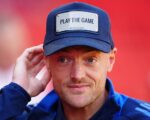
I’d thought that pre-sports day nerves wouldn’t really be a feature of adult life, but as I arrive at the imposing door of a luxurious hotel in Knightsbridge, I feel those familiar knots in my stomach again. The ordeal before me isn’t quite school sports day, however: instead, I’m going to be put through my paces by none other than three-time Olympic champion Max Whitlock, who’s going to attempt to coax some gymnastic potential out of me.
He’s got his work cut out. I would describe my fitness level as distinctly average: I do yoga, I run three times a week, and go to the gym sporadically. But an Olympic athlete, I am not.
Luckily, I’m in the hands of an expert. Whitlock burst onto the scene at the age of 19, winning two bronze medals at his debut Olympic Games in London 2012. More medals and titles followed, including gold on the floor and pommel horse (his specialist discipline) in Rio four years later, and he defended his pommel horse title in Tokyo 2020.
Paris 2024 was set to be his last Olympics, but it ended in crushing disappointment as he missed out on a medal. He had made his peace with retirement despite the circumstances, but realised something was nagging at him.
“I feel like I had just unfinished business,” he tells The Independent. “I feel like I’ve still got something left in the tank, that I can squeeze everything I can out of the sport. If someone asks what you do, it was very easy to answer before: I’m an athlete, I’m a gymnast. When that suddenly stops, a hard stop as well, it was really hard.”
Cue a dramatic return from retirement, with his sights set on a medal in LA 2028, when he will be 35.
It will be one last extraordinary feat in a career full of them, and he is aware of the scale of his task. “Gymnastics is a young person’s sport,” he tells me ruefully, as we warm up in the hotel’s studio. “I’m 10-plus years over peak age.” Well, that’s one advantage I have over the most successful gymnast in British history.
First we’re kitted out with some tech: I’m given the new, a sleek piece of kit to track my heart rate, calories, and all other vitals. Max wears the, a more high-performance version which gives him data on just about metric an athlete might need, from daily cardio load to a personalised sleep and energy score to body ECG and blood pressure monitoring. Especially at his (relatively) advanced age for an athlete, it’s incredibly useful information to guide his training and recovery.
We begin with a few stretches before an utterly punishing core workout, which involves 10 reps of each exercise with no rest in between: crunches, sit-ups, variations on leg lifts, side planks, and different ab rocks, including one lying on your side which makes me feel like a half-dead fish flailing to stay alive.
That is in fact what the whole workout feels like: it only takes about five minutes but it hurts to laugh for the next three days.
Whitlock does this every day at the start of each session.
Next we move onto handstand progressions, with the goal to get me (a handstand newbie) doing one by the end of the session. “Handstand is the foundation of gymnastics, the most important skill,” Whitlock says. “It’s almost a non-negotiable. As a kid, I was just walking around on my hands all day long, stupid stuff like walking down the stairs on my hands. If you can’t master the handstand as a gymnast, you’re in trouble.”
We start with little bunny hops on a mat, getting used to feeling my weight on my hands, and practicing the correct form: shoulders open, body in one straight line. From there we build up to bigger jumps, then from a raised position, with knees and feet on a plyo box. From there, the goal is to alternately bring one leg up and down, and then to step from a lunge, and then from fully upright, smoothly into a handstand.
I look about as ungainly as expected giving it a go. Watch a pro do it, however, and it looks the easiest thing in the world. A hush descends over the room and it feels genuinely calming – aided by the faint twinkling of distant spa music – as Whitlock slowly floats one leg up and then the other, muscles barely flickering with effort.

He then demonstrates the considerably harder, incorrect way of doing things: my shoulders are too closed, he explains, meaning I’m not in a straight line and I’m having to use significantly more strength to stay upright. He does all this while maintaining conversation and barely breaking a sweat.
Eventually, form corrected, I just about manage it, with Whitlock hovering to make sure I don’t topple over. Feeling every one of your muscles working to keep you upright just reinforces how impressive the pros are – and that’s doing just about the most basic element of any elite routine.
One of Whitlock’s major targets for the next phase of his career is to have his own skill named after him, which he will achieve if he successfully performs it in competition. The skill he is training would send the difficulty score of his pommel horse routine sky-high – but at a price, as it caused a wrist injury he is currently managing, and which has prevented him from going to this month’s European Championships.
He says there is “light at the end of the tunnel” and it certainly doesn’t impede him in the studio today, but he adds: “Having a break from sport is actually always going to be hard because you have to taper back in. That takes a long period of time, and I think that’s probably part of the reason for a lot of the injuries and small niggles and pains that I’ve picked up.
“But also, it also doesn’t hurt to have a bit of a break. Actually when I had that time [off], I think it was something that was actually essential for me to have to kind of reset and be fired up to go again.”
He has lowered the volume of his training sessions compared to when he was younger – having previously done around 35 hours a week – but the intensity and drive is very much still there.
After the frustration of this season, his top priority is “staying injury-free”. But on a grander scale, one more pommel horse goal would be the dream end to his career.
He says: “The thing that drives me is retaining titles. Our focus that has been for my whole career, that will never change, is trying to maximize what I can do on the pommel horse. I will be doing more than that [in terms of apparatus] and that’s the plan, to be able to help the team [win a medal].”
And then? “I know I said it last time… but LA will be my final competition, and then I will be a fully retired athlete after that. So it’s my final shot. I’m just giving everything I can.”
As for me? I don’t think I’ll be quitting the day job anytime soon… but I leave with a newfound appreciation for the brutal life of an elite athlete. And with a new, Whitlock-certified core regime to subject myself to.