There is a tiny chance Kyren Wilson was the last ever British world snooker champion.” So wrote former professional Andres Petrov on social media ahead of this weekend’s World Snooker Championship final.
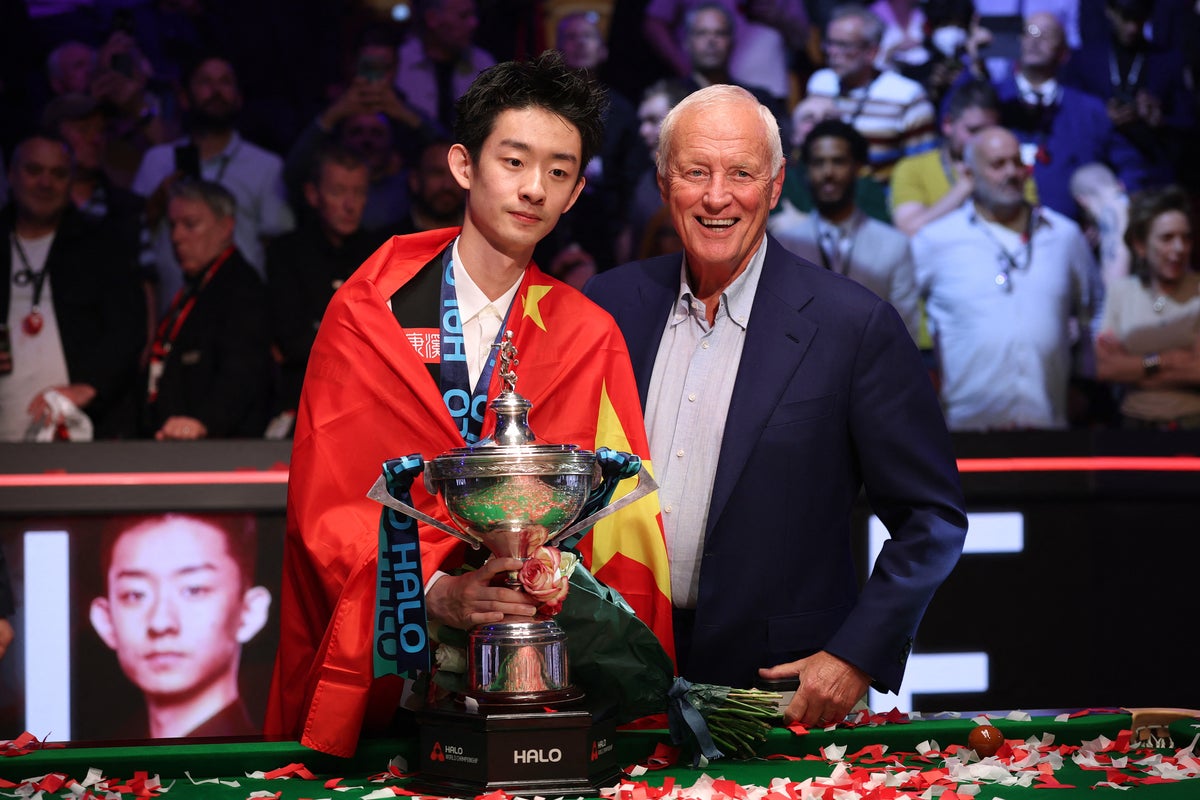
Petrov’s, admittedly caveated, proclamation will still be possible for at least another year thanks to Wu Yize’s incredible 18-17 victory over Shaun Murphy in a Crucible final for the ages.
Having fruitlessly toiled in search of a world champion for two decades in the wake of Ding Junhui kickstarting the Chinese snooker boom with his 2005 China Open success, much like Sheffield trams, two have now come along in quick succession after Zhao Xintong’s historic success 12 months ago.
Petrov’s claim may have been exaggerated but Wilson’s 2024 Crucible triumph as a Brit is certainly on track to become an exception rather than the norm.
Wu’s victory launches him up to fourth in the world rankings meaning Judd Trump is now the only Brit in the top four, while there were a record 11 Chinese players in the 32-man field at the Crucible this year. A quick glance down the world rankings shows streams of young Chinese players slowly climbing the ladder with a further conveyer belt of talent queuing up behind to turn professional.
Years of investment from the Chinese government, combined with outreach from governing bodies WST and the WPBSA, mean there are now more than 300,000 snooker clubs in China, while the first snooker academy was set up in Beijing in 2013 and snooker is at the centre of sporting culture.
The revolution has begun and it will very much be televised.
“The thing is, a wonderkid pops up but there’s 20 or 30 of them now,” said an admiring Murphy after the world final. “Maybe there’s more.
“You can see with the investment that the Chinese government has made into snooker for the last 10, 15 years, you can see the fruits of it now. We had Xintong last year, we’ve now got Wu Yize this year. It’s great for snooker out in China but it would be lovely to see that kind of investment mirrored in the UK.”
That wish may be a pipedream. There are now just 15 remaining locations of the famous snooker club chain Rileys, down from a peak of 165, while Sport England figures show that the number of over-16s playing snooker at least once a week dropped from 112,600 to just 47,700 between 2005 and 2014. There is no suggestion things have improved much since.
The British government were crucial in securing funding to renovate the Crucible and keep the World Championship at its spiritual home until at least 2045. But to expect grassroots snooker to receive meaningful dedicated funding in such a competitive sporting and cultural landscape, while all areas of society are struggling for money, feels like a long shot.
Not that the powers the be aren’t trying. “We’re lobbying government all the time over this,” says WPBSA chairman Jason Ferguson. “And we are keeping our clubs open because they are buildings of community interest.”
Yet Murphy is convinced young British players could still do more to bridge the growing gap to their Chinese counterparts.
The remarkable story of Wu and his father upping sticks from Lanzhou in China to move to Yorkshire when the new world champion was just a teenager and living in a tiny windowless room, sharing a bed, for two years as that’s all they could afford may be on the more extreme end of the rags-to-riches spectrum but the work ethic on display by young Chinese players at both the Ding Snooker Academy and Victoria’s Snooker Academy in Sheffield is certainly replicable.
“We’re seeing this wonderful talent coming through but talent does nothing without hard work,” mused Murphy. “You must give all the players from China absolute credit for the amount of graft and hard work they put in.
“You hear the stories about Wu Yize coming over here with his family living in a room without any windows. I think some of the British players could do with taking a leaf out of their book and just realising that if they think they’re working hard they’re probably not.”
Not that there’s a complete dearth of homegrown talent. The Yorkshire duo of 19-year-old Stan Moody and 20-year-old Liam Pullen both impressed in their Crucible debuts this year and are typically seen as the standard-bearers for the younger generation.
Meanwhile the excellent coverage of snooker in Europe by Eurosport over the past 15 years has helped players begin to emerge from previous snooker backwaters. Antoni Kowalski became Poland’s first-ever player at the Crucible this year, his compatriot Michal Szubarczyk is the youngest player on tour at 15 and the likes of Artemijs Zizins (Latvia) and Iulian Boiko (Ukraine) are showing real promise.
“I think the two Yorkshire lads [Pullen and Moody] conducted themselves amazingly well and of course Kowalski, he did so well on his debut,” added Murphy.
“They’ve got great futures ahead of them and I don’t think Xintong or Wu Yize or other players like that have got any shots that those players haven’t got. The younger players are going for their shots, they’re playing what they see, they’re just attacking the game. It’s entertaining, it’s exciting to watch. I like watching it.
“Wu and his countrymen are exciting, they are the future of the game. My class of [turning pro in] 1998-99, it is the guys coming behind us that are going to have to put up a fight.”
The 43-year-old Murphy alludes to the problem of a lost generation that a brief examination of the world rankings reveals.
Britain’s own snooker boom in the 1980s led to a golden age of talent that defined the game for the next 30 years starting with Stephen Hendry, leading to the remarkable ‘Class of ‘92’ of Ronnie O’Sullivan, John Higgins and Mark Williams, who are still right near the top as they enter their 50s, and then to the slightly younger Murphy cohort where the likes of Mark Selby and Australia’s Neil Robertson also reside. Trump serves as a sort of bridge beyond that but the drop-off afterwards is stark.
World No 8 Wilson is the only Brit born in the 1990s currently in the world’s top 12, there are only seven in the top 40 and he’s the only one to have won a triple crown event (the World Championship, UK Championship and Masters). Those homegrown players from the ages of 26 to 36 should be in their snooker primes and dominating the sport but instead they’re an endangered species.
The reasons for this are multi-layered and far too complex to go into here – a PHD thesis would be more the place – but lack of investment leading to the decline of the British amateur scene, football’s total supremacy in the sporting consciousness, the rise of video games and social media and the relentless expansion of the middle class all have a role to play.
The chances of there never being another British world snooker champion are effectively nil and the green shoots of extraordinary talent will always find a way to push through but the Chinese snooker juggernaut is undoubtedly now on a different level.
Perhaps Murphy is right and hard work can help young British players get closer to the top but they will always be fighting a snooker system that has shifted to the east.