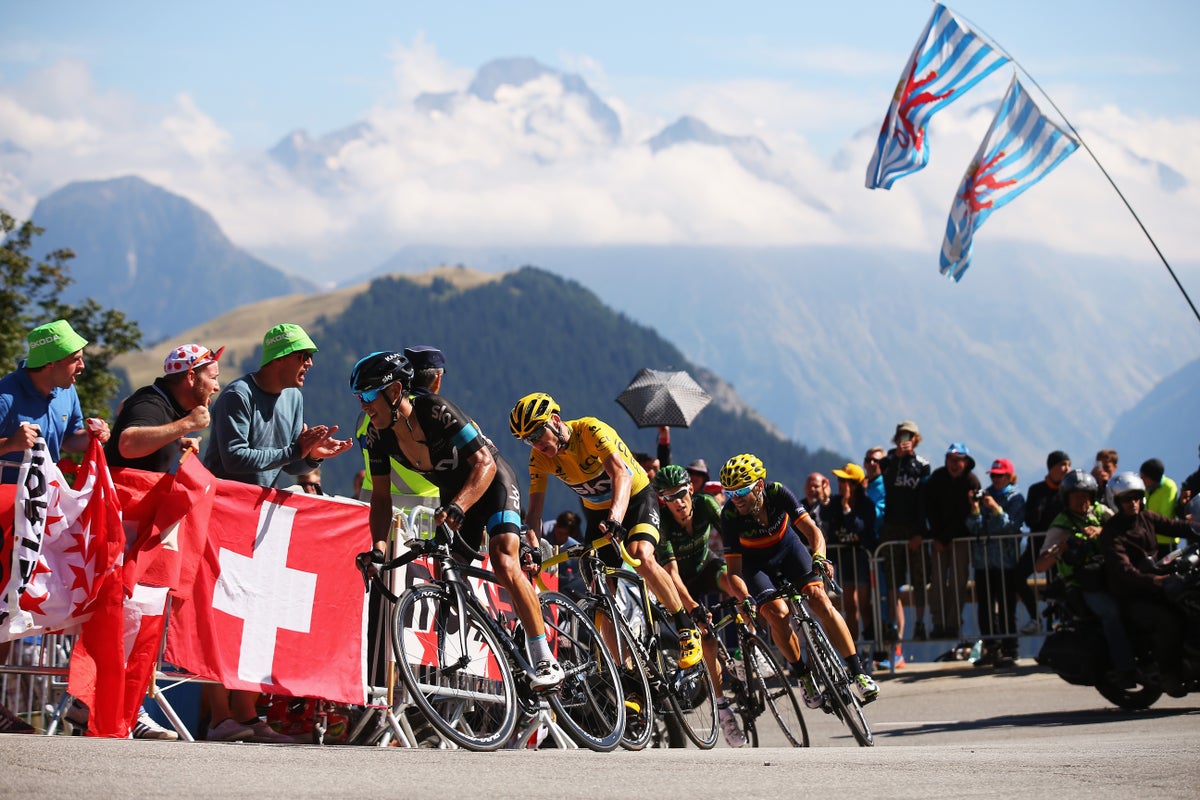
The 2026 Tour de France will meet the famous 21 hairpins of Alpe d’Huez on Friday, in the first of two back-to-back days scaling the famous peak. But it is the second journey, up the lesser travelled Col de Sarenne, which has provoked protest, a petition and criticism of race organisers.
The route for this year’s Tour was announced at a Paris ceremony last October. Saturday’s stage 20 immediately stood out, partly as a rare double ascent of Alpe d’Huez, perhaps the most famous mountain in Tour de France lore; and partly because the stage is brutal in its own right. It features 5,000m of elevation gain over four Tour behemoths: the Croix de Fer, the Col du Telegraphe, Col du Galibier, and finally the Col de Sarenne – the eastern back road up the Alpe – before an undulating final 14km to the finish, via the final four hairpins of the traditional route.
The Col de Sarenne is an unusual pass for the Tour to tackle. This is the first time it has been used as an ascent, after it was used once as a descent in 2013. The debate back then was about rider safety, with sheer drops either side of the narrow, uneven path near the top, and hay bales were hastily planted along the road’s edge to protect a disgruntled peloton.
Ahead of this year’s return to the Col de Sarenne, environmentalists have led protests against race organiser ASO and its decision to send the world’s biggest bike race over the Sarenne pass in the Ferrand Valley, part of a national park and an ecologically sensitive area.
A petition which garnered more than 15,000 signatures called for the stage to be re-routed away from the “beautiful and wild” area, which the petition stresses is home to numerous animals including stoats, marmots, foxes, chamois, eagles, bearded vultures, ptarmigan, rock partridges and the rare black grouse, whose chicks hatch in July.
The petition’s author, an environmental activist and writer aptly named Matthieu Stelvio, writes: “The Col de Sarenne is one of those beautiful and rare places where you can still breathe pure air … The organisers of the 2026 Tour de France want to transform the Col de Sarenne into the world’s largest stadium.”
He also highlights concern over cycling tourists drawn to the route by the Tour’s coverage, and warns that on the day of the race itself, “rare and fragile flora” could be “trampled by the crowds, perhaps even crushed by hundreds of vehicles, hundreds of tents.”
He wrote: “Is this really the place to organise an event that could gather as many spectators as 10 Stade de France stadiums?”
While that estimation may be a little high – a stage on Alpe d’Huez typically draws around 300,000 fans to the mountain – there is no doubt that the Tour de France is one of the world’s most environmentally damaging sporting events, both in terms of its local impact and its overall carbon footprint.
The Tour is far more than just 180 cyclists – it’s an entire carnival with all manner of vehicles tracking the race everywhere it goes. Team staff, broadcasters, journalists, camera crews and sponsors travel with the peloton in hundreds of support cars, trucks and lorries, while a helicopter whirs overhead. That all comes after L’Etape, where thousands of amateur cyclists take on the Tour route a few days before the professional peloton.
Then there are the fans, who drive to the race and fill the roadsides several deep for hundreds of kilometres. This is one of the unique elements about the Tour de France, when the side of an Alpine mountain is transformed into a sporting colosseum, full of noise and chaos, smoke filling the air. Where else can fans get so close they could reach out and touch their sporting heroes in the heat of battle?
But the race puts pressure on the local environment, and locals are concerned by the impact on an area not usually visited by the Tour de France. The Alpine National Botanical Conservatory said: “The faunal diversity [of the Ferrand Valley] is remarkable … the excellent state of conservation of most of the natural habitats … which are relatively undisturbed … allows for the survival of rare animal species.”
In the past, organisers have occasionally placed restrictions either on where spectators can stand or which vehicles can access areas of environmental concern. The Independent has contacted ASO to ask whether it considered the environmental concerns of stage 20’s route, and whether it has put any special measures in place, but has not received a reply.
A similar petition during last year’s Vuelta a Espana was successful in forcing organisers to ban spectators from the final kilometre of the Bola del Mundo climb. The Spanish grand tour is organised by Unipublic, a subsidiary of ASO. But ASO has ignored calls to reroute its unusual stage 20, and the Tour appears to be going ahead as normal atop the Col de Sarenne.
Despite winning plenty of support, petition writer Stelvio has given up hope of deterring the peloton’s arrival this weekend. He wrote: “What do we want to leave to future generations? A planet of steel and concrete? Isn’t it time to say stop to those who want to defile what we hold most dear? NATURE IS NOT A STADIUM.”