Resplendent in red in the memory of Ruth Strauss, the rain relented on Friday to leave Lord’s looking a picture. A phased redevelopment of this ground is well underway, the Allen and Tavern Stands being brought up to standard to provide more modern touches alongside the grand old pavilion facade. The outfield has been relaid, preserving the famous drainage and familiar slope that provides an idiosyncratic challenge for each and every visitor.
It is, then, a shame the most important 22 yards in this grand old sporting cathedral has fallen short of those standards in this first Test of the English summer. Across the opening two days, this tawny strip of turf has caused all manner of problems for even batters of the highest quality, peril and potholes at every turn like a country lane. A rain-curtailed day one brought 16 wickets; day two 17 more as this game hastens towards a conclusion. A second strike for Gus Atkinson from Friday’s final ball left New Zealand three down and 218 behind – Edmund Hillary may struggle to climb this mountain.
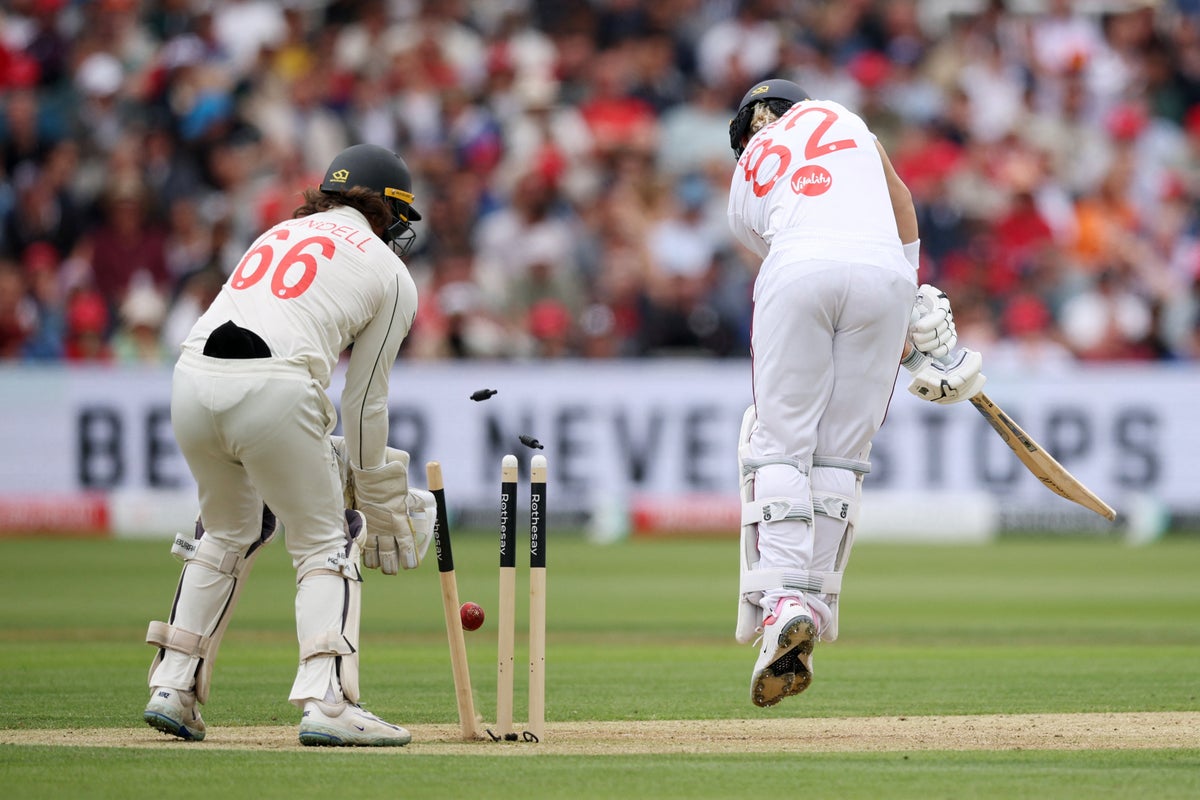
An iffy Saturday forecast could yet take the encounter into day four but there will be refunds to be issued, and questions to be asked over the surface. If the fact that the opening ball of the Test had failed to carry to Tom Blundell had provoked concern, then the delivery that dismissed Jacob Bethell on this second day was damning evidence against a pitch likely to draw a bad mark from the ICC, burrowing beneath the batter’s blade from back of a length. It was a moment that arrived just 97 overs into the Test; Jamie Smith could later feel similarly unfortunate.
Clearly, pitch preparation is an inexact and tricky science – particularly in this strange string of seasons that has oscillated from too wet to too dry and back again. Lord’s, too, has greater difficulties than some grounds in the sheer volume of cricket it has to host – even with the MCC exploring Wormsley as a regular alternative venue to fulfil its fixture list.
But the owners and operators of this ground know they have an issue. Slow surfaces for the World Test Championship final and England’s encounter with India last year had already prompted a rethink, with consideration given to the possibility of Australian-style “drop-in” surfaces at the ground. A novel steaming technique, previously used on the grass courts at Wimbledon, has been employed to try and add life and improve the health of the square. Time will tell if it is effective; the early impressions are not positive.
It may yet flatten out over the weekend, rain notwithstanding – South Africa chased a sizeable total of 282 in that final last year, while England made 279 in the fourth innings in this fixture four years ago. There will be concern, though, that this is the first of three Tests at the ground this summer, with England’s women hosting India in July before the men take on Pakistan late in August. A more compelling contest between bat and ball, and a game that extends deeper, is surely a must for each.
Not that the two days of cricket have been boring. England are firm favourites to wrap up a winning start to the summer but do not count out New Zealand if the sun shines on Sunday. A well-compiled, and highly valuable, half-century on debut from Emilio Gay, and late runs from Jamie Smith and the tail, showed that hay can be made at times – though the task facing the tourists is mighty, despite figures of 6-70 for Nathan Smith.
One wondered what impact a brighter morning might have on the suitability for scoring; it took just seven balls and a clunk of off stump for that query to be answered. Glenn Phillips was Josh Tongue’s victim playing down the wrong line. At least he played a shot, though New Zealand’s Smith was not the first to make an error of judgement in this Test and could argue that Tongue’s nip-backer came a long way down that slope.
Only some merry heaving from Kyle Jamieson’s long levers took New Zealand past 100, before Gus Atkinson and Ollie Robinson, completing his five-for, finished things off with New Zealand 27 in arrears to England’s 140.
Clearing skies had left the best batting conditions of the Test, though, and England made good use. Ben Duckett and Gay measured their opening gambit of 52 nicely, before the former steered to gully, and Jacob Bethell picked up thereafter, combining in a contribution of 47 with his fellow left-hander. They had some help – Bethell survived a review on umpire’s call in the same over that New Zealand had failed to send an LBW shout on Gay upstairs that would have returned three reds. A Bethell edge that parted first and second slip was further cause for Kiwi consternation.
It never felt, though, that wickets were far away – though a collapse of four wickets for one run was dramatic even by a Test of Hitchcock-ian twists and turns. After Bethell’s moment of misfortune had broken the stand, Gay, Harry Brook, Joe Root and Ben Stokes fell in the space of 11 balls as New Zealand’s seamers wisely brought the stumps into play. “It is a pitch that rewards you if you stick on a good length,” seamer Smith said after completing his six-for.
The wickets falling as they did was a passage that showed the value of the measured manner in which the opening pair had played. Useful knocks from Jamie Smith (39) and Robinson (29) left a chase of 254 and an intriguing last hour. Tom Latham played little part in it, loosely driving and edging to Brook at second slip for a three-ball duck, while the departure of Kane Williamson ten minutes before the close felt a major blow. Nightwatcher Will O’Rourke followed soon after – England need seven more for victory on a pitch that may well help them there.