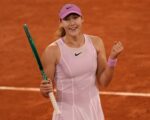
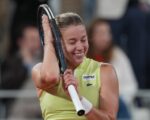
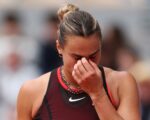
The women’s French Open finals will feature the eighth seed and the world No 114, who came through qualifying on a storming run into the final.
Poland’s Maja Chwalinska has won nine matches in a row, including three in Roland-Garros qualifying, to make her maiden grand slam final – and has made history in the process.
She is the first player to go through qualifying to make the French Open final, and only the second to ever make a grand slam showpiece as a qualifier, after Emma Raducanu at the US Open in 2021.
She is also only the second woman to reach the semi-finals in Paris as a qualifier, after Nadia Podoroska in 2020.
Chwalinska came through the junior ranks playing doubles with compatriot Iga Swiatek, who has since risen to the top of the sport and won six grand slam titles, including four at Roland-Garros.
But this time it is the much lower-ranked Chwalinska who is the last Pole standing on the clay – having only one won grand slam match before this tournament, when she beat Katerina Siniakova at Wimbledon four years ago.
Her stunning run has evoked memories of Raducanu’s fairytale run from qualifying to the title in New York in 2021, and provided a second feelgood story in successive years after home favourite Lois Boisson’s run to the semis in Paris last year.
Who is Maja Chwalinska?
Born in Miechów, 40km north of Krakow, Chwalinska was a talented junior doubles player, reaching the girls’ doubles final of the Australian Open in 2017 alongside Swiatek.
She made her senior grand slam qualifying debut at the Australian Open in 2020, before taking an indefinite break from tennis after a first-round defeat in qualifying at SW19 in 2021, revealing that she had suffered from depression.
Then aged 19, she associated tennis with “pressure, stress and crying”, and did not know if she would ever return to the sport.
But after moving back to live with family and seeking professional help, she rediscovered some enjoyment in the sport and returned after four months.
“The results don’t define me as much as they did before,” she said. “I just couldn’t differentiate [between] Maja and the tennis player. I was just one. I just needed time to kind of figure it out, and also do something else, not just tennis.”
This French Open is only her third major tournament ever, but she has beaten a string of top players, including 2024 Olympic champion Qinwen Zheng, 23rd seed Elise Mertens, and former world No 3 Maria Sakkari. All but one of her matches so far have been won in straight sets.
Prior to this French Open she had never beaten a top-50 player; now she has four scalps to her name and counting. She will now shoot up into the top 50 herself off the back of these results.
Due to her ranking Chwalinska primarily plays on the lower-tier ITF and WTA 125 Tours, winning titles at the Florianópolis Open, Brazil; Montreux, Switzerland and most recently in Oeiras, Portugal. All three of her 125 titles have come on clay, while she has also reached five doubles finals on clay, winning three of those.
At 5’5” Chwalinska lacks the height and power of some of her opponents, but the left-hander plays a wily, crafty game, mixing drop shots and slices with looping moonballs and killing the pace of the ball to stifle opponents and break up any rhythm.
She told the WTA: “I know that I’m playing different tennis than most of the girls on tour. I don’t have the [physical] conditions to play strong, so I need to develop a different kind of weapons for myself. I definitely played differently, and I think it helps me a lot against these players.”
She told reporters after that win: “I just try to change the rhythm a lot. I feel like it’s pretty tough to play against this kind of style, because you don’t have any rhythm, and you just need to be very focused because every ball can be different. I’m aware that it can be very annoying for other players. I just try to use it as much as I can.”
The tactic worked excellently against 22nd seed Anna Kalinskaya in Wednesday’s quarter-final, with the Russian struggling to break down her defence and find any momentum. Windy conditions on Court Philippe-Chatrier also played in Chwalinska’s favour due to the spin and variety in her game.
Chwalinska raced to 5-1 up in the first set before being broken back for 5-2 and again for 5-4, and demonstrated her mental resilience too after Kalinskaya levelled proceedings at 5-5. Chwalinska ultimately prevailed in the tie-break and held off another fightback by the Russian in the second set, coming out on top after 12 breaks of serve in a tense encounter to win 7-6 6-3 and reach the last four.
“I honestly don’t know what’s going on,” she said afterwards, looking amazed. “Every single match here is crazy.”
She went on to defeat 25th seed Diana Shnaider 7-6(4) 6-4 in an electric semi-final, before collapsing to the clay in disbelief and crying into a towel.
Asked how she felt being a major finalist, she said “Like a dream, honestly. I don’t know what’s going on. I don’t know what to say, I’m just very happy.”
Mentally and physically she said it had been a “challenging” three weeks. “I mean, not great. It’s challenging, but it’s a grand slam, so you’ve just got to give your all and more. I’m not complaining at all.”
She will play Russian Mirra Andreeva, also a first-time grand slam finalist, in Saturday’s showpiece.