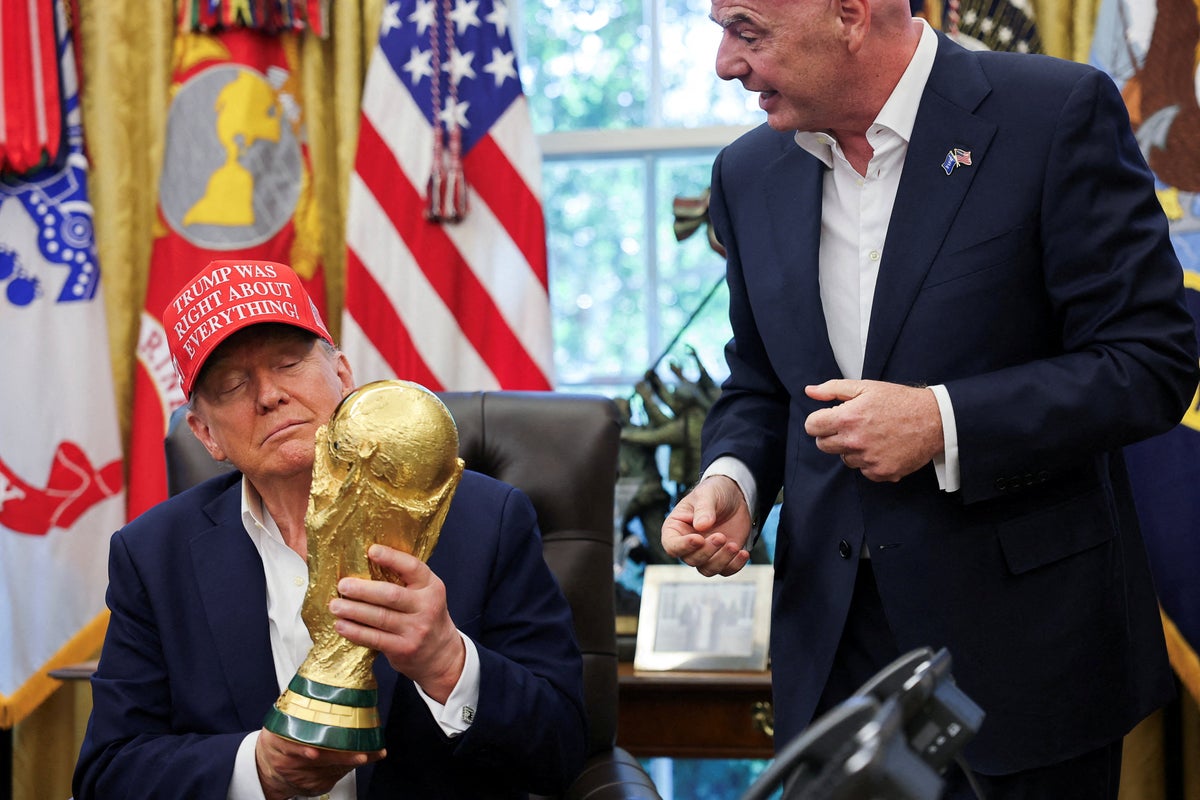
The United States’ World Cup campaign took an extraordinary turn on Sunday when FIFA made the unprecedented decision to suspend Folarin Balogun’s automatic red-card ban, clearing the striker to face Belgium in Monday’s last-16 clash after U.S. President Donald Trump personally urged FIFA President Gianni Infantino to review the case. T
he move thrust FIFA’s disciplinary process into the global spotlight, prompted an angry response from Belgium and ensured that one of this tournament’s biggest talking points would centre not on tactics or team selection, but on the relationship between football’s governing body and political power.
Within minutes, the decision had ignited one of the tournament’s biggest media storms, dominating sports bulletins and talk shows as pundits, commentators and former players argued over whether FIFA had upheld justice or undermined its own rules.
As questions mounted over the circumstances surrounding the decision, FIFA did not respond to multiple Reuters requests for comment about the decision and Trump’s call with Infantino. Balogun scored his third goal of the World Cup in the 2-0 win over Bosnia and Herzegovina but was shown a red card in the second half for planting his boot into the ankle of Tarik Muharemovic. The 25-year-old was sent off after a VAR review, with U.S. coach Mauricio Pochettino saying it was never a red card offence. Trump called Infantino to ask world soccer’s governing body to review the sending-off, according to a source briefed on the call.
FIFA is allowing Balogun to play without rescinding the red card.
“In line with article 27 of the FIFA Disciplinary Code, the implementation of the match suspension is suspended for a probationary period of one year,” FIFA said in a statement.
What you need to know about Article 27:
* Article 27 allows FIFA to suspend the implementation of a disciplinary sanction.
* The sanction itself remains in force but does not have to be served immediately unless the suspension is later revoked.
* The article allows FIFA’s judicial bodies to suspend the implementation of all or part of a disciplinary sanction.
* However, the code does not mention the circumstances in which a judicial body may decide to suspend a sanction.
* FIFA’s judicial bodies include the Disciplinary Committee and the Appeal Committee.
* The sanctioned player is then placed on a probationary period of between one and four years.
* If the player commits another infringement of a similar nature during the probationary period, the suspended sanction is automatically reactivated in addition to any new disciplinary sanction.
* Balogun’s match ban was suspended for a probationary period of one year.
* The only disciplinary measures that cannot be suspended are those related to match manipulation.
* The Disciplinary Committee is composed of a chairperson, a deputy chairperson and additional members. The chairperson and deputy chairperson must be qualified lawyers.
* The Committee takes its decisions in the presence of at least three members.
* Mohammad Al Kamali of the United Arab Emirates is currently the chairperson of the Disciplinary Committee.
* Committee members are elected by the FIFA Congress for terms lasting four years and for a maximum of three terms.
* Article 27 was previously Article 26 when the Disciplinary Code was updated in 2019. It became Article 27 in 2023.