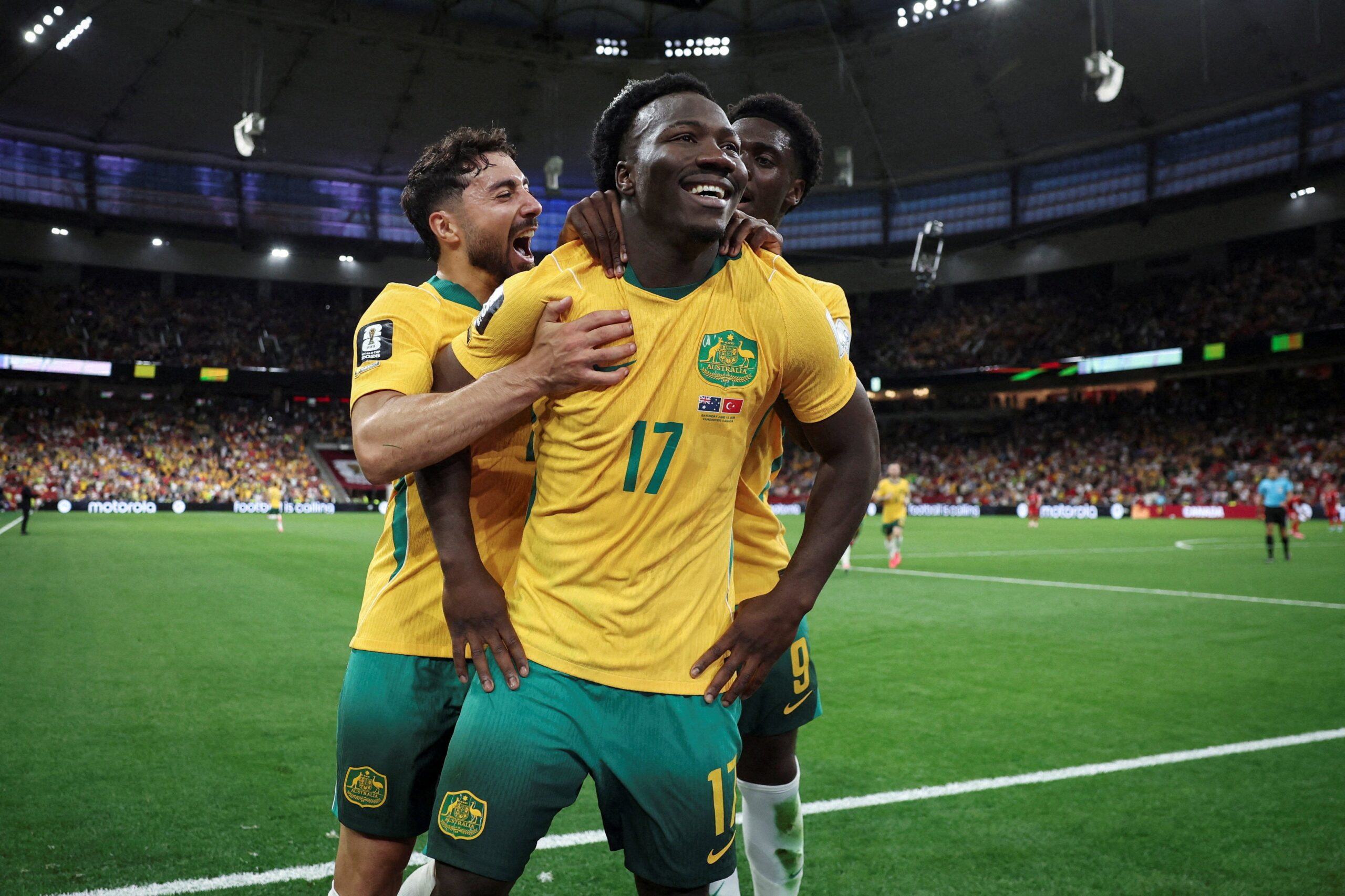
On Thursday, Australia and Paraguay will clash in each team’s final group game of the World Cup 2026, with automatic qualification up for grabs for one of them.
Australia started their Group D campaign with a 2-0 win over Turkey, while Paraguay fell 4-1 to co-hosts USA. Then, on gameday 2, Australia were beaten 2-0 by USA, while Paraguay saw off Turkey 1-0 despite going down to 10 men.
Due to a change in rules for this World Cup, the second deciding factor in the final table of a group (after points of course) is the head-to-head record between teams – not goal difference, as was the case in previous years.
With this in mind, USA have already sewn up top spot and qualified for the knockout stage, and Turkey have already been eliminated, ahead of the tie between those nations on Thursday.
But what of Australia and Paraguay?
One of these two teams will advance as the second-placed side in the group, while the other will have to hope they are one of the best eight third-placed nations at the tournament.
In other words, the winner between Australia and Paraguay would qualify for the knockouts for certain (on 6 points), while the losers’ fate (3 points overall) would only be clear by the end of the group stage.
However, if the game were a draw, Australia and Paraguay would both finish on 4 points, with goal difference finally coming into play. Given Australia’s is 0 and Paraguay’s is -2 – with these remaining the same in the case of a draw – Australia would qualify in second place ahead of Paraguay. As such, Paraguay would be left waiting on other results, to see if they were one of the eight best third-placed teams. It is very possible that 4 points would be enough for them.
Head-to-head prominence over goal difference
If teams finish on the same number of points their standing in the group will be determined by the head-to-head record against the nation they are level with. If one team tied on points with another has beaten them in the group stage, the winners will finish higher up the table.
Where multiple teams are level on points, a mini-league is created, removing the results against the remaining teams. Those tied teams are ranked by points won in the games involving each other, then by goal difference, followed by goals scored. If that does not split them, the next criteria is goal difference followed by goals scored for the group overall.
Any other tiebreakers?
If teams are still level on points following head-to-head results, goal difference and goals scored then the Team Conduct Score (TCS) comes into play. It is basically a fair play score and is rated based on the amount of cards a team has collected. Each team, including managers and backroom staff, started on zero and were deducted points throughout the group stage as follows:
- Yellow card -1
- Red card for two yellows -3
- Straight red card -4
- Yellow then straight red -5
The closer to zero, the better the score. If the teams are still level, whoever had the higher Fifa ranking in June’s published update will go through.
How are the top eight third place finishers determined?
The top eight third place finishers will be decided on which teams have accummalated the most points.
Should eight or more nations finish third with the same number of points, the nations who progress will then be determined by goal difference.
In all likelihood, teams that finish third with four points or higher will go through, the teams on three points will need the best possible goal difference to progress.