The article below is an excerpt from the free Monday edition of the Miguel Delaney: Inside Football newsletter. To get my latest analysis, reporting and insights delivered straight to your inbox, sign up by entering your email address in the box above.
Members of Inside Football and Independent Premium subscribers get an extra bonus edition every Friday. Become a member at just £3 for three months here.
You could immediately see the frustration, and it was more than just Liverpool struggling to break through. As Slot’s side suddenly had to chase, and were looking to find any kind of opening around the City box, a good interchange of passes put Ryan Gravenberch on the ball just outside the area. The midfielder clearly wanted to move it out to the obvious space on the right… but there was no one there.
Mohamed Salah maybe would have been, but he was already in that morass of players in the box. Szoboszlai maybe should have been, given that he was the notional right-back, but he had already drifted inside to a more natural central position at this crucial moment.
You could see Gravenberch’s irritation as he had to play the ball back to the Hungarian, since it completely ended the energy of the move.
Gravenberch just had no choice, but that itself was a consequence of much bigger choices that Liverpool made long before this game.
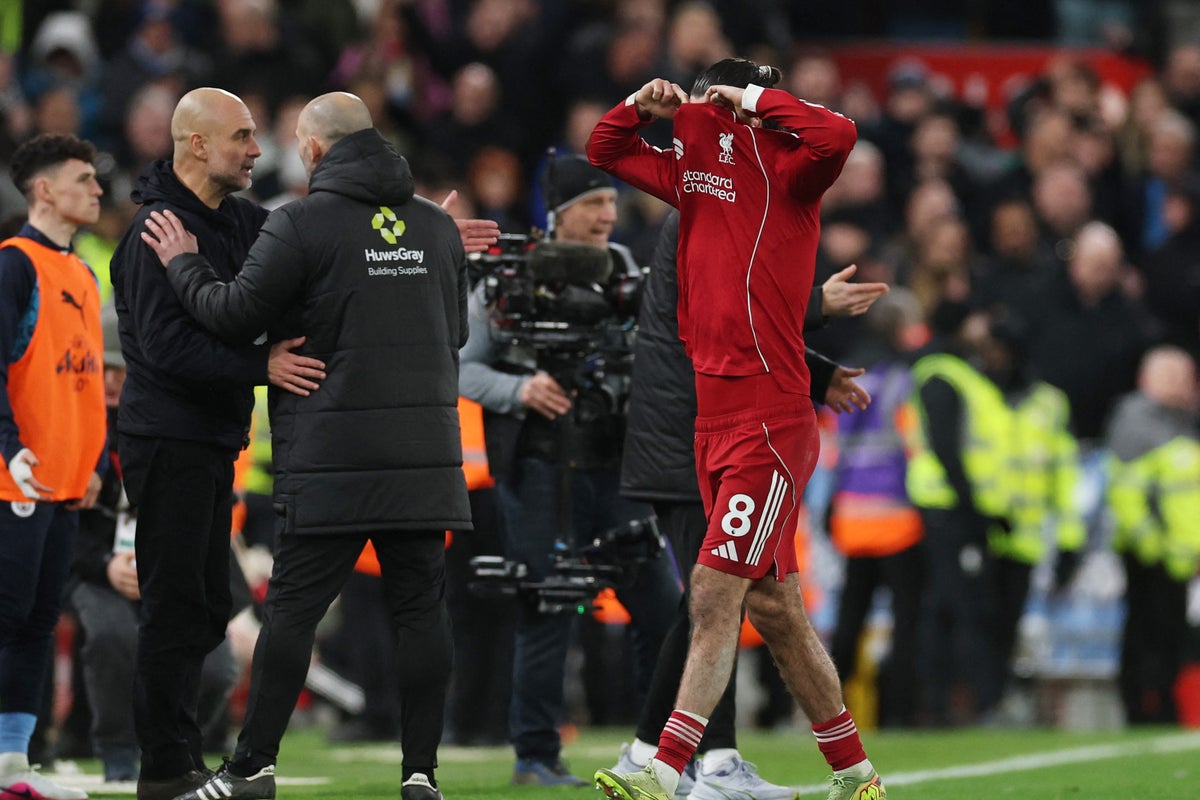
Those choices were also far more relevant to the outcome, and what is happening with the Premier League, than the absurd VAR decision that ultimately saw Szoboszlai sent off and Liverpool lose 2-1 rather than 3-1.
Who knows, mind, maybe that spare goal may be decisive in the title race or chase for the Champions League places. But much of that will be dependent on other outcomes from this game, which may be dependent on other choices within it.
I feel I should – and not for the first time in this newsletter – place on record the sense of tedium I feel any time VAR must be discussed.
Talking about it is arguably the only thing worse than waiting for a decision – and yes, I am fully conscious of the deeper effect on how the game is played and experienced. There are genuinely moments when it is all that most people are discussing and this is one of them.
Perhaps the most frustrating aspect of the whole episode was how the common-sense decision so jarred with the “letter of the law”. Yes, you could understand the basic logic of why VAR had to overrule the goal. Szoboszlai had impeded Erling Haaland, denying him a goalscoring opportunity, leading to Haaland himself impeding Szoboszlai in preventing Ryan Cherki’s strike going in, meaning the VAR had to back through the steps and the cause-and-effect of the moment.
It just seems so ridiculous when the supposed denial of a goalscoring opportunity still resulted in a goal being scored.
And yet such a contradiction is also a fitting reflection of the fundamental circularity of VAR. (There are times talking about this when you feel like The Architect in the Matrix Reloaded, if that isn’t by now a totally out-of-date reference). An increasingly broadcasted and digitised game could not cope with human error and the necessary subjectivity afforded to referees which leads to a “lack of consistency”, ultimately resulting in VAR. VAR itself is almost the inevitable conclusion of so much being broadcast.
And yet since VAR is designed to erode human error as well as the subjectivity that is actually required to make decisions without technological aid, it leads to a rigour that football also can’t cope with.
Forensic attention to detail, after all, is what is implicitly hardwired into VAR – and that on laws that weren’t written with such scrutiny possible. That’s how you get the “consistency” of a decision like Sunday’s, when everyone is crying out for common sense.
And let’s be blunt here: football is never going to be fully happy with either situation. VAR could go and the next great injustice would bring another storm about referees, which is why we’re here in the first place.
There are bigger discussions that could be had about how Fifa trialled it and implemented it – in what is almost a classic illustration of how the modern Fifa works – but none of it is as relevant to how the game went as the choices Liverpool faced. Or, in the case of that Gravenberch moment, the lack of them.
One of a few reasons why Liverpool had no option on that right side is because all of their main right-sided players are injured. Hence the Szoboszlai solution, although that now poses another problem since the red card means he’s suspended for Sunderland on Wednesday.
And that just exposes the next stage of this issue.
Liverpool ultimately have these issues because their squad is too thin, with not enough depth or tactical variability.
That may sound absurd given their outlay in the summer, but that’s another distinctive choice. I have written in this newsletter before that one of football chief executive Michael Edwards’ policies is for most of a club’s wages to go towards the starting XI, and for most of that to go towards the attacking talent that really make a difference, but it feels like Liverpool went too far with that in the summer. You can see it in some of the sales necessary to fund so many big purchases, and the lopsided squad they’re left with.
And yes, people might point to injuries, but that only proves the point.Elite football now has the busiest calendar it has ever had. No matter how good your physical programme – as Liverpool’s was last year – you just cannot bank on the same core players staying fit. Just as relevantly, you can’t continuously play them in this calendar. Any elite team needs what is almost an entire second XI.
This is exactly why Arsenal – and now City – have sought to build deep squads for this campaign.
Liverpool, at this crucial new moment, went in another direction.
You only have to consider Sunday’s constant discussion of the difference between the benches. And then Gravenberch having no option at that key moment. The Liverpool side wasn’t built for that.
While there are multiple fair criticisms of Slot’s attempted solutions to Liverpool’s various issues this season, too, this is another where he had been dealt a difficult hand.
From that, there was yet another direct effect in play, too. Playing Szoboszlai at right-back means Liverpool do not have their best midfielder – and, now, arguably, their best player – in the centre, and that in a game where the area is repeatedly being exploited.
Those gaps eventually told, despite a much better Liverpool second half.Slot’s side probably should have won the game, to properly turn their season, but that crucial difference in depth may now have turned it for City.
The reality of this performance was that Guardiola’s side played poorly, continuing the pattern of bad second halves that has characterised their season. There are still issues there. The pressing problems that other teams have spotted have not gone away.
And yet the potential of this result can be witnessed in the joy and defiance afterwards. It can have a multiplying effect. The players themselves spoke of how they thought the title race was over with a defeat. Marc Guehi had a supreme display, outside that yellow card decision for pulling back Salah. As has now become almost a mantra in elite Premier League dressing rooms, “momentum is everything”, and City now suddenly have it. Even more crucially, they have it ahead of a forgiving period in this schedule, that will allow them to build confidence and deeper tactical coherence.
There will have been understandable frustration at Arsenal, too. This could have been one of those hinge days, and it came down to a lot more than VAR.
Get Inside Football straight to your inbox
To receive the free, Monday newsletter simply enter your email address in the box at the top of this page.
You can also head to our newsletter preference centre to sign up for the email. Once there, all you need to do is press the ‘+’ button and enter your email address.
To unlock the Friday edition of Miguel Delaney: Inside Football and get full access, click here to become a member.