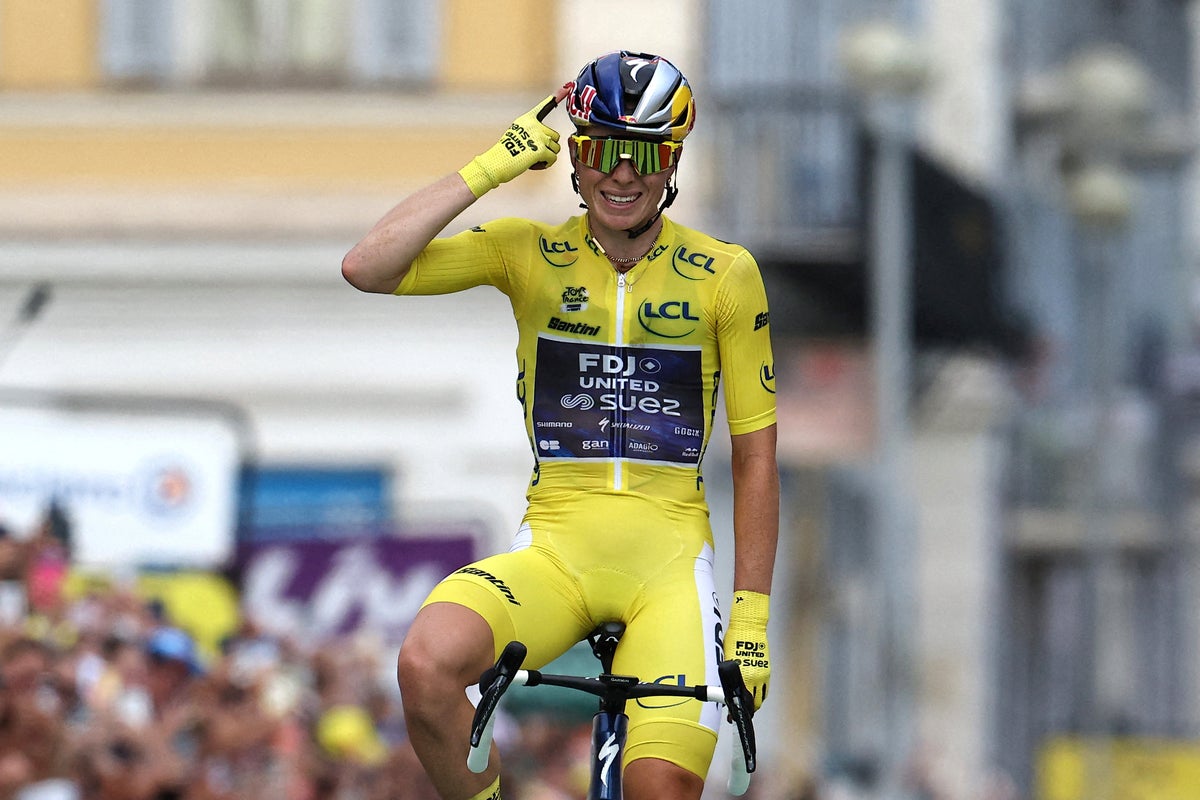
With 16km to go on the final stage of the Tour de France Femmes, Demi Vollering took off. The Dutchwoman timed her moment to perfection, attacking with 600m to go on the final of four ascents of the Col d’Eze, with Kasia Niewiadoma unable to cling on to her wheel. As she barrelled up the remnants of the climb and then down the descent towards Nice Vollering converted her minuscule eight-second advantage over the Pole to a minute and 18 seconds, with time to slow down before the line, soak in the moment, and lift her bike triumphantly overhead.
After nine days of agonisingly close racing, with momentum swinging this way and that, this was a tour de force by the sport’s premier stage racer, the deserving first winner of a landmark second Tour de France Femmes title. “Impériale,” was the verdict on L’Equipe’s front page.
It was a fitting end to a resounding success of a Tour – dramatic, cathartic, and magnified by moments of individual virtuosity. This year’s Tour de France Femmes has been an enormous coup for race director Marion Rousse, and for the sport generally. The Classics-style parcours, where nearly every day has resembled the most intense one-day races, coupled with the dynamics of the peloton and the fact that there are multiple evenly-matched teams rather than one all-conquering super-team, has made for an unpredictable and volatile race.
The fact that no singular team can entirely control proceedings has made for genuine jeopardy over whether breakaways will be brought back or able to seize their moment of glory – best emphasised by the heroics of Sigrid Haugset on stage three. The attacking, all-out nature of the racing, from Niewiadoma’s raid on Mont Ventoux to her team’s attempts to dislodge Vollering on stage nine, with Vollering responding with a devastating attack of her own, has made for thrilling viewing.
And the route design – back-to-back difficult, hilly stages – has made for near-constant general classification action, and a fitting winner. This year’s champion has been the best rider overall on an individual time trial (where she finished third), a gruelling summit finish (second) and tough medium-mountain stages (three stage wins, including on the final day).
Vollering and Niewiadoma have now both finished on the podium in every single edition since the race was reimagined in 2022. Year in and year out the pair have shown they are the most consistent and brilliant stage racers in the peloton, with their rivalry defining this era of women’s cycling, and providing a welcome counterpoint to the one-sided nature of men’s cycling this decade.
“Having a competitor like Demi just motivates me to get stronger,” Niewiadoma said, already turning her attention to next year’s Tour. “I know the Tour is finished, but I already feel like I want to message my coach and say: ‘We need to change this and this and this and this.’”
While there was drama and mud-slinging after stage eight, as Niewiadoma accused Vollering’s FDJ United-Suez team of dirty tactics in the fight for positioning before the final climb, that was later smoothed over. Vollering, too, made a point of attacking to win solo on stage nine. “I have to try to attack, and go alone, because I wanted to make it clear we didn’t win because of an incident yesterday,” the Dutchwoman said. “That’s not what I believe. I wanted to make it clear that we, as a team, deserve to win a beautifulTour de France Femmes with humility and pride.”
While there is evidently mutual respect between the pair, that drama, and Niewiadoma’s wounded pride, tees up an even bigger fight for next year’s maillot jaune.
Behind the established trio of Vollering, Niewiadoma and two-time Giro winner Elisa Longo Borghini on the podium, the next three spots in the top 10 were all taken by stars of the future: Niewiadoma’s primary lieutenant, Antonia Niedermaier, Vuelta Espana Femenina champion Paula Blasi, and French hopeful and former stage winner Cedrine Kerbaol. The peloton is continuing to develop and the number of genuine contenders on any given day is only increasing.
The race is still in its infancy – this is only its fifth year in the current incarnation – but it has already become established as the biggest race in the women’s calendar. It has become bigger and better year on year, from the inclusion of legendary climbs to the expansion in stages.
Rousse is acutely aware of the prestige that comes with the likes of Alpe d’Huez and Mont Ventoux, and how pivotal they are to the growing stature and significance of the women’s race. “We try to align with the most mythical summits,” she has explained. “They’re part of the history of the Tour and the history of the sport.” Niewiadoma’s astonishing ascent of Ventoux wrote yet another chapter in that history; another feat for fans to reminisce on down the years.
With the women’s peloton in rude health, a generational rivalry helming its most prestigious race and no shortage of drama or subplots, Rousse and ASO must capitalise on this moment. The logical next step is to expand the Tour de France Femmes, from nine days to two weeks, and to round out the route further.
How would the race have been different if the riders had had to tackle another day or two in the Alps after the exertion of Mont Ventoux? Or if there had been a mountainous time trial to contend with, up the likes of La Planche des Belles Filles, as well as stage four’s flatter test? How would the teams’ strategies have played out over a longer, even harder race?
Audiences and crowds at the roadside have thrown their weight behind the Tour de France Femmes. 2.17mi viewers watched the opening stage on France 2, representing a 27.6% share of the audience, compared to 2.7m viewers for the first stage of the men’s Tour, with a 30.1% audience share. The fact that the race is still not streamed live in full, with audiences missing the early salvos on multiple days, is another misstep to rectify.
Swiss rider Marlen Reusser, who led the race until stage eight and was unlucky to fall off the podium entirely after a crash on the last day, was outspoken in her response to critics of women’s cycling: “It’s proof that human beings aren’t always such a smart species.” That encompasses generations of Tour de France organisers, who repeatedly belittled the women’s race and resisted calls for an equivalent.
Rousse echoed Reusser’s thoughts: “Nobody asks if the women are good enough any more. They have proved themselves, they’re champions who have shown on the road and on their bikes that they deserve their place.” The runaway success of the Tour de France Femmes prompts just one question – why didn’t any of this happen sooner?