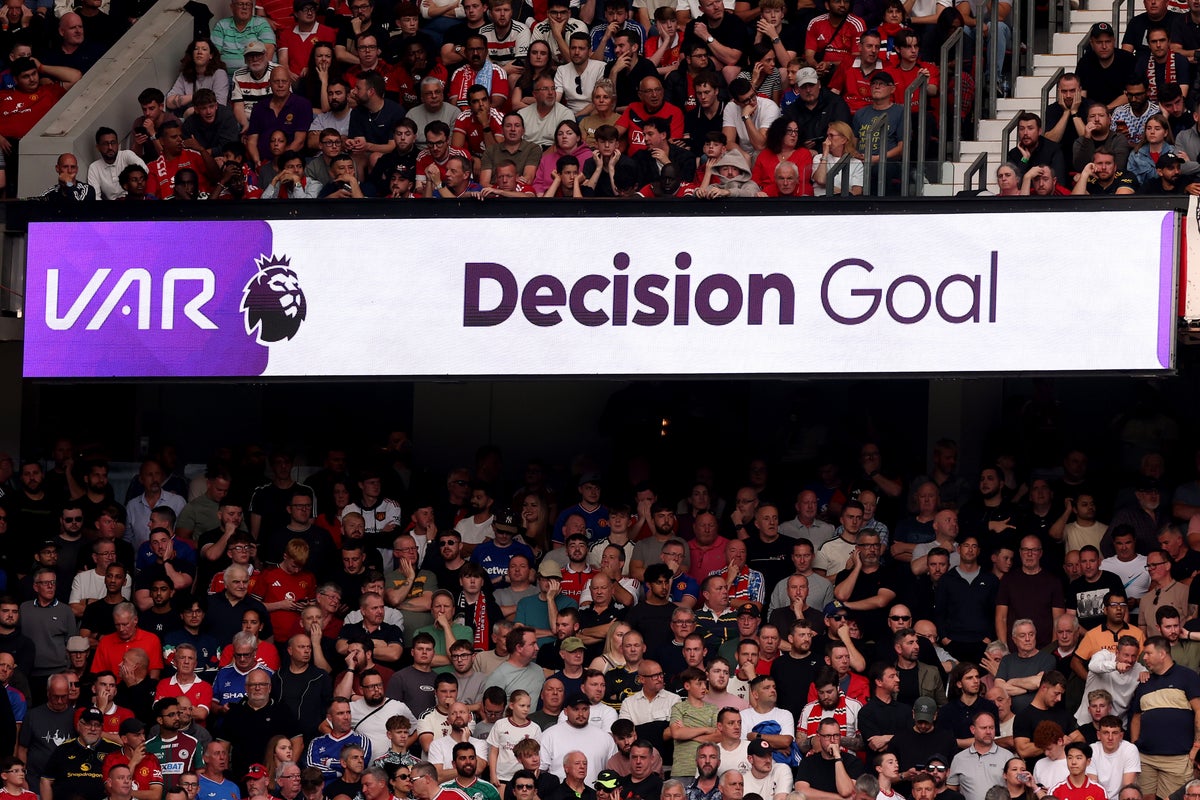
“I’m going to need the offside rule explained to me.”
No, these are not the words of many a football-illiterate significant other who was being forced to watch England vs Mexico at 2am in the summer. This is Gary Neville, a Premier League legend with 19 years of playing experience, plus another 15 years as a pundit, reacting in bafflement as Erling Haaland’s derby winner was allowed to stand.
His confusion was a shared experience nationwide. Somehow, someway, Enzo Fernandez was not deemed to be interfering with play or impacting his opponent when he flung himself at Josko Gvardiol’s cross from a blatantly offside position. The decision objectively went against Ifab’s laws of the game, which all top-level leagues adopt.
Beyond that initial moment of self-doubt, the fear that maybe we don’t understand football at a rudimentary level after all these years, we all quickly realised that was not the case. VAR had got it wrong; they’d seen black and called it white, again.
Within a few hours of full-time, Pro Ref (formerly PGMOL) recognised the “error of judgement” and confirmed they had contacted Manchester United, presumably with an apology.
“It was established that Enzo Fernandez did not play the ball and therefore that makes any offside offence subjective, however, on this occasion, the VAR did not recognise the likely impact of his position and should have recommended an on-field review,” read the statement. Unfortunately, we’ve heard it all before.
There were 25 VAR errors last season according to a report by BBC Sport, up from 18 the season before, as per the Premier League’s key match incidents (KMI) panel. Arsenal and Chelsea were the biggest beneficiaries, gaining from seven and eight errors respectively.
Six of these mistakes were for failing to issue a red card when it was warranted. There was an argument on Sunday that Bruno Fernandes also should have been sent for an early bath for instigating Phil Foden’s kick-out with a little kick of his own – though that was far less cut and dry with the later blunder, so didn’t require the “sorry without saying sorry” statement that we’ve become so familiar to seeing from the refereeing body.
It is not a hot take to pile on VAR. We are less than 18 months shy of the 10-year anniversary of the maligned technology first being implemented in England, and we still feel as lost as ever.
Every year, there is a new fix to get VAR usage right. We got semi-automated offsides in 2025. This season, there’s been more weight on the on-field decisions. There have also been tweaks to what can be reviewed, with second yellows now allowed to be scrutinised by VAR.
But these changes don’t seem to fix the fundamental problem with the technology: that those operating it keep making glaring mistakes. The whole point of VAR is to rectify these faults; in times like these, it feels completely redundant.
Is the solution really as simple as to learn the rules of the game? It feels like a cop-out to say that, but from the outside looking in, that remarkably seems to be a primary issue with officiating in this country.
Far too often are basic laws being disregarded or simply forgotten when reviewing game-changing incidents. If VAR and the process surrounding it was done right, this would never be allowed happen.
Instead, the same old story continues to play out week after week, month after month. With every grovelling admittance of an error, the Premier League’s reputation is hurt. It’s frankly embarrassing.
Referees are under an enormous amount of pressure. Mistakes never go unnoticed, even if your team emerges from it relatively unscathed. Mikel Arteta’s post-match rant following Arsenal’s win at Sunderland was a prime example of this, expressing his outrage at the officials for the decision to award Sunderland a penalty – which David Raya saved – while the match was still goalless.
“I’m so upset,” he said. “It’s unacceptable at this level. Unacceptable. This can change the course of a season, the championship.” Arsenal now want their own explanation from Pro Ref. Even in victory, a refereeing blunder will still be made the story; scrutiny in this role is relentless.
But Arteta has a point: basic errors can cost titles, and maybe even cost jobs. It’s why we continue to beat this dead horse, prolonging this eight-year-old VAR whinge, in an attempt to eradicate these errors from the game.
For now, we enter another cycle of error, apology, review. The outcome of that Pro Ref review will mean nothing to Manchester United who are now categorically enduring a bad start to the new season thanks to Haaland’s wrongly-awarded winner. Questions are already being asked of Michael Carrick after four points in four games.
The deflating fact of the matter is that United aren’t the first to experience this needless misery, and they definitely won’t be the last.