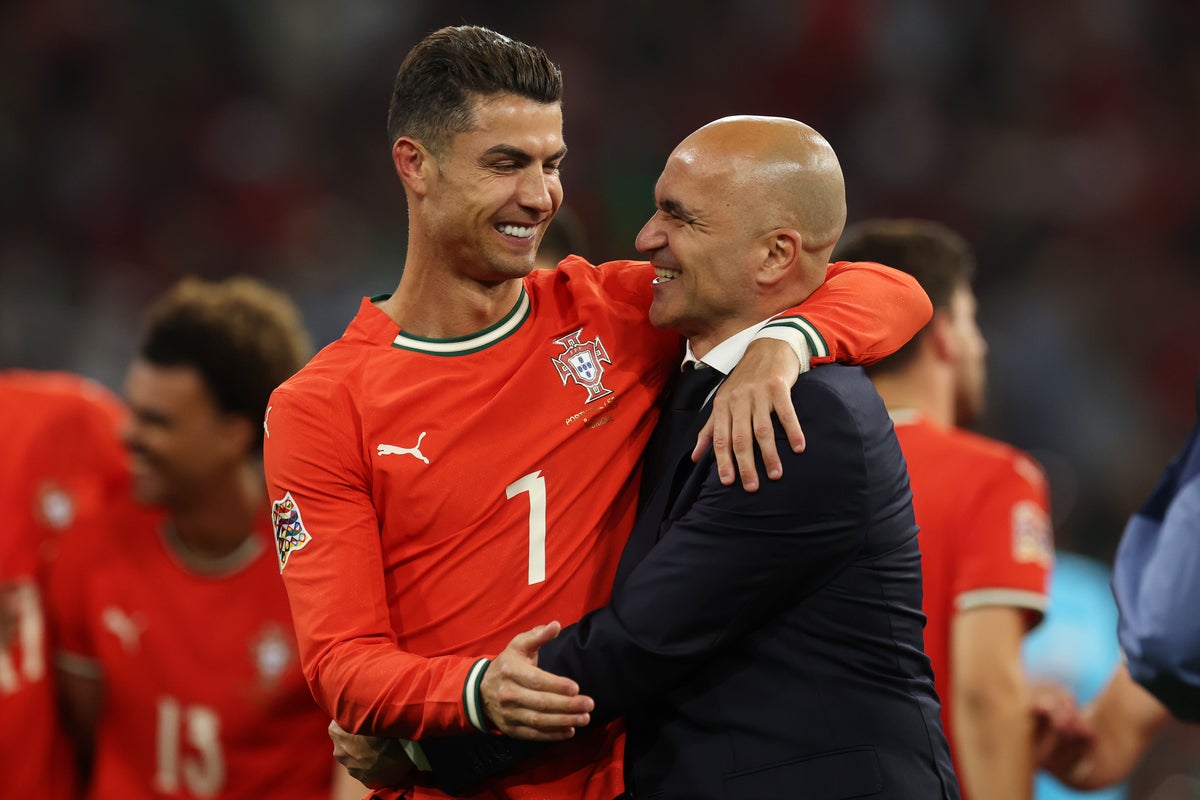
Cristiano Ronaldo, at 41, stands on the cusp of an extraordinary sixth World Cup appearance, a testament to a career that has consistently rewritten football’s record books.
Yet, for Portugal coach Roberto Martinez, the veteran captain’s age is merely a number, with his place in the national squad determined by current form and the same rigorous standards applied to every other player.
Martinez, speaking to Reuters in Lisbon on Thursday, firmly stated that Portugal is not carrying a monument to past glory.
“We manage the Cristiano Ronaldo that plays for the national team trying to get into the squad for 2026, not the iconic figure,” he explained, underscoring a pragmatic approach to squad selection.
The prevailing debate in Portugal centres less on whether Ronaldo, international football’s record scorer with 143 goals, merits a place in the squad, and more on the precise role he should fulfil when World Cup margins are razor-thin. For Martinez, the calculation is straightforward: Ronaldo the player is assessed solely on his contributions in training and to the team.
“Age is only a number,” Martinez reiterated. “Certainly in the national team we can measure exactly what’s happening on the day, and you make the decisions for the next day. You never look any longer than the next day.”
Addressing the question of how to best deploy Ronaldo in a World Cup where matches often hinge on substitutions, tactical shifts, and extended periods of play, Martinez argued that modern football has evolved beyond treating the starting lineup as the sole measure of status.
“Now we’ve got five substitutions. It’s almost like we’ve got a starting team and a finishing team. There is no distinction,” he said. “There are different roles and Cristiano has always accepted his role.”
The question of Ronaldo’s willingness to embrace a reduced role has lingered since the 2022 World Cup, when then-coach Fernando Santos controversially benched him against Switzerland following the final group match.
Martinez, however, declined to draw direct parallels between tournaments, emphasising that form, style, and context are constantly changing. He stressed that Ronaldo’s position, like that of every other player, rests entirely on merit.
“All the players are in the same space in the national team where when they play well, when they execute their role well to help the team to win, they have a better chance to play than when they don’t do it. It’s as simple as that,” he affirmed.
Martinez highlighted that Ronaldo is far more than a ceremonial presence. He pointed to the forward’s impressive tally of 25 goals in 30 Portugal appearances under his management – a superior goals-per-game ratio than under any of Ronaldo’s previous national-team coaches. He also noted that Ronaldo’s value extends beyond raw statistics, manifesting in crucial tactical details.
“He is fantastic at those movements, those runs, opening spaces, splitting centre halves,” Martinez observed. “He’s been disciplined to be in the right positions, always executing the attacking patterns that we have. And that gives him opportunities to score as he’s done, but the opportunity of opening space for our players.”
Martinez insisted that discussions about Ronaldo should not begin with his age, but rather with data, training performance, attitude, and tactical fit. He attributed Ronaldo’s remarkable longevity not only to his physical gifts but also to “that elite brain” and an unwavering daily pursuit of improvement.
What surprised Martinez most after taking charge was not Ronaldo’s aura, but his insatiable appetite for success. “Somebody that has won everything has the hunger of somebody that hasn’t won a trophy yet,” he remarked.
That enduring hunger, Martinez added, has cemented Ronaldo as “a very important figure in the dressing room, as a captain, as somebody that represents what it means to play for the national team”.
Martinez acknowledged that the public discourse surrounding Ronaldo will never fade, noting that “every taxi driver” has an opinion, even if they haven’t watched him recently. However, his own responsibility, he concluded, is to examine the evidence and select the team accordingly.
“The players are always on the pitch on merit,” Martinez stated. “And when the environment shows you otherwise, it’s a natural selection.”