The average Grand Tour stage takes five to six hours, more than half a working day of full-throttle racing, back to back to back over three frenzied weeks. But it’s not as straightforward as just getting to the start line and pedalling: the work begins long before that.
Welcome to Paestum, a quiet town peppered with ancient Greek temples on Italy’s Tyrrhenian coast that this year hosts the start of the Giro d’Italia’s stage six. Down a quiet side street are a long curve of team buses, with mechanics busily pumping up tyres and the world’s elite riders rolling up and down, weaving past oblivious passers-by queuing at the merch stand and gaggles of excited schoolchildren. It’s another day at the circus that is the year’s first Grand Tour, and The Independent is part of a small group of media following broadcaster TNT Sports behind the curtain. Although we nearly don’t make it, with an animated back and forth in Italian with the local police required before they reluctantly lift the cordon near the startline.
For riders and broadcasters alike it’s an early start: presenter Orla Chennaoui, back at the studio in west London, has a 6.30am call time for the longest stages, which run until around 5pm. Out in Paestum we meet on-site reporter Hannah Walker in a brief interlude between rain showers as she’s preparing for her ‘pit-walk’, knocking on team buses, interviewing riders and race directors, and filming footage to be woven into the day’s coverage.
Somewhat bizarrely, far from being secretive, sports directors are often more than willing to expose their entire strategy for the day – meaning for other teams the broadcast is useful in more ways than one.
Walker says they had a sneak peak of Bahrain-Victorious’ team strategy for stage five from a pre-race chat with sports director Franco Pellizotti. She says: “He basically told us exactly what they were going to do. They wanted to put Afonso Eulalio into the breakaway early on, he believed that the breakaway could stay away until the finish line, and that’s exactly how it unfolded.” Eulalio was narrowly denied the win on stage five but his second place sealed the race leader’s pink jersey, which he retained over Monday’s rest day.
The teams also play a role in the broadcast itself; TNT Sports’ multi-feed option, showing several camera feeds of the race alongside data points like elevation gain and weather conditions, was made in collaboration with the teams. Some squads like EF Education-EasyPost are particularly vocal in conversation with the broadcaster, with the relationship one that works both ways.
“I think they like it,” Walker says, of the presence of reporters around the race. She cites a chat with Italian Giulio Ciccone, who had been in pink before Eulalio’s daring raid, and was crushed by losing the jersey before the race visited his hometown of Chieti on Saturday.
“He’d had 20 minutes to sort of come down from a stressful day, obviously a huge shame for him,” she says. “But it was great actually, he was really receptive to questions, his wife was there as well as his dogs, so I was like, can you introduce me to the dogs! And the press officer just said he really enjoyed it. I think it’s a fine balance of knowing when’s the right time and finding the right tone. Having been a bike rider myself I know if your day’s not gone to plan, the last thing you want is… me shoving a microphone in your face.”
A few metres away we find Juan Manuel Garate, a three-time Grand Tour stage winner and now assistant sports director at EF Education-EasyPost. We poke our heads inside the team bus, a sort of reverse Tardis – huge on the outside but cosy on the inside, with a galley kitchen to one side and seats for the day’s briefing to the other.
Garate begins his day with a team meeting: “We talk about the strategy, the role of everyone within the stage, what’s the goal in general for the team and what’s the individual goals for everyone.
“Especially we talk about the weather, the wind, the conditions of the roads and the grip. We did this stage [to Naples] last year and the last 57km are going to be the same, and you can see how slippery the roads are. Then we start preparing the car, the DSs [directeur sportifs], the riders start preparing themselves, clothing, then they need to go to the signing [on, the pre-stage register].”
Garate then heads into the team car for the start of the race, following on a stream, directing orders and encouragement to the riders as necessary, with a mechanic in the back should anything go awry and plenty of snacks and gels on hand. But his view is limited: “We receive the [TV] signal with one minute, one minute 55 seconds [delay], so I cannot say to the riders what I’m seeing because it’s already too late.
“I have a general overview about what’s happening, if the breakaway is collaborating or not, if I can see tension or different teams moving up together. But I cannot say to the rider that is sprinting, watch out, Jonathan Milan is coming to the right hand side, because by that time they are already by the bus!”
The limitations of technology are familiar to Jens Voigt, an ex-pro and Giro and Tour de France stage winner who is now TNT Sports’ roving reporter. His primary job is following the race by motorbike, calling into the studio with tidbits of information from as close to the riders as possible. It’s a hair-raising experience, both for him and the viewer. Stage six is interrupted by smatterings of rain – most notably on the slick cobbled finish – but it’s a significant improvement on stage five, a truly miserable day in the pouring rain.
Voigt says: “Yesterday I had one or two moments on the bike doing 80 kilometres on the downhill where you go, I like my life, I actually want to get off this motorbike in one piece by the end of this. One of the worst and coldest days I’ve had in a very, very long time, when you have this uncontrollable shaking of your body and your teeth rattling together.”
Being on the road for weeks on end – even just a week, as is customary for the motorbike rider’s stint – can take its toll, not that you’d know it from Voigt’s boundless energy. The German, the sort of person universally described as “a character”, begins his day with what he describes as “the minimum programme of fitness”: 40 push-ups, 40 squats, and a casual 10km run with the rest of the team. Then comes a debrief, a shave – “because we’re on TV, so we’ve got to look good” – and the transfer to the stage start.

***
The TV crew arrive two hours before it begins, connections and signal are checked, interviews conducted, with anxiety surrounding the weather and the signal from the camera motorbike’s weak transmission unit travelling on to a helicopter, then to a plane, and only then into the network.
“That’s why when I do a live take, there’s a four to five second delay. So if you look at the way the signal travels, it’s mind blowing how little goes wrong, there’s a million things that could go wrong,” Voigt says cheerfully.
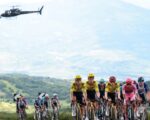
One constant of cycling coverage over the years has been the stunning aerial shots of the terrain the race traverses, anchoring the sport in the real world. Luckily we can experience this first-hand, as race organisers RCS have found space for us in their Giro Club VIP experience – a H130 helicopter trailing the race from on high.
You can only really see from above quite how long the convoy attending a bike race is: at the front are a few race vehicles and a platoon of police motorbikes, before the tightly woven cluster of the peloton, with a mile of cars snaking out behind them: medical cars, directors’ cars, neutral service vehicles, more police and more motorbikes. Above them are the camera helicopters, the drone of their blades humming in the background of coverage.
That footage is all beamed back to Stockley Park, west London, where we meet Chennaoui the next day. Despite her early start she’s as energetic as Voigt, telling us she’s “living and breathing” the race. The Giro consumes everything: from the minute she gets up she’s listening to podcasts about the race on 2x speed, trying to absorb as much as possible from the previous day’s stage that might have been missed, before recording elements of the pre-race show and sitting down for a long day in front of the TV.
She says: “There’s a lot more to making sure you have the narrative right, because it’s all coming from our heads, and if we don’t have it right in our heads, we’re going to tell the wrong story. That’s a responsibility to get right for the race.”
The post-race show can be somewhat anarchic as it’s entirely unscripted – “I think you’ve got to really love chaos to like live television”, she beams. She is tasked with keeping order among the pundits, including 21-time Grand Tour stage winner Sean Kelly and fellow ex-pros Adam Blythe and Robbie McEwen, whose takes on anything from team strategy to the safety of sprint finishes can vary wildly.
Chennaoui says: “Debate is really important, and once we lose that, then we’re sanitising the conversation around sport which isn’t good for anybody. It’s important that those guys who’ve been there, they’ve done it, that we allow them to express their full opinion, but I’m also there to make sure that the counterargument is given.
“I think we have to trust that if something is clipped up on social media and people only see that bit and they don’t see the whole show, if you allow that to to filter into you self-editing, then you’re not contributing to any kind of a conversation.”
***
On stage five, cameras spotted the back windshield of the UAE Team Emirates-XRG car was completely smashed, with Voigt on hand to find out what had happened. He eventually managed to piece together that the Tudor Pro Cycling rider Mathys Rondel had crashed right through it. “[Assistant sports director] Marcel Dieberg told me, he’s back in the peloton, he looks fine. Imagine that you break the window of a car, jump back on the bike and go back in the race. I tell you, these cyclists, they are made differently, they are tough cookies,” he adds, with a wry smile.
Voigt agrees with Walker’s view that the teams get a lot out of the broadcast too – although there is a limit. He adds, “I also had once or twice the case when a biker of the team really does something stupid and f***s up. [Then] they leave the window closed. But normally it gives them a chance to give their point of view unfiltered.”
The spotlight is often on riders’ superhuman ability to carry on despite being somewhere on a scale from discomfort to agony at all times, but the life of someone following the race can be jeopardised easily too. Voigt tells us a media colleague went to hospital with a haematoma after his motorbike slipped in the wet and crashed, falling on top of him. He’ll be fine, Voigt says, but that’s his Giro over.
The advantage of being so embedded within the race is Voigt gets flashes of insight into riders’ character, “precious” human moments that illuminate the entire race. He recalls the first time Tadej Pogacar won Strade Bianche, in 2022, when Voigt and his motorbike driver headed up to the road to catch a glimpse of him on a gravel sector. “I go, hey, Tadej, Tadej, and that little bugger in the middle of that race looks up, recognises me, gives me a little smile, and goes like this,” he gestures a cheeky, dismissive wave of the hand. “He was so easy. He dropped everybody by two minutes and he just went like this. I’m like, oh, that made my day.”
***
Back at Stockley Park producer Doug Ferguson presides over what he compares to a swan: the viewer’s experience should be of their coverage “floating serenely”, while behind the scenes everyone is “paddling like crazy”.
The gallery is a bewildering array of screens with different cameras, footage of each of their on-site reporters, and graphics designed by a team in Chile ready to be swapped in and out where needed, while next door is the studio where the pre- and post-show is filmed, a mind-bending space significantly smaller than it appears on TV, with a wraparound screen for the graphics wizards to work their magic.
This is Chennaoui’s terrain, and she’s whisked away to hair and makeup after we chat to get ready for the post-race show, The Breakaway. As we speak the riders are beginning the first major climb of this year’s race, the Blockhaus, and we’ve been keeping an eye on the dramatics unfolding throughout. Jonas Vingegaard is the majority’s favourite for the win; Chennaoui has gone for former Giro and Blockhaus winner Jai Hindley.
Chennaoui says part of the beauty of the show’s format is that the dynamics between her and the pundits reflects the audience watching on TV. She says: “We’re not going on with a set agenda as to what to talk about, and I think that’s reflective of the kinds of conversations I hope that fans will be having in their living rooms as well. People will love that or they will hate it, but it comes from a place of genuine passion and caring about the sport. I think bringing that authentic love of the sport is really important.
“We’re used to seeing people losing their shizzle over sport and I think that’s a wonderful thing. I feel so strongly about the role of sport in society and in people’s lives, and I’m conscious of the fact that, it’s easy to say the world is on fire, right? And I think sport is a really important distraction from that and I want to allow people to have a chunk of light in their day, and to do that in a way that is fun and entertaining and engaging and really authentic.”
As expected, Vingegaard is crowned winner atop the Blockhaus and the action switches to the studio, while Walker and Voigt head to the team buses back in Italy for the debrief and post-race analysis. All the infrastructure – protective fencing, the finish line archway, the hospitality portakabins – is rapidly dismantled and shunted along to the start of the next stage. The whole circus moves on, and the next day, it happens all over again.
TNT Sports is the Home of Cycling in the U.K, with every stage of the Giro d’Italia live on TNT Sports and HBO Max.