The rain is lashing down on a cold January day in Robertsbridge. Flood defences man the banks of the tributaries of the River Rother as they weave through the village, a legacy of the burstings of 2000 that bedevilled this quiet corner of East Sussex and many others like it. Strolling along Station Road down from the railway line, huddled beneath a frankly inadequate umbrella and splashed by the morning traffic, a faint whiff of wood draws me into the cricketing cornucopia I have come to find.
It is the cricket bat, in many ways, that is Robertsbridge’s claim to fame. For 150 years, master craftsmen have been whittling away on pieces of willow in the village, a long lineage stretching back to LJ Nicolls in the late 19th century. “Dear Sir,” WG Grace once wrote to the bat-maker in an 1894 letter. “I used one of your bats at Hastings in 1894 and scored 131. I may mention that it was perfectly new. I kept it until this year and have scored 2,000 runs with it. I used it when I made my 100th century and scored 1,000 runs in May with it. So I think I may call it my record bat.” Well, if it was good enough for WG…
One can still find Nicolls’ original workshop – long since converted into housing – on the High Street, but his legacy remains at an English institution. Gray-Nicolls, formed from a merger between the old bat-maker’s company and Grays of Cambridge, is just one of a number of businesses based on this site, with the paraphernalia of rugby equipment giant Gilbert not hard to find. But it is for cricket that I have made my pilgrimage to find a faintly remarkable place.
It is possible on this single site to virtually track a bat from sapling to finished product. I am given a tour by Richard Gray – it remains a family business – who shows me the newly-planted Salix Alba willow trees on the riverbank beyond. In 15 to 20 years, these will be ready for felling; from each will come about 40 bats. Unlike most other companies of its size, every Gray-Nicolls bat is made from wood grown by the company in the United Kingdom, and handcrafted by a bat-maker at a factory like this.
“I’ve been here nearly 20 years now,” explains Alex Hohenkerk, downing tools for a moment within his workshop. “As bat-makers, we are looking and honing in on those bits of timber that are going to make really good bits of kit. I’ll happily sacrifice a really pretty piece of wood if I can find something with a high density and levels of rebound. That is much more important to what they need than finding them something pretty.”
It is this bespoke approach that is one reason why these bats are so popular. “When I started here, I was very lucky that I walked into a team where they had all done approaching 50 years service,” Hohenkerk adds. “They’d done high-volume manufacturing when bats were less specific. When you do high volume manufacturing like that, yes, you are more likely to find 100 that you really, really like if you make 10,000 bats. But they are not tailored to anybody.” Admitting that it is a Gunn & Moore currently in my bag feels like a faux pas, so I am pleased to see one on the repair bench beyond him.
As any cricketer knows, a bat is not merely a piece of equipment, but an expression of identity; an extension of one’s personality. An attachment can form. “We’ve found in the last five years more players trying to look after cricket bats through upkeep and maintenance,” says Hohenkerk. “We’ve gone full circle now in terms of players who will keep getting their favourite bats refurbed and looked after, and only use them at the crease. That filters down and shows that bats can last if you look after them.” Harry Brook, for example, has had the same red-ball bat for two and a half years. “And that bat has scored a lot of runs.”
At the top level, some cricketers can and will tinker at will with the exact specifications they require. While former England captains Heather Knight and Alastair Cook have relatively settled set-ups – Cook’s since 2013 – the Pakistan vice-captain Saud Shakeel is noted as a player with exacting standards. There are no bad words to be heard here about any Gray-Nicolls athlete, though – not even Zak Crawley, who having been provided with two gorgeous examples for the Ashes lasted just 11 Mitchell Starc balls in a Perth pair. That, alas, is cricket.
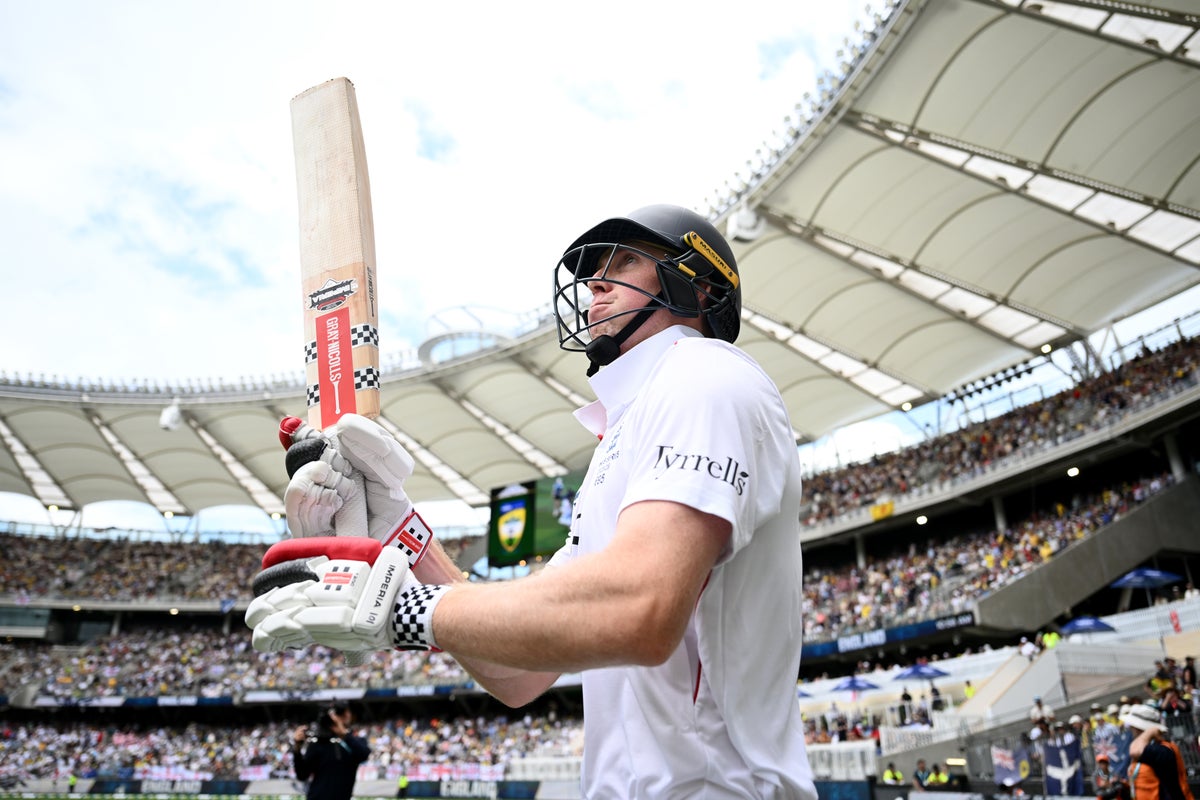
Gray-Nicolls has been at the forefront of bat innovation since the company’s early days. Out of Gray’s office spills a large selection charting the history of the tool, from the hockey-stick style early days through to the latest developments. It was 51 years ago that the Gray-Nicolls Scoop, the iconic bat, launched to redefine the genre; now, it is ideas like the Neocore bat, with a cored internal scoop to improve weight distribution and pick-up. Notably, too, the company has also seen huge and continued growth in India, with consumers in the country connecting strongly with a brand of such history.
What’s next? Gray and his team hope it may be what is known as “laminate”, or “blended”, bats. These are bats made by manufacturers from more than one bit of wood. It comes at a time when the most pressing concern for the industry is the shortage of English willow, driven by a rapid growth in demand of late. More trees are being planted, but it will take two decades for these to mature. Already permitted for junior cricket, Gray-Nicolls and others are having “constructive discussions” with the MCC about allowing use in the recreational game. Thinking purely in terms of sustainability, it would be a game-changer in terms of wood wastage.
“Lamination is great, and demystifying what it is and does is important,” Hohenkerk concludes. “There is a lot of stuff said about cricket bats that doesn’t really ring true. Saying a laminate bat is better because it is three bits of wood put together? Actually, the more important thing is that you are using up three bits of wood that you otherwise wouldn’t have used.
“There is a huge demand for everybody to have a bat. The village kit bag with 10 bats in it doesn’t really exist anymore. Everyone wants their own thing, so you’ve got to try and find a way to make that thing.”
And with that, it is out of the warmth of the factory and back into the wind and rain, via a pint of Harvey’s at the nearby George Inn. Suddenly, the summer season does not quite feel so distant — after a century-and-a-half of bat-making, here’s to many more.