Beyond the visible marks of effort and passion, the football jerseys worn by players at the World Cup carry profound cultural and historical significance. As the globe’s premier sporting event unfolds across the United States, Canada, and Mexico, these kit designs often reveal compelling — and sometimes controversial — narratives woven into their fabric.
Cape Verde’s flight paths
Making their World Cup debut, Cape Verde, the tournament’s smallest nation by population, defied expectations with a resilient performance. The team, representing approximately 525,000 inhabitants across 10 volcanic islands off the coast of Africa, showcased a profound sense of unity.
This spirit is literally woven into their blue home and white away jerseys, featuring a geometric, triangular print. The design symbolizes flight paths connecting the islands, reflecting the idea that the entire nation stands united behind its players. That togetherness was evident on the field, as the squad held firm to secure an unlikely 0-0 draw against heavily favored Spain in their opening match.
Belgium’s surrealism
Belgium’s away soccer shirt carries an intriguing message on its collar: “This is not a jersey.” This unusual detail serves as a direct homage to the European nation’s profound surrealist heritage, particularly the groundbreaking work of early 20th-century artist René Magritte.
Magritte, renowned for questioning the complex interplay between mind, eye, reality, and language, famously inscribed “Ceci n’est pas une pipe (This is not a pipe)” beneath his iconic pipe painting, “The Treachery of Images.” The light-blue kit itself is adorned with vibrant pink patterns and black detailing, incorporating classic soccer motifs such as pitch lines and a ball.
According to the Belgian federation, “True to the surrealism theme, the kit sparks the imagination and invites conversation.”
Haiti’s battle scene
Haiti encountered an unexpected setback when FIFA rejected its initial jersey design. The original kit, a powerful statement from the Caribbean nation, featured a depiction of the final battle of the Haitian War of Independence in 1803 on its front.
Colombian sportswear manufacturer Saeta, which produced the jersey, described the imagery as a “tribute to the men and women who contribute every day to Haiti’s future.” However, FIFA intervened during its approval process, deeming the historical artwork “too political.” Consequently, an updated blue soccer kit was required, one that no longer includes the battle scene.
Argentina’s swirling paint technique
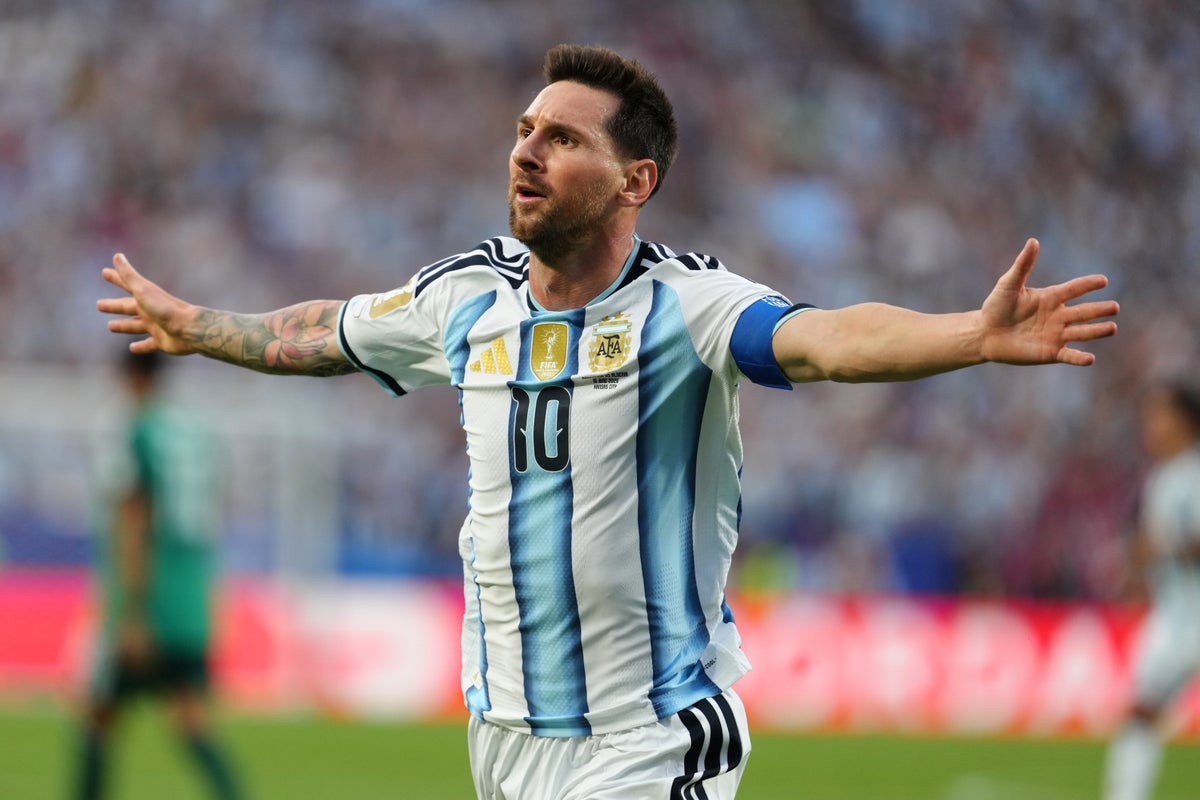
Argentina, the reigning World Cup champion, is seamlessly blending its rich sporting heritage with vibrant artistic expression in its latest national team jerseys. The home kit, recently worn by Lionel Messi during his hat trick performance against Algeria on Tuesday, showcases stripes in three distinct shades of blue.
This design serves as a direct homage to the nation’s triumphant World Cup-winning uniforms from 1978, 1986, and 2022. Complementing this, the dark blue away jersey draws its inspiration from filete porteño, a traditional painting technique originating from the capital city of Buenos Aires. This ornamental style, known for its brilliant, swirling colors and specific lettering, now adorns the team’s kit.
France’s American connection
France’s World Cup away kit arrives with a striking tribute to a historic transatlantic gift: the Statue of Liberty. The national team’s jersey features a distinctive green hue, mirroring the iconic sculpture’s oxidized copper.
Designed by Frenchman Frédéric-Auguste Bartholdi, the statue was presented to the United States in 1886 as a powerful symbol of French-American friendship. Further underscoring this connection, the kit includes a copper-colored logo, reflecting the monument’s original metallic sheen. Emblazoned with the French phrase “Nos différences nous unissent” (Our differences unite us), the design encapsulates a message of unity.
Iran’s endangered Asiatic cheetah
The most striking imagery on Iran’s home (white) and away (red) kits is an Asiatic cheetah low across the front. There also are cheetah spots on the sleeves up to the shoulder. The Asiatic cheetah, an equally fast cousin of the African cat, is one of the world’s critically endangered species — one that Iran has long tried to save. There were as many as 400 in the 1990s but the numbers have dwindled to less than an estimated 70 remaining in Iran.
Norway’s runic font
Norway’s World Cup kit is turning heads, not least for its literally sharp design. The distinctive font for player names and numbers draws inspiration from runic writing, an ancient Germanic alphabet used across northern Europe before the Latin script.
This pointy, geometric, and highly visible typeface powerfully reflects the Norwegian team’s embrace of its centuries-old history. Intricate Viking art patterns, in the Urnes style, further embellish the jersey, flanking the prominent blue cross.
Colombia’s yellow butterflies
Look closely at Colombia’s typically vibrant yellow jersey and you’ll notice a burst of butterfly patterns. That’s an homage to the classic novel by the nation’s Nobel Prize-winning author, Gabriel Garcia Marquez, “One Hundred Years of Solitude,” and the stories that made him literature’s best-known practitioner of magical realism — the blending of the everyday with fantastical elements such as a man trailed by a cloud of yellow butterflies.
Mexico’s Aztec calendar
Mexico’s home jersey brings back the Aztec calendar design that was popular in the 1990s. In the run-up to the World Cup, the team visited the National Museum of Anthropology in Mexico City and posed for a photo with the uniforms in front of the Aztec “Piedra de Sol” or Stone of the Sun, best known as the Aztec calendar.
Saudi Arabia’s architecture
Dotted across Saudi Arabia’s dark green home jersey are symmetrical lavender squares or diamond shapes, a tribute to doorway decoration — namely geometric, triangular architecture — commonly seen in homes in the kingdom. Wild lavender flowers fill Saudi’s desert landscapes in springtime, so purple is a celebrated color in the nation and regarded as a symbol of generosity.
Brazil’s Amazonian frogs
What might immediately jump out when looking at Brazil’s navy blue-and-black away jersey made by Nike is a yellow “Jumpman” logo synonymous with Michael Jordan-promoted sportswear. However, more closely linked to Brazilian culture is the color of the kit, inspired by the skin of the poison dart frog found in the Amazon. It’s a nod to the danger posed by Brazil, the record five-time world champion.
___
Associated Press writer Luis Andres Henao contributed to this report.