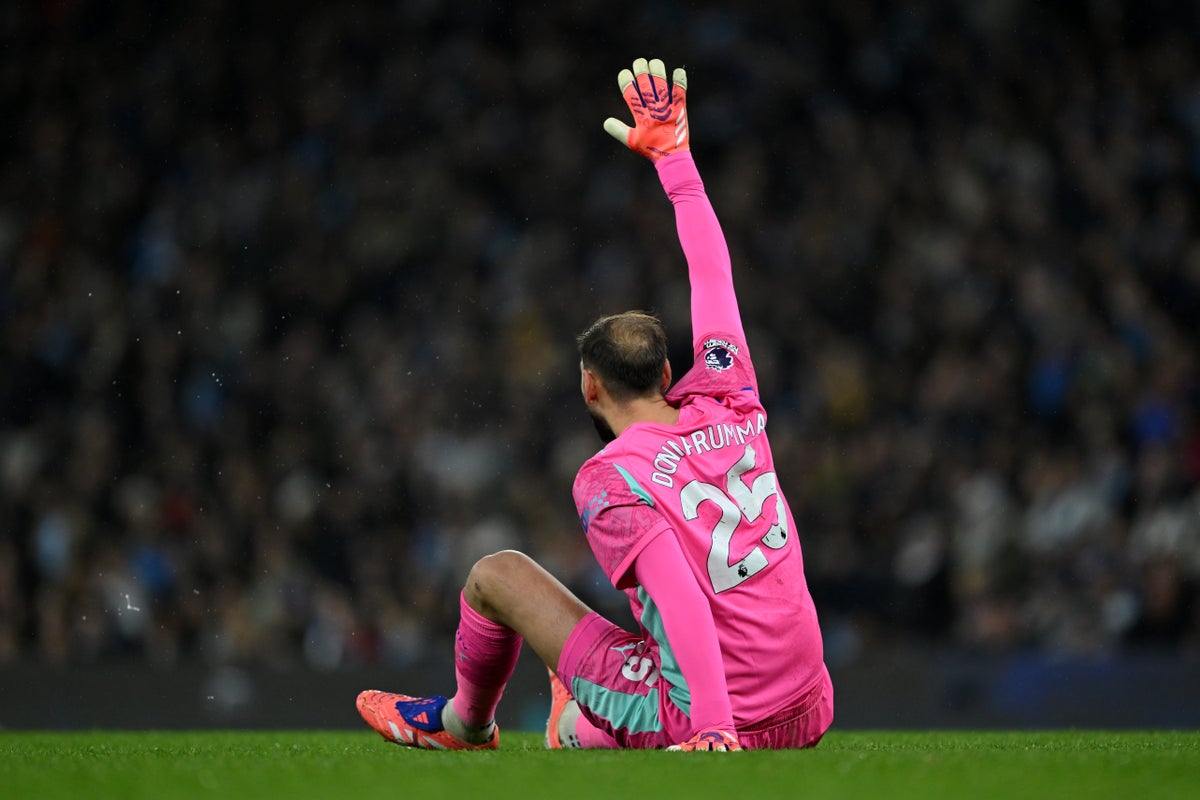
Players will be banned from going over to the touchline to receive tactical advice from coaches when goalkeepers are down injured at this summer’s World Cup.
In one of a number of rule changes ahead of the tournament revealed by Fifa referees’ chief Pierluigi Collina, the so-called ‘tactical timeout’ where a goalkeeper will strategically go to the ground to be treated by physios, while their outfield team-mates rush over to the coach in order to receive instruction, has now been forbidden by the International Football Association Board (Ifab).
The ‘tactical timeout’ – where, once the tactical instruction has been received, the keeper simply gets up to play on – has become a trope across the world, with one of the most high-profile examples coming in the Premier League in November when Leeds boss Daniel Farke accused Manchester City goalkeeper Gianluigi Donnarumma of feigning injury to “bend the rules” and break up play.
Leagues have been invited to hold a series of trails throughout the 2026-27 campaign to find a solution, while the women’s professional league in the United States, the NWSL, introduced its own temporary measure earlier this year, which will be replicated at the World Cup.
If a goalkeeper is injured, the players of both teams must stay where they are or gather in the centre circle, not being permitted to go to the touchline.
The officials will be responsible for enforcing the rule but Collina said there will be no yellow cards or disciplinary action for players who do try to go over and speak to the coach. However, all nations will be aware of the rules.
“We had a workshop with all the coaches of all the 48 teams and we told them that referees will be proactive,” explained Collina. “They will not allow the two teams to go to the benches when a goalkeeper is lying on the ground injured.
“The goalkeeper has the right to be injured, but the players do not have the right to leave the field of play to have a sort of timeout with their respective coaches.”
Arguably, this measure only tackles part of the problem, as it will not stop goalkeepers going down simply to break up the momentum of the other team.
The relevance at the World Cup is up for debate, given that there will be a three-minute hydration break in each half anyway due to the hot weather, creating a natural timeout for coaches.
“It’s quite weird that there really is only the referee, the physio and the goalkeeper on the field play,” added Collina. “All the other players leave the pitch, and it is not good.”
There will be another handful of law changes, primarily aiming to speed up play and reduce time-wasting from teams and Collina is hopeful they will help limit the amount of stoppage time, which reached remarkable levels in 2022. They are:
Throw-in countdown (five seconds): If a player deliberately delays the restart of play, the throw can be given to the opposition.
Goal-kick countdown (five seconds): Also applies to deliberate attempts to run down the clock and can result in a corner being awarded.
Time-limited substitutions (10 seconds): Substituted players have 10 seconds to leave the field at the nearest point. If they fail to do so, the substitute cannot enter the field for at least one minute and the team must continue with 10 players.
Off-field treatment (one minute): Players who are treated by the physio must stay off the field for 60 seconds. There are some exceptions, including for goalkeepers, injuries and if the opponent is booked or sent off.
Players covering their mouths: Any player covering their mouth in a confrontational situation with an opponent may be sanctioned with a red card. This is in light of the controversy surrounding Benfica winger Gianluca Prestianni and Real Madrid’s Vinicius Jr in a Champions League game in February. Prestianni covered his mouth during a confrontation with Vini Jr, who accused him of racist abuse. This was unable to be proven but Prestianni received a six-game ban from Uefa for homophobic conduct. “If the conversation is friendly, they can continue to do it without any problem,” Collina explained. “When the conversation is confrontational, covering the mouth means that you are doing something very wrong, potentially, and the sanction is the red card.”
The VAR protocols have also been tweaked for the tournament, with video assistant referees now having new powers to intervene if fouls are committed immediately before the ball is in play at set-pieces. The measures will allow VAR to step in if a clear foul committed by the attacking team before the ball is in play leads to a direct impact on a goal, penalty kick or disciplinary sanction.
In a statement, Ifab said: “The Ifa has approved a clarification to the video assistant referee (VAR) protocol for use at the 2026 Fifa World Cup regarding clear offences committed by the attacking team before the ball is in play at a corner kick or free kick that have a direct impact on a goal, penalty kick, or disciplinary sanction.
“If the offence meets the criteria set out in the clarification, the VAR will recommend an on-field review, following which, if the referee determines that an offence occurred before the ball was in play, the appropriate disciplinary action will be taken and the corner kick or free kick will be retaken.”