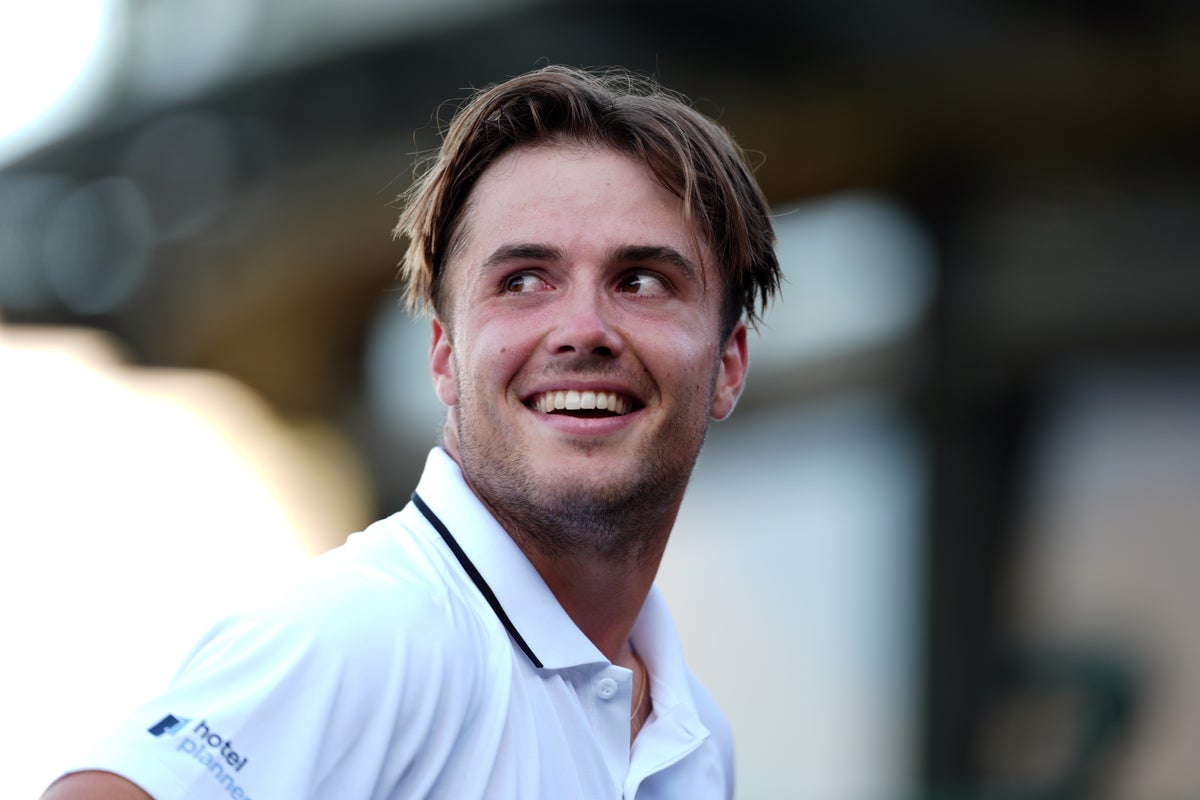
Serving to stay in the biggest match of his life, as the shadows began to lengthen across Wimbledon’s Court 18 and fans climbed onto fold-out seats on the balcony and clambered onto benches to look down below, Arthur Fery was suddenly ground to a halt. A third nosebleed of the match stopped Fery in the his tracks and forced him to think. He had been battling Belgium’s Zizou Bergs for over four hours for a place in the last-16, scrapping from the brink after being a double-break down in the fourth set and a single break down in the fifth. Fery trailed 4-1 in both sets, but the deeper a hole the British wildcard faced, the tougher he fought, and the higher he climbed.
Once again, Fery managed to block out the distractions, with his epic 2-6 7-5 2-6 7-6 (3) 7-6 (10/5) over Bergs ensuring there will be a British player in the fourth round of Wimbledon. With his victory, Fery will enter the world’s top 100 for the first time. His decision to remain on the bearpit of Court 18, with its capacity for around 750 fans, rather than one of Wimbledon’s bigger showcourts, was justified as he whipped up a raucous atmosphere. “No words for it, honestly,’ he said. “With that support, it is unbelievable. I requested to play on this court and the club made it happen which was awesome. I love this court and had a great time on it.”
But the path to becoming the last British player left in the singles at Wimbledon has been an unusual one for a player who was born in France. His mother, Olivia Fery, was a professional tennis player who played at the 1991 French Open. His father, Loic Fery, is the wealthy owner of Ligue 1 football club FC Lorient. Fery briefly played for France at under-12 level, but grew up 10 minutes down the road from Wimbledon. There was no choice to make when deciding between the two countries. He sounds like a south Londoner. His home tournament was to be played on grass, not clay.
The contentious subject of British wildcards has been a theme throughout the opening week of Wimbledon, particularly after the dismal Monday that brought 10 defeats and the snubbing of Dan Evans from singles ahead of his final tournament before retirement. But it is clear the decision to award Fery direct entry into the main draw, offering him a fourth appearance at the Championships, was a sound one. His run at Queen’s, when he reached the quarter-finals, also as a wildcard, brought his ranking to a career-high 118th in the world. Having also qualified for the main draw of the Australian Open in January, where he defeated an ill Flavio Cobolli, Fery could walk through the gates of the All England Club and feel like he could belong there.
It has, as Fery said following his round one win over Damir Dzumhur, made Wimbledon feel more “normal”, less daunting. And perhaps that is the trick, shutting out the prestige and primness of the oldest and most famous tennis tournament in the world and treating it like any other competition. Fery carries an eye mask and earplugs in his tennis bag and has been doing so since the start of the year. They turned out to be especially handy during his fiery four-set victory against Dzumhur on Tuesday, as his opponent accused him of dishonesty over a let call before ranting and raving to the chair umpire and match referee. Amid the carnage, Fery sat alone with his thoughts.
How about Thursday, after the culling of British players from singles draws only intensified the focus on him? When returning serve from the 6ft 4in Finnish qualifier Otto Virtanen on the deuce side of Court 18, Fery could glance to his right and see the Princess of Wales sitting three rows away. There was a definite buzz as the future Queen, flanked by Tim Henman and All England Club chair Debbie Jevans, emerged onto court. Fery, though, didn’t notice. “I was locked in,” he said. “I didn’t hear it.”
He remained in his own bubble. “Obviously, in a big tournament like this, there’s a lot going on,” he said. “Sometimes it’s easy to get stuck into that once you win a match. That’s what I’m focusing on and I’m going to try to keep going in that direction.” Perhaps that explains why Fery opted to return to Court 18 and its intimate yet intense surroundings for his third-round match against Bergs, the world No 37, rather than being tempted by the possibility of taking to Court No 1.
Even on his path to becoming a professional tennis player, Fery always walked his path at his own pace. Following the advice of his parents, he stayed in school when some boys began to think about committing to tennis full-time at the age of 14. He did his A-levels and had a normal upbringing. By 18, tennis still wasn’t his “life”, so, after juniors, he had the clarity of mind to think about his future beyond the court and used his talent to secure a place at the prestigious Stanford University in California, where he studied science and technology and became the No 1-ranked singles player in the college system during his second year.
Fery matured in college and left feeling “hungry” and “ready to attack the tour” when he graduated in 2022. But he still required patience, only breaking into the world’s top 200 last October, and still had to do things his own way. At 5ft 9in, Fery can be towered over by many of the serve-bots on tour. The Finnish qualifier Virtanen, who had defeated fifth seed Ben Shelton in the previous round, was able to fire 140mph serves out wide or down the middle. Fery, though, was not overpowered, and instead broke Virtanen down with his movement and craft. “Tennis is a sport where I think everyone, all heights, can thrive in a certain way,” he said.
He is a classic counter-puncher. Give him a ball to chase – force his back against the wall – and Fery will respond by coming back swinging. He plays with bravery, control, and heart. “I was down for pretty much the whole match, managed to scramble back from two breaks and 4-1 in the fifth,” he said after his escape against Bergs. “Just tried to put up as much of a fight as I could.”
And he is the last one of the Brits standing. The second Monday of Wimbledon will not feature Emma Raducanu or Jack Draper or Cameron Norrie – but it will involve the world No 118. “I wouldn’t say it’s pressure,” Fery said this week. “I just want to win for myself.”