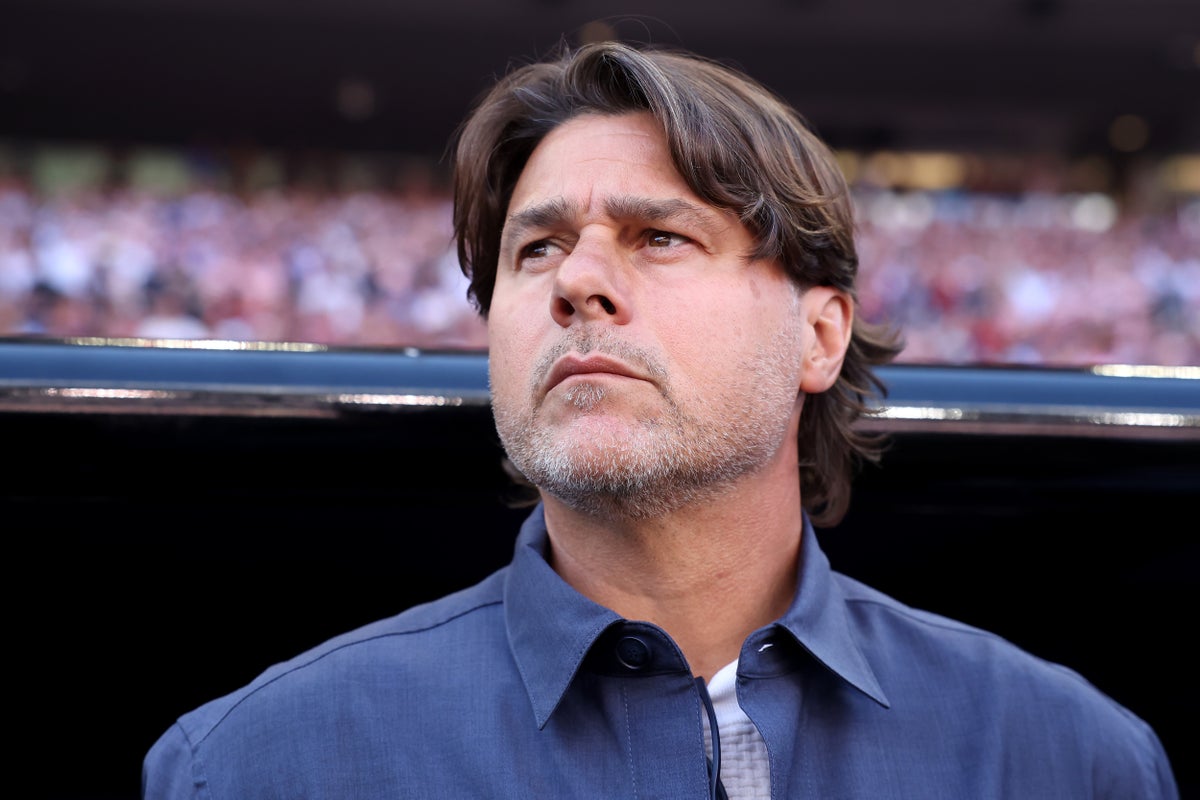
Mauricio Pochettino met Thomas Tuchel at Craven Cottage last weekend, where they inevitably discussed their World Cup experiences of the summer. Had recent history taken slightly different courses, though, they could have been speaking from completely different perspectives. Pochettino might actually have been the England manager rather than USA manager, a prospect he was open to. Or, he might have been back in club football, admitting he would take over Tottenham Hotspur in the Championship.
As it is, both are still in the same jobs having endured some of the same criticisms, and Pochettino’s decision to stay with the US has stunned many in the game.
He explains why in a wide-ranging interview at a hotel in Knightsbridge. Aside from just being about a moment in time, though, Pochettino starts to touch on the passing of time – or, rather, coaching eras.
Pochettino can’t but reflect on how he and Tuchel are two of many established-name managers – now including Jurgen Klopp – that are in the international game. He puts it down to how that level of football now fits with something their generation feels more keenly than the current school of coaches. They feel the “emotion” of management more.
Pochettino believes club coaching is now too data- and systems-driven, to the point of eroding the human dimension that international football retains.
“Yes, it’s more pure. The time restriction, but it’s really intense, but that is the thing that you are maybe losing in the clubs. You enjoy really a lot [with countries] when you are one week with the players, the players are not toxic, the players come because they want to enjoy, they want to play, want to show that… and they don’t have time to become upset.”
Pochettino laughs about how it doesn’t even matter if they don’t like the face of assistant Jesus Perez, sitting beside him as ever.
“Because it’s a very short period, it’s all very motivated and so happy and the moment they start to become upset, ‘go home to your club!’”
You can understand why Klopp and Tuchel also become attracted to this, too, after years amid the obsessive intensity of the club game. Pochettino is essentially talking about the generation of 2016, when a group of “star” coaches rose, and many of them went to the Premier League that very summer. Despite that, it was Pochettino’s Spurs that finished second on a club record 86 points behind Antonio Conte’s Chelsea, and he believes they should have been awarded the 2016-17 title after Chelsea’s new ownership self-reported rule breaches from that period under Roman Abramovich.
That medal might be appropriate recognition for his impact, while amplifying the Argentine’s profile.
It is perhaps instructive that had he indeed gone back to Spurs this summer, which felt like a sure thing had relegation worries not forced the appointment of Roberto De Zerbi, the 54-year-old would have been the second oldest in the league after David Moyes.
Amid a debate over how the current generation are lacking “stars”, too, Pochettino feels something else is missing. It’s something the international game brings out.
“I think it’s more, because you are talking about the last generation … the human connection, the generation that is analogue-digital, always I say that. We were born in an analogue period, and we come now in the digital period, but we know how to mix that, and we know how to do the chemistry. And the worry is that the new generation of coaches, we don’t know if they know how to, because the football that we know is the right chemistry. We’ll see.”
It was the human dimension that persuaded Pochettino to stay on with the USA, especially the national impact of the World Cup.
“One thing that changed our mind: the people. The human beings in the federation. Because before the start of the World Cup we met the whole board in New York, before starting working with the players in Atlanta. And they offered us to do four more years. I said ‘yeah but if we lose all the games in the [World Cup]…’ [And they said] ‘No, we trust in you, we trust in your vision, in the way that you behave. We know very well that you gave your word and you stayed here, when it was possible to move to another place.’
“We said, ‘This type of people, I like to be with them’.”
Hence, when Spurs did call again, he had to say no. When there was later a suggestion around the game that he could do both jobs to keep his old club up, Pochettino says: “We are serious people.
“And when we finish, it was completely different, the vision,” he says of the impact of the World Cup. “Because we create something. The fans were so excited. The players changed completely the mindset. After one week they call and say ‘OK, we can talk now’. And we are ready for it.
“Because I think we changed the view of the people and the organisation of the people about that sport.
“It’s a sport that is about being brave, about showing your culture. We start to provide them the possibility to see that sport in a different way. Of course they are very passionate, very patriotic. They start to see in a different way and they start to buy the idea. Amazing.”
Pochettino contrasts it to a game against Paraguay in Philadelphia last year, when it felt more than half the crowd were supporting the visitors.
“Now, we play four games: Orlando, St Louis, Phoenix and [St Paul] Minnesota, sold out.”
There did look a danger this could have been damaged by the Folarin Balogun affair, especially with the way Belgium were driven to beat the USA 4-1 for another early last-16 exit. Some in the camp do feel it was a distraction that distorted the team’s chemistry. Pochettino denies that, amid a wider defence of the situation.
“I think that is like an excuse. For me, it’s not an excuse. We didn’t play well. Even if with a different situation, we perform the same way, it’s more the noise around, but we didn’t feel that, we were in a bubble.”
Another major controversy from that World Cup was the fallout of England’s semi-final defeat to Argentina, and the latter’s abrasive campaign, For one, there was his friend Tuchel’s tactics.
“It was a difficult game and difficult for the coach to make the decision. You know, Thomas in a previous game did similar and it worked. And if you approach it differently and you lose, people say, ‘a few days ago, you did that and it worked perfectly, why didn’t you do the same?’”
There was then the bad blood, which Pochettino especially laments given this was his home country against his adopted country. He has come to love England so much that he would have considered the job in the past, and may well in the future. There is nevertheless a sense that the semi-final made him see that emotions run so high it would have been “hard”.
But.
“I am the first to feel for my people in Argentina, but at the end of the day it’s just football and it was just one game of football, but people wanted to convert it to other subjects.
“It is true it can be controversial because an Argentinian guy is thinking to maybe one day defend the flag of England and we were involved in a war…
“For me it is because we are very similar in the way we feel the passion of football. I think we are very similar. I love the countryside, I love the farms and here it is amazing. I think you respect all the things that I also grow up with in my country.
“It is a country that is very like Argentina. Now I am here doing my passion that is football and I cannot work [as England manager], why? It is crazy. I really believe in the diplomatic things, going to talk and for sure to find the best way.”
Pochettino is struck by how that illustrates another difference from his time in the club game. Whereas the Argentina-England animosity feels at its highest in years, he now sees rival English clubs doing business with each other – including Spurs and Chelsea.
“It would have been impossible to sell or buy with one of the other contenders… I remember things that had happened which would have made it crazy and impossible to do business between them. Now, I don’t know what’s happened or because of the rules.”
That goes hand in hand at his surprise at the expenditure – including by Spurs.
“A team that gets promoted from the Championship is spending massive money. I am happy if Tottenham now have the possibility to spend and to bring proven players… because I feel Tottenham. It’s still my club and I want the best for them.”
Along those lines, he feels Harry Kane “deserves” the Ballon d’Or this season.
“I think if I pick one, then it’s Harry Kane.”
Some things don’t change with time.