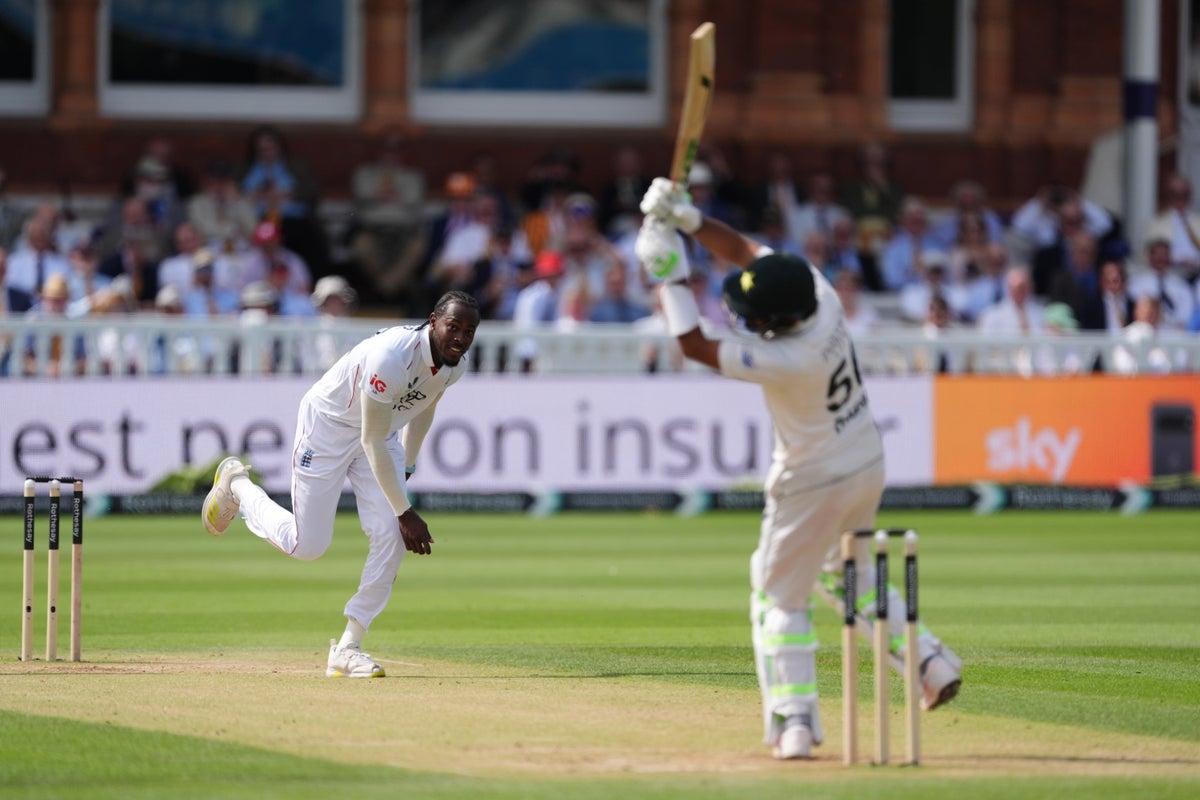
Off the field, there have been midnight misadventures and political wranglings, but in a cricketing sense, at least, all is rosy for Joe Root’s England. For the first time since the end of 2024, they are Test series victors, and there have been few more comprehensive successes than these back-to-back blitzings of Pakistan. After three days at Headingley, this Lord’s Test at least lasted four, though only thanks to interrupting rain that has arguably proved more troublesome opposition than the tourists.
One must reserve judgement on this new era given the relative paucity of Pakistan, but Root will have been encouraged by the signs his side showed. A potent pack of pacemen proved too hot for most to handle, while there was a measured maturity to how England went about their work with bat and ball to make the most of the surface. In Ollie Robinson, they now have a frontman averaging under 20 in Test cricket; in Jofra Archer, Gus Atkinson and Josh Tongue, a backing band that can lift the volume and tempo with the best of them.
That said, mind, this was a meek showing from a Pakistan side for which this is turning into a treacherous, tormented tour. Since the very first knockings at Headingley, they have been most demonstrably second best, and they will not look forward to a final Test trip to Edgbaston with any particular relish. Only Mohammad Abbas, who will at last have his name etched on the Lord’s honours board, and Saud Shakeel – who postponed the pain of defeat with a sparkling 97 to show what might have been – emerge in particular credit from a performance that again showed how far they have fallen.
One need not look back to Wasim and Waqar and Imran and the genuine greats to find comparative giants. It was only a decade ago that Pakistan achieved their modern Test cricketing high, climbing to No 1 in the world rankings at the close of a 2-2 drawn series between these two sides. A senior batting spine of Mohammad Hafeez, Azhar Ali, Younis Khan and Misbah-ul-Haq was always going to prove hard to replace but scan through the attack and the venom and variety of Mohammad Amir, Wahab Riaz and Yasir Shah contrasts with the – Abbas excepting – rather more modest unit sighted of late. To see Shaheen Shah Afridi and Naseem Shah bowling in white-ball cricket domestically while, with respect, inferior bowlers toil in Tests is a real shame.
Clearly, the perma-chaos that engulfs Pakistan cricket is no help in producing a consistent Test team. Perpetual tinkering to the domestic structure and coaching staff has left a generation of players that seems uncertain of itself. Abdullah Shafique still averages nearly 40 in this format but has found himself shunted out of the side, up to open and now into the middle order; Babar Azam once threatened to be bracketed in the same company as the so-called “Fab Four”, but hasn’t made a Test hundred in nearly four years. The fact that Mohammad Wasim, Pakistan’s chief selector between 2020 and 2022, accused Imam-ul-Haq of faking the calf injury that has prevented him batting at all in this Test rather summed it all up.
Pakistan are victims, too, of a landscape that works against them. If, as we are told, the IPL is now cricket’s best talent incubator, it is surely detrimental for a nation to be locked out of it entirely. The financial rewards that others reap from bilateral series against India are unavailable to Pakistan, too. There was a certain sadness to their two-Test encounter with the West Indies in July, a meeting of fallen giants played out in two empty Trinidad amphitheatres. No doubt, Test cricket is poorer for a smaller cast of protagonists.
There was a greater attendance here, and those of a Pakistan persuasion at least had early wickets to cheer. England’s tail had managed to frustrate their visitors on the second morning though, given the circumstances and size of their advantage, they were not necessarily displeased that there was no repeat. Dan Lawrence could not build on a fine 50 made in testing conditions on the third day, becoming Abbas’ fourth victim as he was bowled, and Pakistan’s clear standout soon had a five-for as Robinson edged behind.
It was celebrated with a gleeful gambol – the scoreboard may have plainly displayed the situation his side were facing but one could not really begrudge Abbas his moment, a throwback talent deservedly on the honours board after three previous four-wicket hauls at Lord’s. If only Pakistan had more like him.
A run out from Azam left a total of 208 all out and target of 389; a nominal number, really, for a batting line-up that had struggled so in its outings so far. So it proved. Robinson struck twice in his third over, first running one down the slope into Azan Awais’ back pad before landing a sweet peck on the off bail to remove both it and Shafique. Jofra Archer’s stylings were alternative yet no less effective, Babar bounced out with a brute that hit top edge then helmet en route to Jordan Cox in the cordon.
At that point, one rather feared a capitulation. Frankly, it was a surprise that it did not come, though Shakeel playing excellently to bring up a half-century from 54 balls and found stodgy support from Masood. Their stand swelled to 97 until Robinson – who else? – pinned Masood LBW for 26 on review. Mohammad Rizwan came and went by the same method after a wretched heave across the line.
Ali Usman (16) kept Shakeel company for a while before dragging Archer on. Knowing that the rest may not be around long, the left-hander accelerated, hoisting Tongue for two sixes to move into the 90s. An attempt, though, to reach the landmark in the same style landed in the hands of Harry Brook at long leg – and the seamer ensured the end came quickly after that with Pakistan still yet to breach 200 in this series.