By Marcus Deloney
The 2025-26 season broke the one thing cord-cutters had relied on for years: a simple map. For most of the last decade you could follow the NBA with a couple of subscriptions and roughly know where every game lived. That map is gone. National rights have been split three ways, the regional sports networks that carried your local team are collapsing, and if you also follow the EuroLeague, the official feed may or may not be sold in your country. This is the honest guide to where games actually live now, and how to set yourself up without paying for cable you don’t want.
The national NBA picture: three homes, no single ticket
Start with the biggest change. In July 2024 the NBA signed new 11-year U.S. media agreements running from 2025-26 through 2035-36, and they split the league across three companies: Disney, NBCUniversal and Amazon. TNT and Warner Bros. Discovery are out of national NBA coverage entirely after a November 2024 settlement ended the matching-rights fight. Inside the NBA — Ernie Johnson, Charles Barkley, Kenny Smith and Shaquille O’Neal — is still produced by TNT Sports, but it now airs on ESPN and ABC.
Here is how the national schedule breaks down:
- Disney (ESPN/ABC) holds the largest package, roughly 80 regular-season games across ABC and ESPN, including a slate of Saturday and Sunday games on broadcast ABC. You can reach it through cable, over-the-air ABC, or the new ESPN direct-to-consumer app that launched on August 21, 2025. The Unlimited plan is $29.99 a month (or $299.99 a year); a cheaper ESPN Select tier with ESPN+ content is $11.99 a month.
- NBCUniversal (NBC/Peacock) carries up to 100 regular-season games. NBC is over the air; every game NBC Sports presents also streams on Peacock. That includes Peacock’s Monday night games, the Coast to Coast Tuesday doubleheaders, and Sunday Night Basketball beginning February 1, 2026, plus All-Star and a share of the playoffs and Conference Finals.
- Amazon Prime Video, in its first NBA season, has 60-plus regular-season national games (typically Thursday and Friday, with select Saturdays), the Emirates NBA Cup knockout rounds, and exclusive rights to the Play-In Tournament.
The takeaway is blunt: no single subscription covers a full national season anymore. A complete cord-cutter needs some combination of Peacock, Prime Video and an ESPN/ABC path. That is a real cost stack, and it is worth doing the math before the season starts rather than mid-January when you realize your team’s Thursday game is on a service you don’t have.
Out-of-market games: League Pass and its hard limit
NBA League Pass is the league’s out-of-market streaming product and it is genuinely good at one job. Standard runs about $16.99 a month or $109.99 for the season, Premium (no in-app ads, some multi-view) about $24.99 a month or $159.99 for the season, and a single-team package starts around $13.99 a month. It’s also sold through Prime Video Channels. For that you get roughly 40 out-of-market games a week — ideal if you live in Chicago and want to follow, say, the Oklahoma City Thunder.
The limit is the part people forget. League Pass blacks out your local team’s games and every nationally televised game in your market. Blacked-out national games only appear on demand at 6:00am ET the next morning; local games show up about three days later. In plain terms, League Pass is not how you watch your home team live. Keep that straight, because it’s the single most common cord-cutting mistake.
Your local team: the real pain point
This is where 2026 gets ugly. The regional sports network model that carried most local NBA broadcasts is unwinding. Diamond Sports Group exited bankruptcy on January 2, 2025 and rebranded as Main Street Sports Group, running its RSNs under the FanDuel Sports Network banner. After a failed DAZN stake deal and missed payments, Main Street moved to wind those networks down around and after the 2025-26 season, with a final telecast reported for April 30, 2026. That leaves a batch of local NBA teams scrambling for distribution.
The replacements are a patchwork. Some franchises have launched their own direct-to-consumer apps — Jazz+ and BlazerVision are two examples that have been reported — while others are landing on new carriers or regional streaming arrangements. Where your home team lives right now depends entirely on your market, and gaps and blackouts are common. If you’re a local fan, the honest first step is to check your specific team’s current broadcast home for this season, because there is no longer a national rule that covers everyone.
The EuroLeague and international access
TalkBasket readers follow both leagues, so this matters as much as the NBA half. The official route for the EuroLeague and the BKT EuroCup is EuroLeague TV (euroleague.tv), the competition’s own OTT service, reported around $17.99 a month with a day pass near $7.99 plus annual and phase packages for the Playoffs and Final Four. The catch is territorial: availability and blackouts vary by country wherever a local broadcaster holds the rights, so what you can watch — and whether you can watch it at all — depends on where you are.
Those local deals are real and specific. In Italy, Sky holds EuroLeague exclusivity from 2025-26, with games streaming through its Now service. In Spain the competition sits with Movistar Plus+. This is region by region, not one global contract, and the map keeps shifting: DAZN, which carried EuroLeague in Italy in prior seasons, did not renew men’s EuroLeague there for this cycle. The genuine gap for a lot of fans is the cross-continent one. Depending on your country, the official feed for the other league — the NBA in parts of Europe, or European basketball feeds in the U.S. — may be limited, geo-restricted, or simply not sold to you. Even NBA distribution abroad is fragmented now; in Germany, for instance, this season’s rights moved to Sky Deutschland and Amazon Prime Video.
Where a live-TV subscription fits
That international gap is where a broad live-TV/IPTV subscription earns a mention. Be clear about what it is and isn’t first. A service like this is a breadth play: a large bundle of live channels and international feeds on one device, useful when you’re chasing a wide sports lineup or a foreign broadcast that no single U.S. app sells. It is not a substitute for League Pass or a licensed national broadcast. For the definitive, guaranteed-HD, no-blackout feed of your specific team, the official broadcaster or League Pass still wins, full stop. That’s the honest limitation, and it’s worth stating plainly.
With that caveat on the table, for fans who want a lot of live and international sports channels running on one box, Apollo Group TV on Roku is one way to widen the net. It’s a legitimate live-TV subscription with 22,000-plus live channels including many international and sports feeds, 120,000-plus on-demand titles, up to 4K, no contract, and pricing around $13.35 a month. It installs on Roku as well as Firestick, Apple TV, Android and Smart TV, and the range of international sports channels is the reason to consider it — not as your primary NBA feed, but as a way to reach European broadcasts and a wide live lineup you’d otherwise juggle across several apps.
The practical bottom line
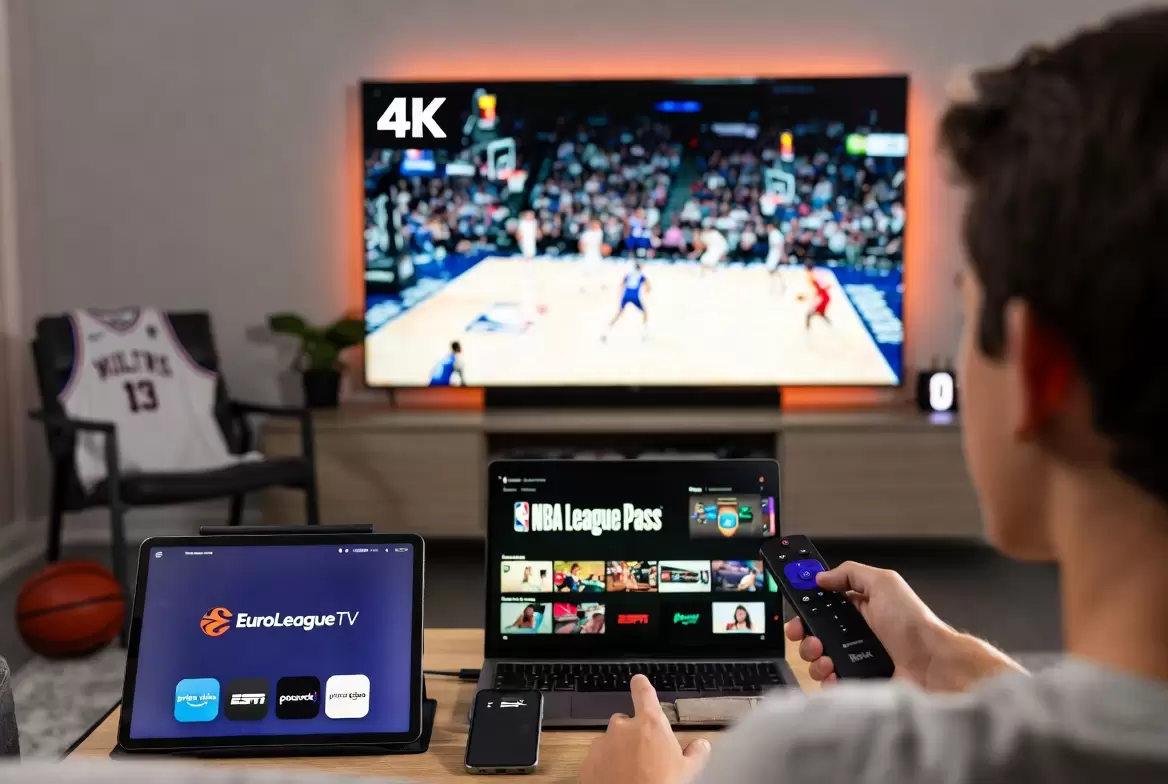
Roku is the sensible hub for all of this because nearly every service here has a native app on it: the ESPN app, Peacock, Prime Video, League Pass and a live-TV subscription can all live on the same remote. Build the stack around what you actually watch. If you mostly follow the national schedule, budget for Peacock plus Prime Video plus an ESPN/ABC path. If you follow a team in another city, add League Pass and accept the local blackout. If your home team just lost its RSN, track down its new direct-to-consumer home before opening night. And if you’re a two-continent fan trying to catch the EuroLeague from the wrong side of an ocean, EuroLeague TV is the official answer where it’s sold — with a broad live-TV subscription as the fallback for the feeds your market doesn’t offer. The map is messier than it used to be, but it’s readable if you build it deliberately.