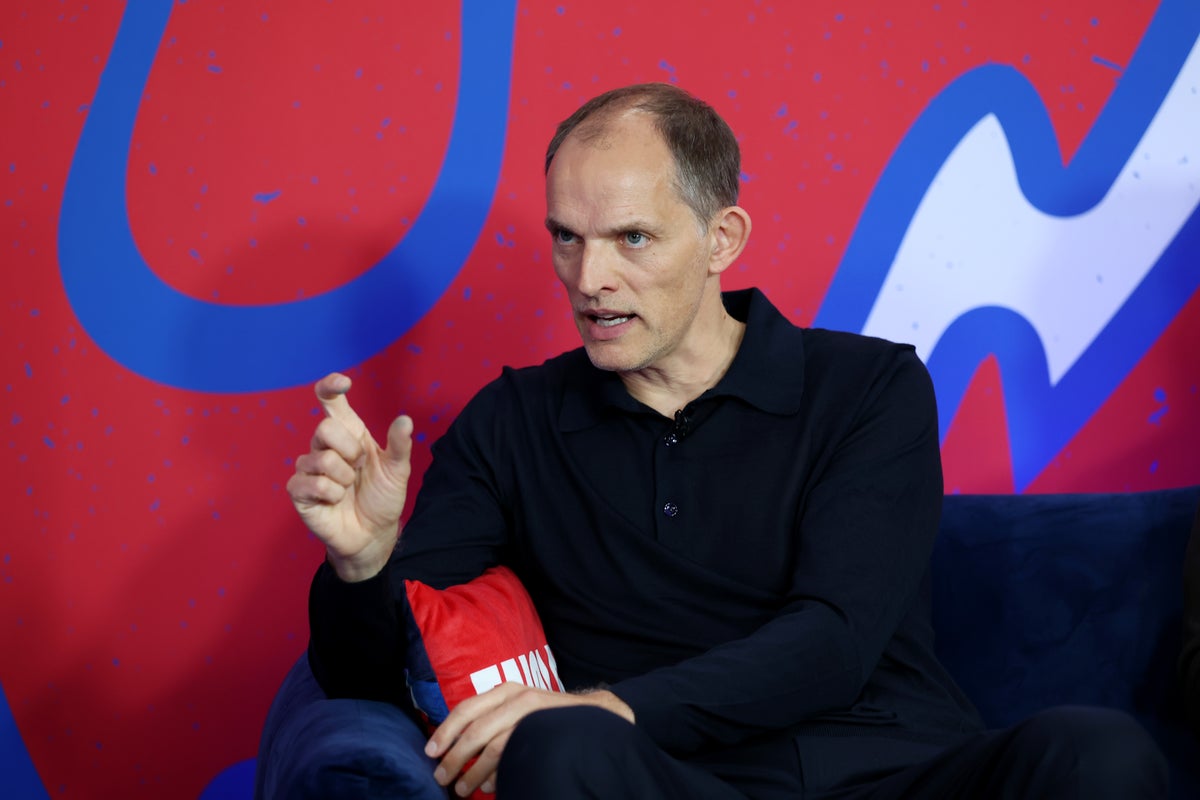
Thomas Tuchel spent around four hours on Thursday calling disappointed England players to explain to them that the rationale for his 26-man squad was one that could navigate every element of a possible seven-week campaign.
This is the biggest World Cup ever, so it contains more variables than any other – above all, the conditions. Tuchel, rather than just assembling the “26 most talented names”, as he put it, has ultimately tried to cater for every obstacle they may face.
“Specialists for all kinds of different scenarios,” Tuchel said. Hence, Ivan Toney for penalties.
And a preference for players who can play in a few positions, especially with how demanding the conditions are going to be.
All of this is ultimately predicated on the reality that most of his first XI – and certainly the front six – picks itself.
Reece James will be the right-back, but obviously can fill in for either Elliot Anderson or Declan Rice in the middle, behind Jude Bellingham, likely ahead of Morgan Rogers, plus Bukayo Saka, Marcus Rashford and Harry Kane.
It’s a strong core, now with new experience at winning at the elite level, and a lot of quality. They can give any side a game. After that, though, it’s a little thinner.
Most of England’s real world-class talent – the truly top-tier players – have been clustered in specific positions.
That’s especially been true of the No 10 role, but it would obviously be absurd and almost self-defeating to force in all the best names just because you have them.
Brazil, after all, didn’t take one of the best forwards in the Premier League. That specific issue has also caused England so many notorious problems in the past.
You could see in Euro 2024, where there was almost confusion over where they should go, as so many clustered in the centre. Stripping them down makes it cleaner and frees up space elsewhere.
And once you take that entirely understandable rationale, it means big talents get dropped. In this case, it’s Phil Foden, Cole Palmer and Morgan Gibbs-White.
And, outside of the Nottingham Forest star, it’s easy to understand why. Foden has not made much impact for Manchester City this season, having witnessed Rayan Cherki excel in a role that should be his. Palmer has only recently started to recover fitness, but is still only playing in bursts.
Gibbs-White is more unlucky to miss out, but that’s just the type of hard call that’s required.
As Tuchel put it, “it’s part of the job … if you bring these names, you leave out other big names. I like these decisions. It brings an edge.”
It is also probably overkill to bring more than three No 10s, especially when players like Kane and Saka can fill in there.
Bellingham is still one of England’s best players, despite all the debate. Tuchel loves Rogers, feels he’s great for the flow of the team, and is also aware that he had a better season than Gibbs-White.
Eberechi Eze was, meanwhile, a transformative attacker with the champions Arsenal, with so many key moments, and is also known as a great personality in the squad.
The latter point has also been key for Tuchel, especially with a group of young men set to be sequestered away together for so long.
Jordan Henderson is included for that very reason. If Bellingham can still occasionally be abrasive, he responds well to Henderson. The former Liverpool player still polices the squad.
There have been suggestions that Tuchel has issues with the personalities of both Cole Palmer and Harry Maguire.
It isn’t necessarily that he sees them as problematic, but more that certain personality traits related to football decisions – such as what they can be like if left out – may rankle Tuchel over seven weeks.
Tuchel did have a very pointed line on opening his announcement, saying: “I can assure every fan in the country we have 26 players who are 100 per cent committed, and know their role, and are committed to the idea of team spirit and being unselfish.”
Maguire, meanwhile, offered an unintended vindication for that decision immediately, with a surprisingly strident statement.
Tuchel admitted he was “a bit surprised by that. We had a private conversation and he had a chance to express his feelings, which is fair enough. We stood firmly with our central defenders who carried us in September to November.”
While Maguire obviously offers qualities, none of them is exactly indispensable to this England. He didn’t go to Euro 2024. The defence is still probably the thinnest area, and England still ultimately lack a proper passer.
The latter may be crucial in the heat, which is why Tuchel – like Southgate – has to work around it. He has to give himself different options and different solutions.
It does feel like a squad closer to “tournament ball” rather than an ideology based on the Premier League intensity he initially envisaged.
That can be witnessed in the selection of Toney, who offers an almost guaranteed goal from the penalty spot but will also be less fatigued than many of his squadmates.
Tuchel admitted his selection was “also a bit of a surprise to us” but on getting good feedback from Al-Ahli coach Matthias Jaissle, and analysing the various requirements, “he was back in the picture”.
“I think he has very special skills he can help us [with], meaning when we are chasing the goal. He can help us with set pieces… and world-class penalty taker. He ticks a lot of boxes.”
Ultimately, for all the debate around England and how the divisive history of these decisions frames any squad announcement, Tuchel has stayed true to himself.
He’s made big calls, but it’s for a big tournament. In every sense.
England don’t have a perfect squad. They do have one that the manager feels can solve enough problems.
“That’s why I’m so sure we picked the right squad. It is about building a brotherhood, about building excitement,” Tuchel said. “And once we get this energy right, anything is possible.”
And any possibility is covered.
Go behind the game – join Miguel Delaney: Inside Football today