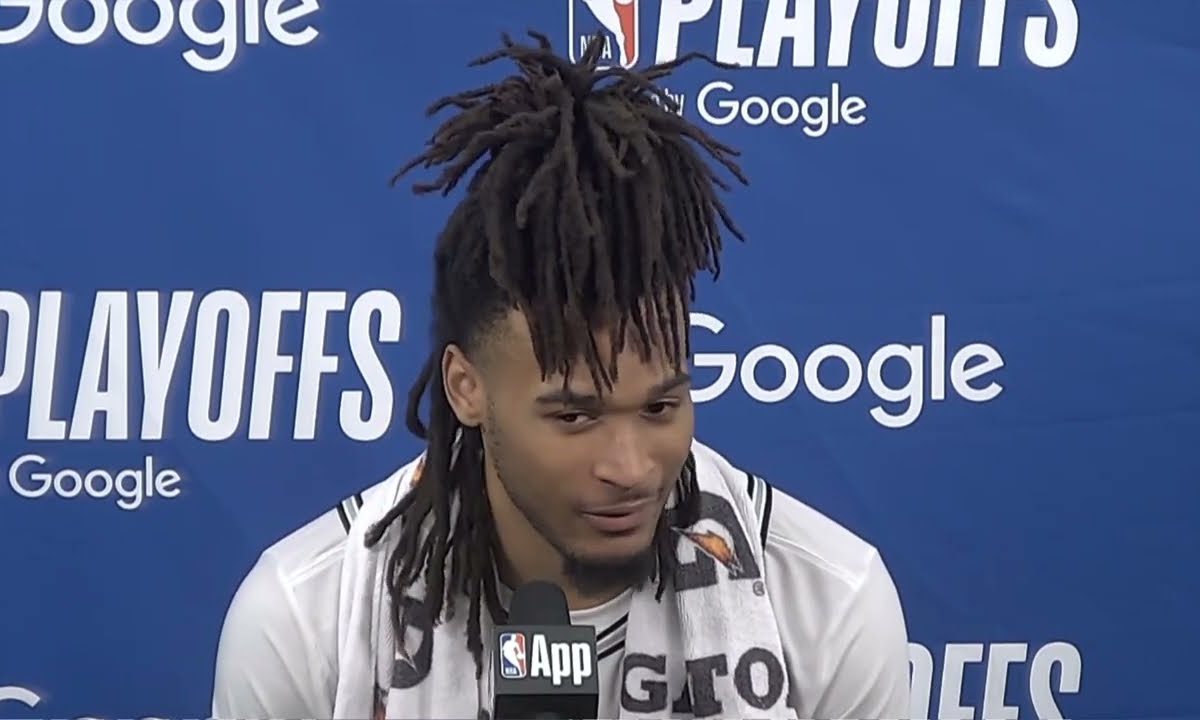
Game 2 of the Western Conference finals saw the Oklahoma City Thunder defeat the San Antonio Spurs 122-113 at Paycom Center in Oklahoma City, leveling the series as both teams dealt with rotation disruptions and late-game swings.
Stephon Castle finished with 25 points and handled an expanded on-ball role with both De’Aaron Fox and Dylan Harper unavailable or limited during stretches of the contest.
Speaking about the increased responsibility, Castle pointed inward when discussing the turnover issues and early-game mistakes. “I think it’s more personal on my end. Just really speeding myself up. Not allowing our screeners to get hits. So it’s putting me in a position where I have to play fast or my screener might get an offensive foul. I put us at a disadvantage to start the game with those.”
He also acknowledged fatigue and the intensity of the stage, while refusing to separate execution from effort. “Some of it comes with fatigue, but at this point of the season it’s really no excuse.”
With ball pressure increasing across the series, Castle addressed the Thunder’s defensive approach and the Spurs’ response. “It’s not the first time we’ve been pressured. We’ve been playing basketball for a long time. We get pressured as guards all the time. It was something that we talked about and went over with our coaches. So we just got to be better and cleaner with it.”
The Spurs were forced into constant adjustments after injuries disrupted their guard rotation, including the absence of De’Aaron Fox. Castle explained how that changes possession control and rhythm. “Having another ball handler on the court at all times is definitely a luxury. Jac played big minutes today when he came in. He helped us out a ton.”
He also detailed how the group attempted to manage offensive structure without its primary organizers. “It’s tough, but with all of our energy mainly focused on the defensive end, I just have to take my time a lot more on the offensive end and try and make the simple read as much as I can.”
Castle was asked about balancing aggression with decision-making against an elite defense led by the Thunder’s switching schemes. “A lot of the times you can probably go create your own shot. But for the team and for the way that we play, we don’t want to play that way. So trying to balance when to be aggressive versus keeping my teammates involved and trying to make the right pass, make sure everybody’s in rhythm.”
Turnovers also played directly into Oklahoma City’s transition offense, something Castle connected to early-game control issues. “I think it started probably a lot with my turnovers honestly. Them being able to get out in transition and get a rhythm that early. I don’t know how many points they had in transition in the first half. Probably like 15 or 16.”
Even momentum shifts, including a second-quarter dunk, were quickly neutralized in a game defined by runs. “It’s a game of runs. With high level teams like that there’s a lot of talent on the floor and typically that comes with big plays. But with all the talent that is on the floor everybody’s seen it play like that before. You kind of wash it pretty quick and get back to playing basketball.”
Castle also highlighted teammate Dylan Harper, who was injured during the game but recently earned recognition for his season. “D is really good. I think he’s going to be a great player in this league for a long time. He’s super humble and super selfless with how good he is. I’m happy that he got that award. He was very deserving of it.”
Game 3 shifts to San Antonio, where the Spurs will look to stabilize their backcourt rotation while managing the same pressure that defined a tightly contested Game 2.