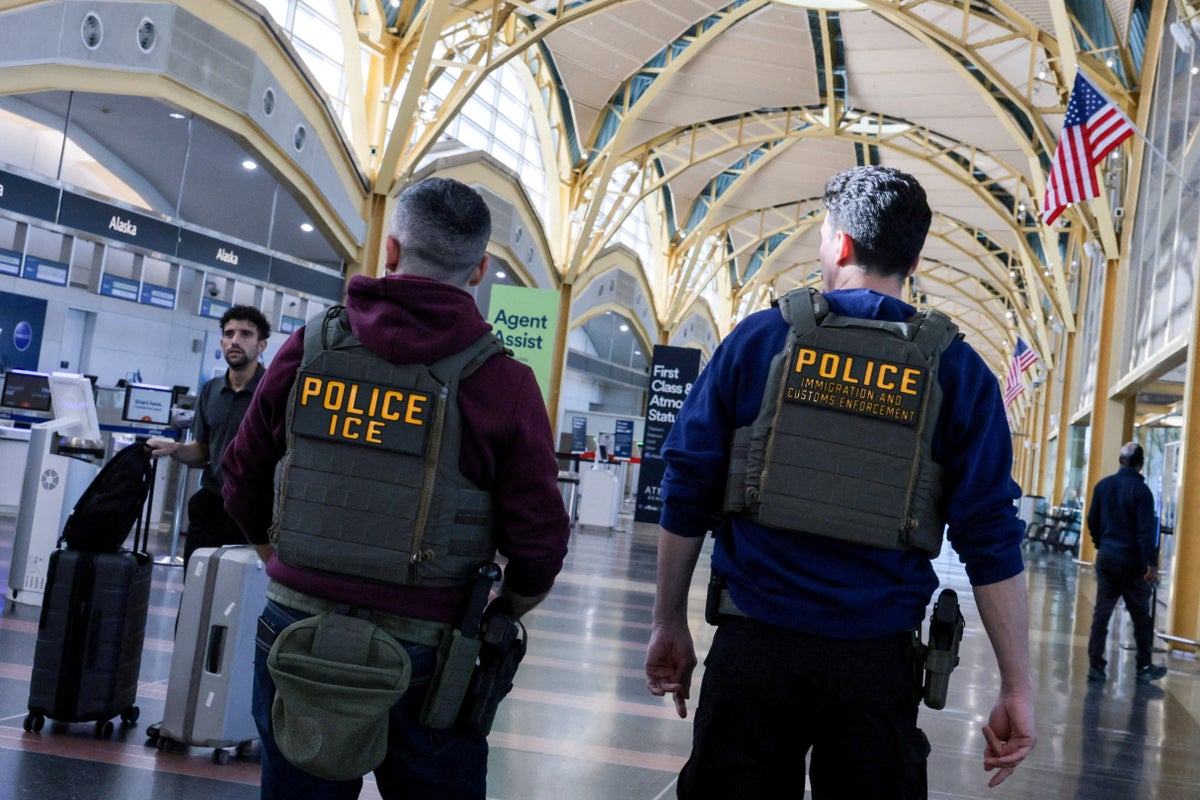
Miami has been assured by the Trump administration that ICE agents will not be deployed to its games at this summer’s FIFA World Cup, the co-chair of the Florida city’s hosting committee has said.
Rodney Barreto told The Athletic he had spoken to Secretary of State Marco Rubio and been promised that federal immigration forces would not be on hand in the Sunshine State during soccer’s biggest international showcase, a relief to some who feared their presence could stoke unrest.
“A lot of people are talking, ‘Well, ICE will be at the stadium,’” Barreto said. “I talked to Marco Rubio. ICE is not going to be at the stadium.
“This is not going to turn into some ‘round them up’ type of thing. That’s not the purpose of this. It’ll be a great experience for everybody.
“I think that we’re lucky that we do have a president who loves sports and has given us the resources to reimburse the cities for their police protection.”
The U.S. is co-hosting the World Cup with Canada and Mexico and has approved a $625 million federal grant to bolster security at the 11 American cities at which games will be played.
The Hard Rock Stadium, home to the NFL’s Miami Dolphins, will host seven games in total, including four group stage fixtures, a quarterfinal, and the third-place game. Teams already set to play in Miami include Brazil, Saudi Arabia, Colombia and Portugal.
Barreto said President Donald Trump had been “very vocal with his thoughts” on the tournament, carefully adding that the fact that he is a “big sports fan” was a help to the organizers, not a hindrance.
He also said the administration had pledged to streamline the visa-approval process for arriving players and guests, including four of the 48 qualifying nations that are currently the subject of U.S. travel bans – one of which is Iran, whose participation has been much-debated because of the ongoing war.
“I spoke to Marco and, first of all, he’s going to make sure that the passports get processed and people can get here and there is an orderly process so people won’t be held up,” Barreto said.
“It’s going to be a major undertaking by the federal government to do that. We feel very comfortable that we’re going to be in good hands.”
ICE’s potential role in the World Cup was the source of some concern earlier this year when Todd Lyons, the agency’s now-former acting director, said that it would be a “key part of the overall security apparatus.”
He was referring to Homeland Security investigations, although some feared he might also have been hinting at a repeat of the raids on undocumented migrants seen in cities such as Los Angeles, Chicago, and Minneapolis over the last year.
The White House initially refused to rule out the prospect of ICE raids on stadiums during the tournament, leading FIFA President Gianni Infantino to consider making a personal appeal to the commander-in-chief to secure a moratorium until the games had concluded.
Infantino was much-mocked for presenting Trump with the inaugural “FIFA Peace Prize” in December but appears to have genuine influence with the president.
Andrew Giuliani, executive director of the White House FIFA World Cup Task Force, has attempted to downplay concerns about safety by saying that Trump had told him to “ensure a safe and secure World Cup.”
However, his assurances did not stop civil liberties organizations from warning players, fans and journalists attending that they could face “serious harm” if they got caught up in the administration’s immigration crackdown.
A coalition of 120 groups, spearheaded by the American Civil Liberties Union, released a travel advisory last week, urging visitors to the U.S. to “exercise caution” given the climate of “rising authoritarianism” under Trump.
“ICE continues to act with little accountability or regard for human dignity, and should be reined in both during and beyond the FIFA World Cup games,” the ACLU said in its statement.