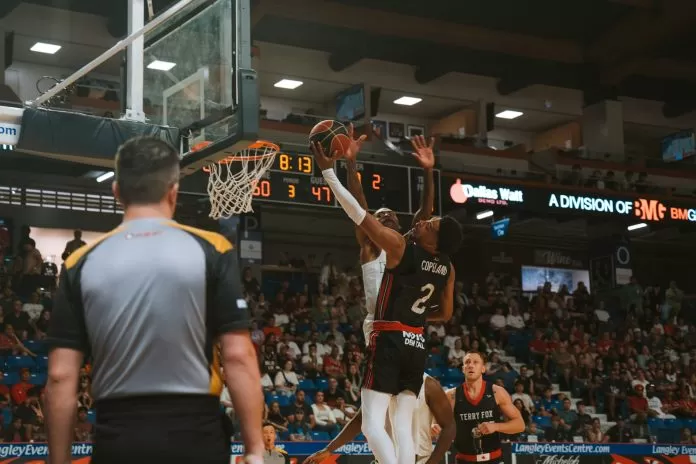
Basketball rewards statistical literacy in a way that almost no other sport does. You can watch a football game with no knowledge of analytics and experience it fully. Basketball is different. The sport’s pace and scoring frequency mean that probability is constantly visible in real time: a shooter’s percentage from the corner, a team’s offensive rating in transition, the likelihood of a comeback given the current score and clock. Fans who understand what the numbers mean experience the game at a fundamentally different level than those who do not, and increasingly, that understanding is changing how entire fanbases process what they are watching.
The concept of momentum in basketball has always been debated among analysts. The hot hand fallacy, the idea that a player having a successful shooting stretch is more likely to make the next shot, was famously challenged by research suggesting that previous makes do not statistically influence future attempts. But subsequent work has complicated that picture considerably. Players and coaches with skin in the game have always trusted momentum as a real phenomenon, and recent analysis of shot selection and defensive attention patterns suggests they may not be entirely wrong.
Streaks, Runs, and Why Your Brain Cannot Stop Tracking Them
What makes momentum psychologically real even when statistically murky is how the human brain processes sequential events. We are pattern-recognition machines by evolutionary design, and we are particularly sensitive to runs. Three consecutive misses register very differently than three misses spread over eight possessions. A 9-0 run in the third quarter feels like a turning point even when the same points scored across twelve minutes would not. The compression of success or failure into a streak triggers narrative construction that changes how fans experience everything that follows.
This is exactly the mechanism that makes basketball such a natural fit for the kind of engagement that other high-variance entertainment formats also produce. If you spend time playing on SpinBlitz social casino, the streak psychology transfers almost directly. A run of wins on a social gaming platform activates the same anticipatory circuitry that a shooting streak in basketball does. The brain reads both as meaningful patterns. It wants to know whether the streak continues or breaks, and that want is what generates sustained engagement regardless of whether you are watching a fourth quarter comeback or watching a reel spin toward the result.
The Comeback Math That Keeps Everyone in Their Seats
Win probability models have become genuinely mainstream in basketball coverage, and their effect on fan experience is worth examining. When a broadcast shows a team with a twelve-point deficit in the fourth quarter at sixty-three percent win probability for the opponent, it does something interesting: it makes the math visible and simultaneously demonstrates that the math is not the story.
Fans have always known intellectually that large leads can evaporate. Win probability models quantify exactly how rare that is while also demonstrating through thousands of historical examples that rare things happen regularly enough to stay invested in. A team with a twenty percent chance of winning still wins one time in five. Watch enough basketball and you will see multiple examples per season. That knowledge changes how you watch a game that looks decided. The twenty percent possibility is not just a statistic. It is an invitation to stay in the room.
This is the underlying structure of fan retention in basketball, and it mirrors the engagement architecture of virtually every entertainment format built around uncertain outcomes. The game is never fully lost until it is, which means there is always a reason to keep watching. The comeback probability provides permission to remain invested in what might otherwise feel like a foregone conclusion.
Defensive Schemes and the Probability Battles Nobody Talks About
The offensive fireworks in basketball attract the most attention, but some of the most interesting probabilistic battles happen at the defensive end. A drop coverage designed to surrender threes in exchange for protecting the paint is a calculated probability trade: the defense is accepting a lower-percentage shot to eliminate higher-percentage opportunities near the rim. Whether that trade works depends on individual shooter quality, shot clock pressure, and defensive rotation discipline.
Understanding these trades changes the viewing experience significantly. A wide-open corner three is not just a good shot. It is the result of a specific defensive decision that prioritized something else. Whether the shot goes in or not, the probability trade has been revealed, and watching how teams adjust their trades over the course of a game adds a strategic dimension to what might otherwise read as a sequence of individual plays.
Elite fans track these adjustments in real time. They notice when a team shifts from a drop to a hedge scheme in the second half. They see when a star player is being denied on the ball versus being allowed to catch and then pressured. These reads are the basketball equivalent of noticing hand strength tells: not accessible to every viewer, but for those who have developed the literacy to see them, they transform spectating into something closer to active participation.
Clock Management as Probability Compression
Late-game clock management is where basketball’s probability landscape becomes most visible and most emotionally intense. Every possession in the final two minutes of a close game is a probability event with enormous consequence. The decision to foul or not foul, to go for two or three, to call timeout or push pace: each choice moves the win probability needle in ways that are now quantifiable in real time. Fans who understand the math experience these moments with a kind of informed anxiety that is qualitatively different from pure suspense. They know what should happen and then watch to see what does, which is its own specific form of engagement.
When the Final Buzzer Is Just a Formality
The most purely basketball-brained experience any fan can have is arriving at absolute certainty about the outcome and watching the game validate it in real time. Whether it is a thirty-point lead with two minutes left or a last-second shot going up with the game tied, certainty and its absence are the emotional poles that probability thinking creates. The fans who live between those poles for the full forty-eight minutes are getting something that casual viewers simply cannot access. They are playing a different game.