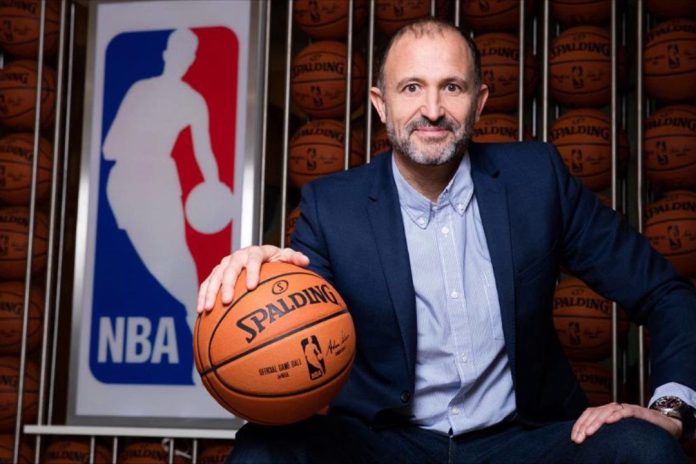
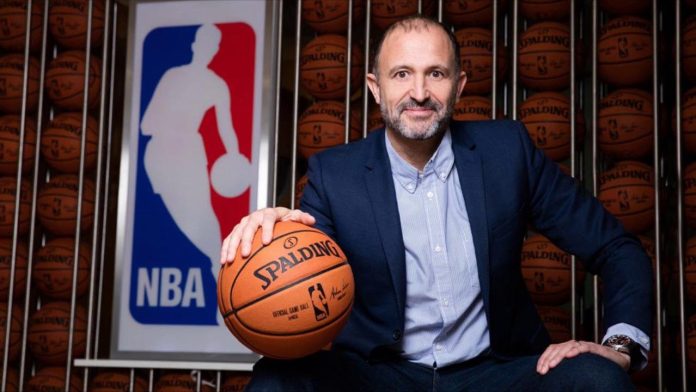
EuroLeague has moved to the center of the European basketball power struggle by replacing Paulius Motiejunas as chief executive officer and selecting former NBA Europe vice president Chus Bueno to lead the competition. The decision was approved unanimously by the league’s 13 shareholder clubs during a meeting in Barcelona on Friday.
MARCA reported that the EuroLeague board voted 13-0 to remove Motiejunas, who had served as CEO since 2023, despite extending his contract in 2024. The league exercised a release clause after two years of that deal, signaling urgency at the top of the organization.
Bueno, 56, has been offered the position and is expected to formalize his contract in the coming days. He was selected over German executive Michael Ilgner, a former Deutsche Bank senior executive, in a process that ultimately produced a unanimous outcome.
The timing of the leadership change reflects mounting pressure on EuroLeague as the NBA advances plans to launch a new European competition in 2027. Several major clubs, including Real Madrid, Fenerbahce Beko Istanbul, and LDLC ASVEL Villeurbanne, have not renewed their long-term EuroLeague licenses, increasing instability.
Barcelona’s decision to commit for another decade temporarily eased concerns, but uncertainty remains across the league’s ownership structure. EuroLeague has warned of potential legal action if the NBA continues discussions with teams under contract.
Bueno’s background positions him as a bridge figure during this standoff. He spent nearly 13 years as the NBA’s vice president of operations for Europe, Africa, and the Middle East, and was one of the architects of the Basketball Africa League.
His resume also includes senior leadership roles with DAZN Basketball and Legends, along with prior executive positions at the Spanish Basketball Federation. Before entering management, Bueno played professionally in Spain’s top division, giving him experience across both competition and business.
EuroLeague’s owners believe that blend is essential as the league attempts to strengthen its commercial base while defending its competitive model. The priority now is attracting new investors, stabilizing club commitments, and reopening dialogue with both the NBA and FIBA.
On the court, the EuroLeague remains competitive and commercially relevant. Fenerbahce leads the 2025-26 standings at 17-7, with Olympiacos, Hapoel Tel Aviv, Real Madrid, and Barcelona all firmly in playoff position.
However, league executives view governance and media rights as the decisive battlegrounds. The NBA’s proposed league would reportedly feature 16 teams and significant franchise fees, potentially reshaping the European basketball economy.
Bueno is expected to sign a mid-term contract, likely four years, to provide continuity through the most turbulent period in EuroLeague history. His appointment signals that the league intends to respond aggressively rather than passively to the NBA’s expansion plans.